



Walk into any hardware store's back room in October and you'll find the same depressing sight: pallets of unsold grass seed, stacks of fertilizer nobody wants, and enough garden hoses to supply a small city. Meanwhile, the first snow hits and there's not a bag of salt or snow shovel in sight.
This seasonal inventory disaster costs the average independent hardware store somewhere between $25,000 and $40,000 a year in markdowns, storage costs, and missed sales. The frustrating part is that most of these losses happen during just four critical transition periods throughout the year.
The problem isn't that seasons change. It's that most hardware stores run seasonal transitions like it's still 1985 — waiting for visual cues, making gut-based reorder calls, hoping last year's patterns repeat. Buying windows for most seasonal categories have shrunk from 10-12 weeks down to closer to 6-8 weeks, and that compression makes late decisions much more expensive than they used to be.
The hidden math behind seasonal deadstock accumulation
Seasonal deadstock follows a predictable accumulation pattern that most owners don't see until it's already too late. A typical independent store carrying 40-50 seasonal SKUs will see deadstock build in three waves.
First wave hits around week 9 when early-season enthusiasm leads to overordering. You ordered 200 bags of mulch because last March was strong, but this March stays cold two extra weeks. Now you're sitting on inventory that won't move at full price.
Second wave comes at the season's midpoint when reorder habits — whether from software or instinct — fail to account for compressed selling windows. The system says you sold 50 bags of grass seed last week, so it orders 75 more. What it doesn't know is that 40 of those sales were to one landscaper who won't be back.
Third wave, the killer, arrives in the final 3-4 weeks when stores try to maintain selection while demand evaporates. You keep six types of fertilizer on the shelf because customers expect variety, but at this point they're really only buying two of them.
Here's what that looks like with real spring garden inventory:
| Week of Season | Customer Demand % | Typical Stock Level | Deadstock Risk |
|---|---|---|---|
| Weeks 1-2 | 8% | 15% | Low |
| Weeks 3-5 | 22% | 30% | Low |
| Weeks 6-8 | 35% | 35% | Medium |
| Weeks 9-11 | 25% | 40% | High |
| Weeks 12-14 | 10% | 25% | Critical |
That gap between demand and stock level in weeks 9-14 is where seasonal deadstock materializes. Most stores end the season with 20-30% of their peak inventory still sitting there.
Pre-season setup: the 6-week countdown that determines everything
The difference between stores that nail seasonal transitions and those drowning in deadstock usually comes down to what happens in the six weeks before the season starts. This pre-season window breaks into three distinct phases.
Stop losing sales due to inventory gaps.
Hardzly helps you manage stock levels, orders, and supplier interactions efficiently.
- Unified inventory and sales tracking
- Supplier and purchase order management
- Automated workflow and task scheduling
No credit card required
Weeks 6-5 before season: Data gathering and SKU rationalization. Pull three years of sales data by week, not month. Monthly data hides crucial patterns. That spike in snow shovel sales you remember from December? It actually happened in one week, not spread across the month. Strip out anomalies like bulk commercial orders or unusual weather events. You're looking for the baseline pattern.
Pull three years of sales data by week, not month.
During this phase, cut SKUs that didn't earn their shelf space. If a product didn't sell at least 6 units per week during peak season, it probably shouldn't come back. One store analyzed carried 14 types of grass seed, but 70% of sales came from just 3 types. They cut to 5 types total and actually increased sales by making the decision easier for customers.
Weeks 4-3 before season: Initial orders and space planning. Place opening orders at 60% of peak season levels, not 100%. This seems conservative but it serves two purposes: you avoid overcommitting before you see actual demand, and you create urgency early in the season rather than projecting abundance.
Space planning happens now, not when the product shows up. Map out exact locations for each seasonal category. That corner where you always put fertilizer? Measure it. Calculate how many pallets fit. Assign backup overflow locations now. When trucks arrive, everyone knows exactly where things go.
Weeks 2-1 before season: Marketing calendar lock and staff training. Your promotional calendar for the entire season gets finalized now — not on Thursday for that Saturday. Map it out:
-
Opening weekend push (20-25% off select items)
-
Week 3-4 momentum builders (bundling deals)
-
Mid-season volume drivers (contractor appreciation days)
-
Week 10 transition sales (first markdowns)
-
Final 3-week clearance cascade
Train staff on the season's storyline. Not just product knowledge, but the narrative arc. Early season is about preparation and possibility. Mid-season shifts to problem-solving and active projects. Late season becomes completion and value. Staff who understand that arc sell more effectively throughout the whole transition.
Visual workflow of the 6-week pre-season process.
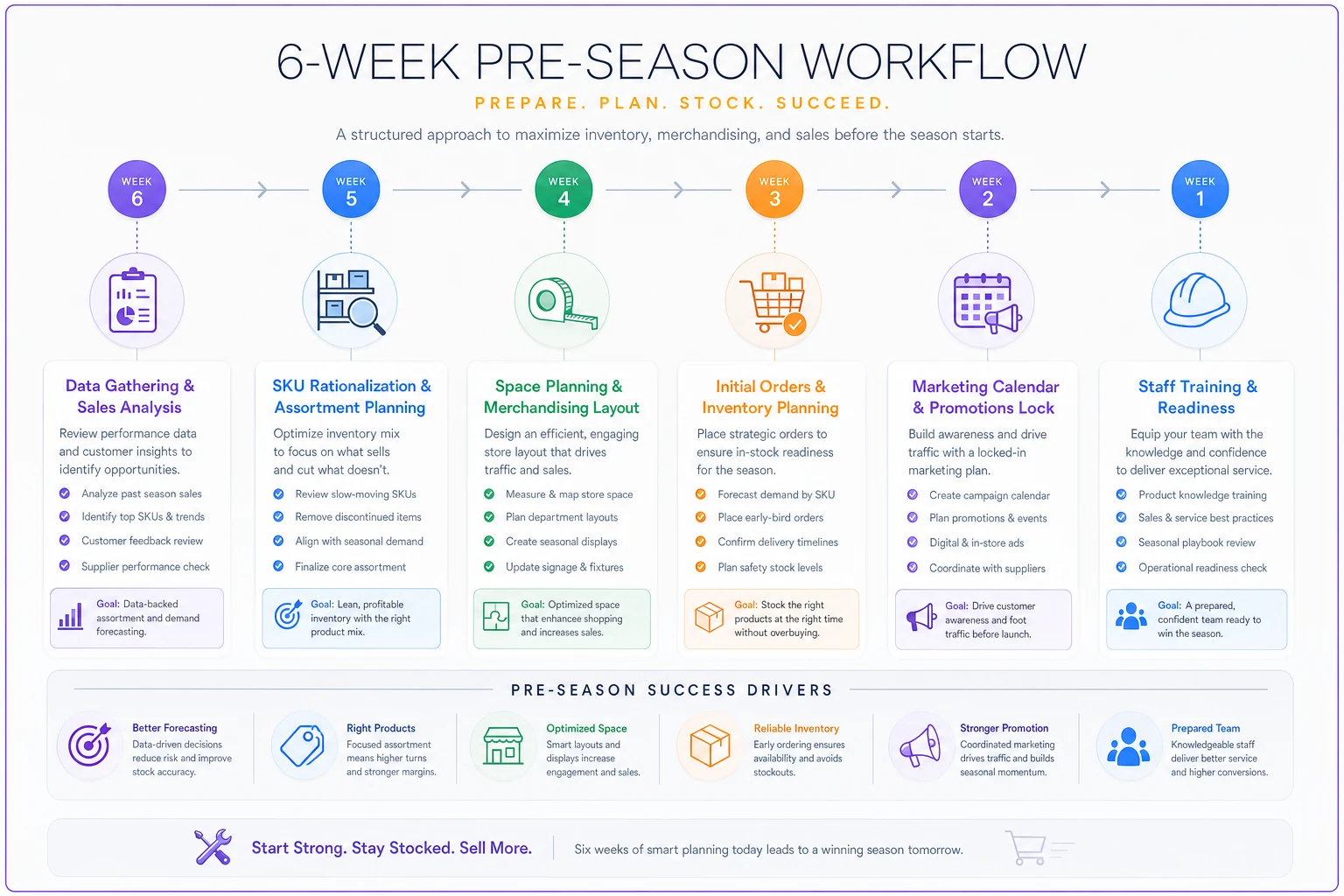
This illustrates the phases and key actions so teams align before trucks arrive.
In-season management: weekly checkpoints that prevent disaster
Once the season starts, success depends on disciplined weekly reviews, not daily scrambling. Every Monday morning needs a 30-minute seasonal health check covering four metrics.
Week-over-week velocity changes tell you whether you're accelerating or decelerating relative to plan. A 20% drop in week 3 sales versus week 2 might seem bad, but if your plan called for a 25% drop, you're actually ahead. Most stores miss this and make panicked adjustments based on absolute numbers instead of relative performance.
Coverage weeks remaining shows how long current inventory will last at the current sales rate. If you have 100 bags of mulch and you're selling 20 per week, that's 5 weeks of coverage. But if you're in week 11 of a 14-week season, that's too much. This one simple calculation prevents most late-season overstock situations.
Reorder trigger adjustments need weekly tuning based on actual patterns. Your initial reorder point for topsoil might be 30 bags. If contractor sales come in stronger than expected, that trigger might need to move to 50 bags. These small adjustments keep inventory flowing without building excess.
Markdown timing decisions can't wait until product stops selling entirely. Start identifying markdown candidates by week 8, not week 12. Products selling below 50% of their week 3-4 peak rate are candidates. Mark them down in week 10 when people still have active projects, not week 13 when the season is mentally over for most customers.
Here's a weekly decision framework one successful store uses consistently:
-
Calculate this week's sell-through rate versus the same week last year
-
If tracking 20% or more behind
immediate 15% markdown on slow movers
-
If tracking within range
hold pricing but reduce reorder quantities by 25%
-
If tracking 20% or more ahead
expedite reorders but don't increase quantities yet
-
Check weather forecast for next 10 days and adjust all decisions accordingly
The point is making small adjustments weekly rather than massive corrections monthly.
Post-season recovery: the 4-week sprint that resets everything
The four weeks after a season ends determine whether you start the next one clean or handicapped by old inventory. This window demands aggressive action.
Week 1 post-season: Final customer push. Whatever's left gets marked down 40-50%, no exceptions. Bundle related items aggressively. Those 30 bags of grass seed? Pair them with leftover fertilizer at 50% off the bundle. Create "project packs" that help customers use your excess. Run contractor-only clearance hours where bulk buyers can score deals.
Week 2 post-season: Inventory reality check. Count everything. Calculate your actual deadstock value at cost, not retail. If you're sitting on more than 15% of your seasonal investment, you have a problem that needs fixing before next year. Document which SKUs died and which surprised you. This becomes your blueprint for next season's buy.
Week 3 post-season: Storage or liquidation decision. Calculate storage cost versus liquidation loss. Storing 50 bags of ice melt might feel like the smart play, but if storage runs $2 per bag and you can liquidate now at a $3 loss per bag, you're better off taking the hit. Most products also degrade in storage. Year-old grass seed germinates poorly. Last year's ice melt clumps.
Week 4 post-season: System adjustments and automation setup. This is when you fix the systematic problems that created the deadstock in the first place. If your POS system can't track weekly velocity, that needs addressing now. If reordering still happens manually, this is a good time to explore platforms that factor in seasonality, weather patterns, and local demand signals automatically.
The promotional calendar that actually prevents deadstock
Most hardware stores run promotions reactively — marking down what isn't selling. Smarter stores use promotions proactively to shape demand before inventory piles up. Here's a rhythm that actually works:
Pre-season teaser (2 weeks before): 20% off one anchor category to drive early traffic. Choose something customers need anyway — mulch for spring, salt for winter. This creates early momentum and gives you real demand signals before the season peaks.
Week 2-3 volume builder: Contractor appreciation pricing on bulk quantities. Set minimum quantities high enough to move serious volume. 10% off at 10+ bags isn't enough. Try 25% off 20+ bags. You'll move a pallet in one transaction instead of grinding through 40 individual sales.
Week 5-6 project promoter: Bundle complementary items at an attractive package price. Grass seed plus fertilizer plus spreader rental for one combined price. These move multiple categories at once and increase the chance customers actually finish their projects.
Week 8-9 transition pricing: First markdowns on slow movers, but frame them as "late season project savings" rather than clearance. 25% off without any clearance language maintains brand perception while still moving product.
Week 11+ clearance cascade: Progressive markdowns starting at 40%, moving to 50% in week 12, 60% in week 13, and 70% the final week. Each wave should move 30-40% of remaining inventory. If it doesn't, the markdown isn't aggressive enough.
Sample reorder cutoff calendar for zero deadstock
Hard reorder cutoffs prevent more deadstock than almost anything else. Here's a cutoff schedule built around a 14-week season:
Full reorder period (Weeks 1-6): Order freely based on velocity. If something's selling, keep it flowing. Don't restrict successful products early in the season.
Restricted reorder period (Weeks 7-9): Only reorder items selling at 150% or more of their historical average for these weeks. This stops momentum-based overordering when underlying demand is quietly softening.
Emergency reorder only (Weeks 10-11): Reorders require manager approval and must be for items with less than one week of coverage. Accept stockouts on slow movers rather than adding inventory this late.
No reorder period (Weeks 12-14): Zero reorders, no exceptions. Run out of bestsellers if necessary. Customer complaints about a stockout are better than eating deadstock for six months.
This schedule feels harsh but it works. One store that implemented these exact cutoffs dropped seasonal deadstock from $32,000 to $11,000 in a single year without meaningful lost sales.
When aggressive deadstock reduction backfires
Not every store should chase aggressive deadstock reduction. If you're the only hardware store within 20 miles, maintaining broader selection might be worth the carrying cost. Customers depend on you having what they need.
Stores with strong contractor relationships need different strategies too. Contractors buy in bulk and they often buy late. Cutting off reorders in week 11 might save inventory costs but damage relationships worth far more than any deadstock savings.
Weather-volatile regions also need buffer stock. If your area sees random late freezes or early snow events, strict cutoff dates can leave you empty-handed during surprise demand spikes. Carrying 20% extra and marking it down beats missing a genuine selling window.
The operational reality of seasonal transitions
Running clean seasonal transitions while managing daily store operations is hard because you're balancing competing goals simultaneously. Maximum selection during peak season, minimum inventory at the end. Capture every sale but avoid any excess stock.
The answer isn't perfect prediction — it's systematic response. Build your seasonal transition system once, then run it consistently. The same pre-season analysis, in-season checkpoints, and post-season cleanup every single cycle. Most stores that struggle with deadstock don't lack information. They lack consistent execution of basic inventory disciplines.
What typically happens is that attention fades as the season progresses. Weeks 1-4 get intense focus. Weeks 5-8 run on momentum. Weeks 9-14 get whatever energy is left after managing daily fires. That attention fade is what creates the deadstock problem. The system needs to run whether you're fully focused on it or not.
Modern inventory management platforms can automate much of this seasonal discipline — tracking velocity changes, calculating coverage weeks, suggesting markdown timing, enforcing reorder cutoffs without requiring someone to manually check it all. Instead of daily attention to seasonal metrics, you get alerts when something actually needs a human decision.
The compounding effect is real too. Less deadstock means less time running clearance events, which frees up energy for the next season's setup. Better setup leads to cleaner execution, which reduces deadstock further. Most stores see meaningful improvement within two or three seasonal cycles once they commit to running transitions systematically.
Seasonal transitions will always challenge hardware stores. Weather varies, preferences shift, competitive pressure builds. But the stores that build disciplined transition systems consistently outperform those running on instinct. The difference between 30% seasonal deadstock and 10% isn't luck — it's systematic execution of proven operational disciplines, repeated every season until they become habit.
Ready to elevate your hardware store management?
Join 500+ hardware stores using Hardzly to boost operational efficiency, reduce stockouts, and grow revenue.