



Most hardware store owners already know which suppliers are slow. That's not the problem. The problem is that "slow" isn't a number you can plan around — it's a feeling, and feelings don't reorder deck screws.
Almost every independent store falls into the same trap: judging a supplier by their average lead time. "Oh, ABC Fasteners takes about a week." But averages hide the thing that actually breaks your shelves — variability. A supplier who delivers in 5 days every single time is worlds better than one who averages 4 days but swings between 2 and 9. The first one you can plan around. The second one forces you to carry extra safety stock to cover for their chaos, which quietly eats your cash.
So supplier lead time management for a hardware store isn't really about getting faster deliveries. It's about making deliveries predictable enough that your reorder rules can trust them. That's a different game, and it's one small stores can actually win — you have a manageable number of vendors, usually somewhere between 8 and 40, not thousands.
This article lays out a framework for that: how to categorize suppliers, what a realistic SLA looks like when you have zero leverage, how to line up your reorder rules with each supplier's actual behavior, and how to score vendors in a way that changes what you do next Monday.
The lead-time distribution nobody tracks
Here's a pattern that causes most stockouts. Once you see it you can't unsee it.
Say you sell a decent-moving caulk. You reorder when you hit 12 tubes on the shelf, because your supplier "takes about a week" and you sell roughly 2 a day. Twelve units should cover you. Except last quarter that supplier delivered in 5, 6, 4, 11, 5, and 8 days. The 11-day delivery? You blew through your 12 tubes on day 6, sat empty for five days, and a contractor who wanted a case walked to the big box down the road. Your average lead time was fine. Your worst-case lead time is what actually determined whether you had product. And nobody was tracking the worst case.
-
Median lead time — your typical case, good for rough planning
-
Max recent lead time — this is what your safety stock actually has to cover
-
The spread between them — this is your real risk, and it's what most people ignore
The wider that spread, the more dead cash you're forced to park on the shelf to stay in stock. Reducing variability is often worth more than reducing the average, because it lets you carry less buffer and stock out less. Both at once.
Step one: categorize suppliers by role, not by size
Before you build any rules, you need to sort your vendors — but not by how much you spend with them. That's the mistake. Sort them by what happens to your business when they're late.
Stop losing sales due to inventory gaps.
Hardzly helps you manage stock levels, orders, and supplier interactions efficiently.
- Unified inventory and sales tracking
- Supplier and purchase order management
- Automated workflow and task scheduling
No credit card required
A typical categorization for a hardware store looks like this:
| Category | What it means | Late-delivery impact | How you manage it |
|---|---|---|---|
| Critical-core | High-velocity SKUs, few substitutes (fasteners, common electrical, adhesives) | Immediate lost sales + walked customers | Tight reorder rules, biggest safety stock, scored monthly |
| Broad-line | Your main distributor covering hundreds of SKUs | Widespread but partial — you can usually cover gaps | SLA on fill rate, watch backorder behavior |
| Specialty/slow | Niche items, low velocity (specialty tools, odd sizes) | Annoying but rarely urgent | Order in batches, generous lead-time buffer, don't over-monitor |
| Seasonal-spike | Garden, snow, grilling — dead half the year, frantic the other half | Catastrophic if late in season | Pre-season commitments, separate scoring window |
A supplier you spend $40k a year with might be less critical than one you spend $6k with, if that $6k vendor is the only source for a fast-moving item with no substitute. Dollars don't tell you where the pain is. Substitutability and velocity do.
Once suppliers are sorted, you stop treating them all the same. Your critical-core vendors get real attention. Your specialty-slow vendors get left alone on purpose — chasing a specialty tool supplier for tighter lead times is a waste of energy when you order from them four times a year.
Step two: SLA templates that work when you have no leverage
Here's the honest part. A single-location hardware store is not going to dictate terms to a national distributor. So an "SLA" for you isn't a contract you enforce with penalties. It's a written expectation you agree on verbally or by email, then measure against. The measurement is the leverage.
What you're really doing is turning vague promises into something you can point to. When you call your rep and say "your last four orders averaged 9 days against the 5 we agreed on, and it cost me two stockouts," that's a different conversation than "you guys seem slow lately."
-
Target lead time — order-to-receipt, stated as a range ("3–5 business days"), agreed with the rep
-
Fill rate expectation — what percentage of ordered lines actually ship complete ("we expect 95%+ on standard stock")
-
Notification rule — how fast they tell you about a backorder or short-ship, so you can react
That third one matters more than people realize. A supplier who's late but tells you early is manageable — you can pull from your emergency bundle or substitute. A supplier who lets you find out when the truck shows up short is the one who actually hurts you. Silent short-shipping is the real enemy, and if you're still handling backorders reactively, tightening that up is worth its own project.
Keep the SLA to a few lines per critical supplier. If it doesn't fit on a note card, it's too complicated to hold anyone to.
Step three: align reorder rules with each supplier's actual behavior
This is where most of the value lives, and where the categories and the lead-time data finally do something useful.
Your reorder point isn't a fixed number — it should be built from the specific supplier serving that SKU. The rough logic:
Reorder point = (average daily sales × supplier's max recent lead time) + a safety buffer sized to their variability
Two SKUs that sell at the same rate should have different reorder points if they come from different suppliers with different reliability. The reliable supplier lets you reorder later and carry less. The erratic one forces you to reorder earlier and hold more. That's not being paranoid — that's pricing in their chaos.
-
Supplier A (reliable, delivers 4–5 days consistently)
reorder point around 3 × 5 = 15, plus a small buffer of 6 → reorder at ~21 boxes
-
Supplier B (same product available, but delivers 3–11 days)
reorder point around 3 × 11 = 33, plus a buffer of 12 → reorder at ~45 boxes
Same sales, same product, but Supplier B forces you to tie up more than twice the cash on the shelf just to avoid stocking out. That gap — the extra 24 boxes sitting there — is the real cost of that supplier's variability, and it's invisible until you do this math. Sometimes it tells you to switch primary suppliers. Sometimes it tells you Supplier A is worth paying a little more per box because the lower buffer saves you more than the price difference costs you.
Track each supplier's max recent lead time in the SKU notes so reorder points can be updated quickly when their behavior shifts.
The point is your reorder rules and your supplier data have to be connected. When they live in separate heads and separate notebooks, you end up either overstocking everything (safe but expensive) or using one lead-time assumption for all suppliers (cheap but full of stockouts).
Step four: a supplier scorecard that actually changes decisions
Scorecards fail when they're a report nobody acts on. The trick is to score only the things that trigger an action, and to keep it to your critical-core and broad-line suppliers. Nobody needs a scorecard for the guy you order specialty hinges from twice a year.
Score each key supplier monthly or quarterly on:
-
On-time rate — % of orders received within the agreed range
-
Fill rate — % of ordered lines that arrived complete first time
-
Lead-time spread — gap between their fastest and slowest recent delivery
-
Notification behavior — did they warn you about shorts, or did you discover them?
-
Error rate — wrong items, damaged goods, invoice mismatches
Then — and this is the part people skip — attach a decision to each score band:
Think of the flow like this: you collect real delivery data → score each supplier → adjust reorder points based on their actual reliability → free up cash where you're overstocked and protect yourself where you're not. Every step depends on the one before it. If the data collection slips, the rest falls apart.
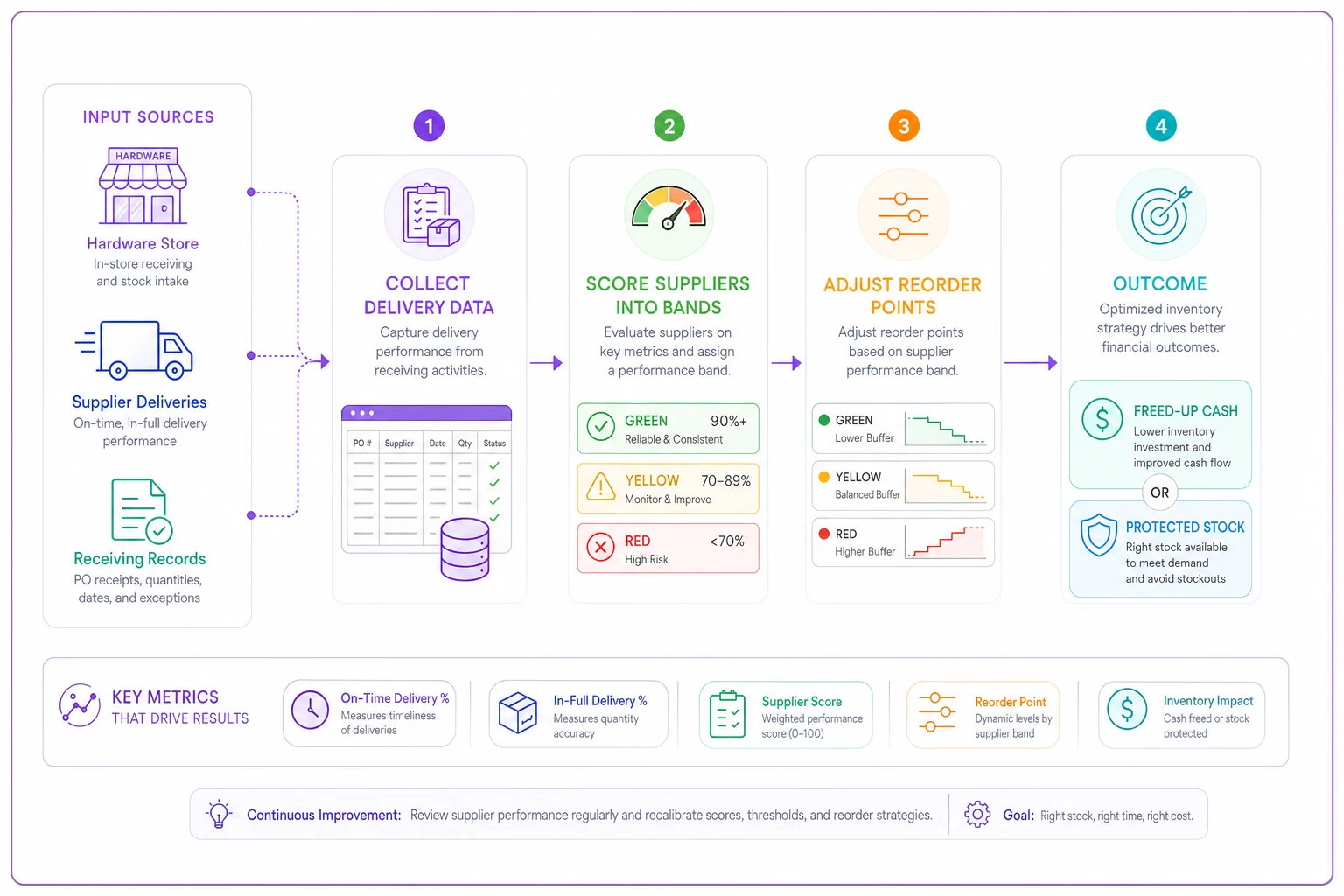
The scorecard isn't there to grade suppliers for fun. It's there to tell you, concretely, whether to trust a vendor enough to lower your buffer, or whether to protect yourself. When a supplier moves from green to yellow, your reorder points for their SKUs should move too. That link — score changes → reorder rule changes → cash on shelf changes — is the whole system working together.
Where this quietly breaks as you grow
At 8 suppliers and one location, you can hold most of this in a spreadsheet. The framework mostly formalizes what a sharp owner already senses.
The breakage starts around the point where you're juggling 25–40 vendors, or you add a second location, or you bring on staff who receive shipments while you're not there. Now the lead-time data lives in three people's memories instead of one. The person who knows "Supplier B has been flaky lately" is off that day, so someone reorders on the old assumption and you stock out. The scorecard exists but hasn't been updated in two months because updating it is manual and boring.
This is the coordination problem, and it's where a lot of stores silently lose ground. The knowledge exists — it's just trapped in people's heads and never gets converted into the reorder rules that actually drive purchasing. Every handoff is a chance for the lead-time reality and the reorder point to drift apart again.
What helps at this stage is having delivery timing captured automatically at receiving, so the actual order-to-shelf time gets logged without anyone remembering to write it down, and reorder points that recalculate as a supplier's reliability shifts instead of sitting frozen at last year's number. This is where AI-assisted operational platforms earn their keep — quietly tracking the pattern of a supplier's deliveries, flagging when variability starts creeping up before it causes a stockout, and adjusting your reorder points accordingly. Not because it's clever technology, but because it removes the manual bookkeeping that always slips when the store gets busy. The framework still comes from you; the software just keeps it current when your team is too slammed to.
A real scenario
A single-location store — general hardware, small contractor customer base — kept stocking out on a handful of high-turn plumbing and fastener items, usually right when a contractor wanted volume. Their read was "our main distributor is unreliable."
When they actually logged deliveries for a couple of months, the picture was different. The main distributor was fine — median 4 days, tight spread. The stockouts traced to two smaller specialty suppliers whose lead times swung from 3 to 12 days, and whose backorders were never announced. The store had been carrying the same safety stock across all suppliers, which meant they were overstocked on the reliable distributor's SKUs and dangerously thin on the erratic ones.
They recategorized, bumped reorder points on the two erratic suppliers, lowered them on the reliable distributor to free up cash, and set up a monthly scorecard for just that handful of vendors. Over the following quarter, stockouts on those problem items dropped noticeably — from a near-weekly annoyance to a couple of instances — and they actually pulled cash off the shelf overall, because the reliable-supplier SKUs no longer carried buffer they didn't need. Rough sense of it: a few thousand dollars in freed-up inventory and a clear drop in walked contractor sales.
Nothing about their suppliers changed. Their understanding of their suppliers changed, and the reorder rules followed.
When this framework is worth it — and when it isn't
Do this if: you have a handful of high-velocity SKUs with no easy substitute, you've had stockouts that walked real customers, or you suspect you're overstocking to compensate for suppliers you can't quite trust. The smaller and tighter your supplier base, the more leverage you get from formalizing it — you can actually finish it.
-
you have a handful of high-velocity SKUs with no easy substitute
-
you've had stockouts that walked real customers
-
you suspect you're overstocking to compensate for suppliers you can't quite trust
Skip the heavy version if: most of what you sell moves slowly and comes from one reliable broad-line distributor. In that case, just track that one distributor's fill rate and don't build scorecards for vendors you barely use. Effort should follow risk.
-
most of what you sell moves slowly and comes from one reliable broad-line distributor
Who should not bother scoring every supplier: anyone tempted to build a 20-vendor scorecard on day one. Start with your five most critical suppliers. If the framework doesn't earn its keep on those five, it won't on the other fifteen either.
The takeaway
The core shift here is small but it changes everything downstream: stop thinking about supplier lead time as one number and start thinking about it as a range you manage. Once you do that, categorization tells you where to focus, SLAs give you something to measure against, reorder rules translate each supplier's real behavior into cash-on-shelf decisions, and the scorecard closes the loop by telling you when to adjust.
For an independent hardware store, the advantage is that your supplier base is small enough to actually do this well. A big-box chain manages thousands of vendors with layers of software and staff. You manage twenty, and you can know each of them cold. That's not a disadvantage — used right, it's the reason your shelves can end up more predictable than theirs, not less.
Ready to elevate your hardware store management?
Join 500+ hardware stores using Hardzly to boost operational efficiency, reduce stockouts, and grow revenue.