

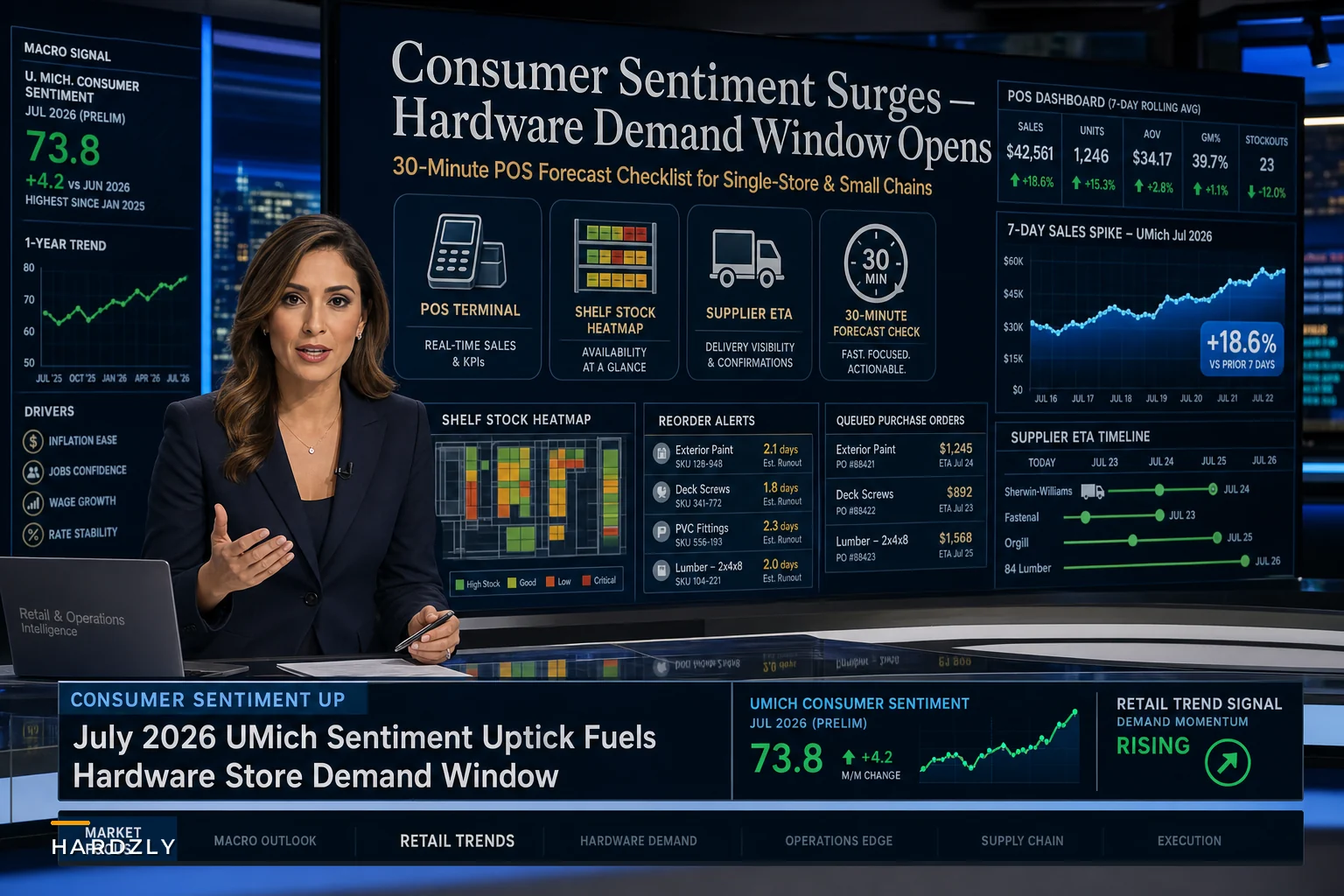

The University of Michigan just released their July consumer sentiment numbers — 55.2, up from 49.5 in June. That's an 11% jump in a single month. We haven't seen a single-month move like that since early 2023.
Your regulars are about to walk in with bigger shopping lists. The question is whether you'll have the inventory to back it up.
The 72-Hour Window Problem
Sentiment improvements create a weird operational problem for hardware stores specifically. Big-box retailers absorb demand swings with massive inventory buffers. You're running 8-12 days of stock on most SKUs. When sentiment jumps, the sequence looks like this:
First 72 hours: Nothing happens. People are still in the thinking-about-it phase. Days 4-10: Early movers start projects. POS velocity picks up on paint, basic tools, fasteners. Maybe 15-20% above normal if the shift is real. Days 11-21: Full acceleration. Weekend warriors who've been putting off deck repairs and bathroom updates finally pull the trigger. Your fast-movers can hit 40-50% above baseline. Day 22 onwards: Either you captured the demand, or you're telling customers their project has to wait another week for restock.
The Reuters coverage of the July numbers noted the improvement was broad-based across income levels — meaning both contractor accounts and DIY customers will likely open their wallets.
Reading POS Signals Without Getting Burned
Most hardware stores run weekly sales reports. That's too slow when sentiment shifts. You need daily velocity tracking on specific indicator categories:
Stop losing sales due to inventory gaps.
Hardzly helps you manage stock levels, orders, and supplier interactions efficiently.
- Unified inventory and sales tracking
- Supplier and purchase order management
- Automated workflow and task scheduling
No credit card required
Morning velocity check categories:
-
Interior paint (1-gallon sizes)
-
Basic drill bits and driver sets
-
Drywall patches and spackle
-
Cabinet hardware
-
Light switches and outlets
Automate the 3-day vs 30-day comparison to avoid manual calculation errors and spot sustained lifts faster.
These move first because they're project entry points. Someone finally decides to repaint the bedroom — they start with paint. Ready to tackle the kitchen? Cabinet pulls come before any major work starts. Pull POS data every morning on these categories. Compare the last 3 days against your 30-day average. Three consecutive days of 20%+ lift is your signal to adjust reorder points.
The Cashflow Trap Nobody Talks About
What actually kills hardware stores during demand spikes is the overcorrection. Sales jump, so they place huge orders across the board — and then sentiment reverses just as fast as it appeared. Suddenly they're sitting on six weeks of inventory right when demand normalizes.
I watched a store in Ohio do exactly this in 2022. They saw a sentiment bounce, ordered heavy across 400+ SKUs, and got stuck with $47,000 in excess inventory when things cooled three weeks later. Took four months to work through it.
The smarter move is tiered ordering based on margin and velocity:
| Tier | Details |
|---|---|
| Tier 1 — Order same day: | SKUs with 50%+ margin AND 14+ annual turns. These are your moneymakers — contractor-grade fasteners, premium drill bits, spray paint. They move fast enough that getting stuck on them is unlikely. |
| Tier 2 — Order within 48 hours: | 35-50% margin OR 10-14 annual turns. Hand tools, electrical supplies, standard lumber. Place orders, but cap them at 110% of normal, not 150%. |
| Tier 3 — Wait and watch: | Everything else. Low-margin commodities, seasonal items, special-order categories. Let these ride normal reorder cycles unless POS data shows sustained 30%+ lift for a full week. |
Let these ride normal reorder cycles unless POS data shows sustained 30%+ lift for a full week.
Supplier Communication That Actually Works
Your reps are already seeing the same consumer sentiment headlines. They're expecting inbound order increases. Most small hardware stores handle this conversation the wrong way.
"I'm seeing 25% daily velocity increases on interior paint and basic electrical. My current order won't cover the next 10 days at this rate. Can you expedite 30 gallons of Swiss Coffee and 40 units of standard outlets for Tuesday delivery? I'll take a secondary shipment Thursday if this velocity holds."
Specific SKUs. Quantities. Timing. And a follow-up order signal, which gets their attention. Suppliers prioritize stores that order predictably over stores that panic-buy randomly.
The Promo Window Everyone Misses
When sentiment improves, most stores think "great, I can just sell at full price." That's leaving money behind. The real opportunity is using light promos to pull forward demand from competitors who haven't adjusted yet. Not deep discounts — just enough to tip the decision for customers who are comparison shopping.
Focus on project-starter categories:
-
Paint brushes and rollers (10% off with paint purchase)
-
Drill bit sets (free index case with purchase)
-
Measuring tapes (buy 2, save $3)
-
Work gloves (3-pack pricing)
Minimal margin impact, but they signal to customers that this is the place to start their project. Once someone's in your store with paint and brushes, they're buying everything else from you too. Timing matters. Launch promos on day 5-6 after the sentiment news breaks — that's when customers are moving from thinking to planning. Run them for 10 days. Any longer and you're training customers to wait for sales.
Managing the Team Without Overtime Explosion
A 30-40% demand spike means your three-person team is suddenly doing four people's worth of work. You can't just throw overtime at it — that eats the margin you're trying to capture.
Stop doing:
-
Detailed shelf straightening (basic facing only)
-
Non-critical special orders
-
Full cycle counts (spot check only)
-
New plan-o-gram implementation
Double down on:
-
Restocking fast-movers
-
Contractor account service
-
Checkout speed
-
Receiving and putaway
Not sustainable long-term, obviously. But for a short demand window, it keeps you from burning out your team or your payroll budget.
Your 30-Minute Daily Forecast Routine
Morning (10 minutes):
-
Pull yesterday's POS data for indicator categories
-
Calculate 3-day rolling average vs 30-day baseline
-
Flag categories showing 20%+ sustained lift
-
Check current stock levels on flagged categories
Midday (5 minutes):
-
Spot-check shelf stock on top 10 movers
-
Text your supplier rep if emergency reorders are needed
-
Confirm tomorrow's delivery schedule
End of day (15 minutes):
-
Review actual vs forecast
-
Adjust tomorrow's staff coverage if needed
-
Update reorder points on categories with 3+ days of elevated velocity
-
Queue purchase orders for overnight processing
Simple, but the discipline is the point. Most stores check POS data randomly, make emotional ordering decisions, and then scramble when shelves go empty.
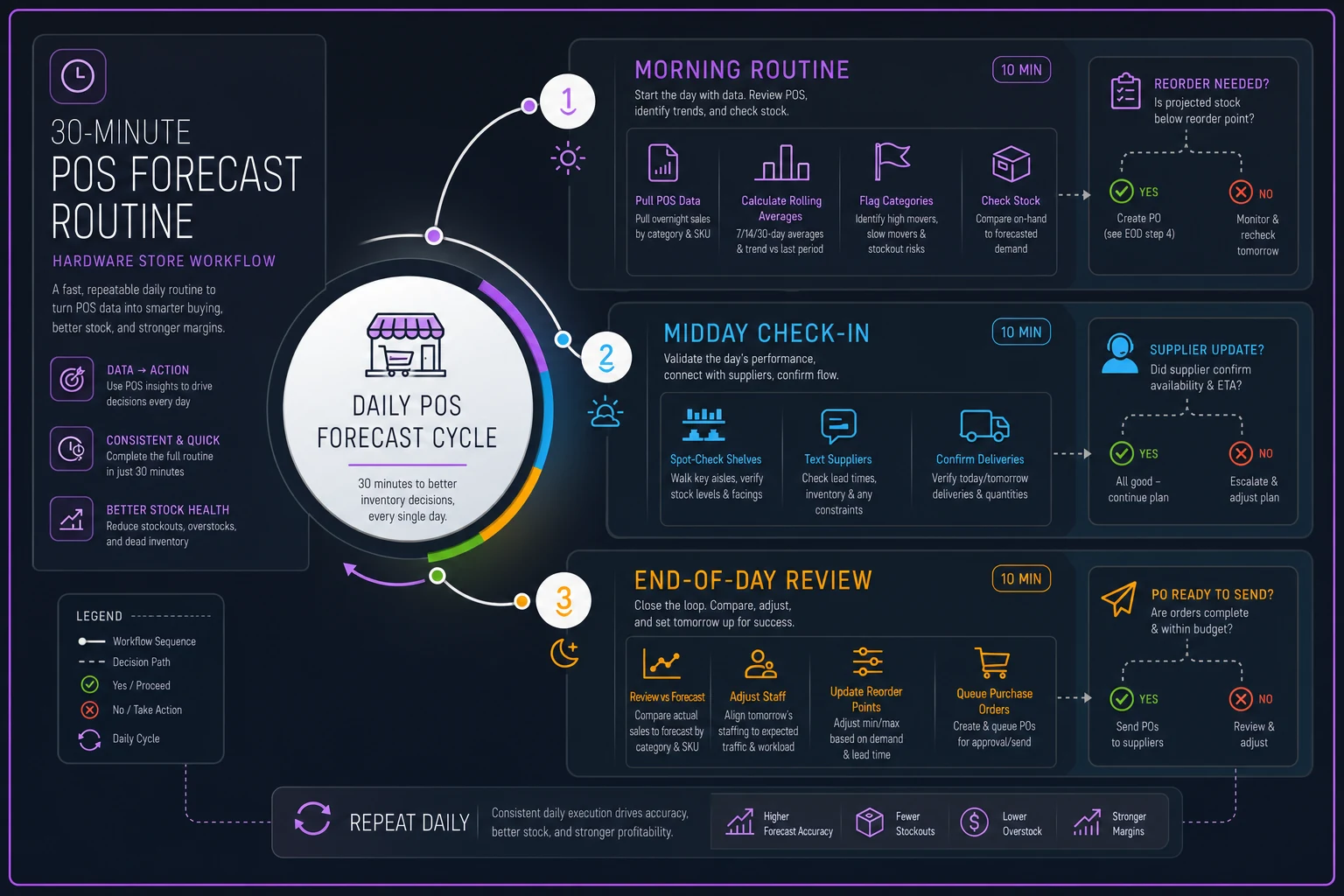
This visual maps the routine steps and decision points so you can run the 30-minute check reliably.
The Tech Stack That Makes This Manageable
Running these processes manually works, but it's a grind. AI-powered operational software handles most of the heavy lifting:
-
Automatic POS velocity tracking with anomaly detection
-
Dynamic reorder point adjustments based on rolling averages
-
Supplier order queuing with approval workflows
-
Inventory monitoring with mobile alerts
-
Demand forecasting that incorporates external indicators
That turns a 30-minute daily scramble into a 5-minute review. You're still making the calls. The software just handles the data gathering and calculation work so you don't have to.
What Happens If You Miss This Window
The damage from missing a sentiment window isn't just one bad sales day. It compounds.
A customer comes in for paint. You're out of their color. They drive to Home Depot, grab brushes and drop cloths, and pick up that drill they'd been debating. That's $200 in immediate lost revenue.
Worse — they remember Home Depot had what they needed. Next project, they start there. Over a year, that one stockout might cost you $2,000-3,000 in lifetime value. Multiply that across 20-30 customers during a demand spike, and you're looking at $40,000-60,000 in long-term revenue impact from not adjusting reorder points when the signals were right there.
The Next 30 Days
Sentiment doesn't stay elevated forever. University of Michigan data shows dramatic improvements rarely sustain for more than 2-3 months. The window is real, but it's narrow.
Tomorrow morning: build your indicator category list. Pick 15-20 SKUs across different project types. Track velocity daily for a week. Sustained lifts — execute the tiered ordering strategy above.
Don't try to optimize everything at once. Protect stock on high-margin, fast-moving items first. Let competitors run out of commodity products while you capture the profitable demand.
The stores that win during sentiment improvements aren't the ones with the most inventory or the biggest credit lines. They spot the signals early, adjust quickly, and don't overcorrect.
That 55.2 reading isn't just an economic data point — it's your customers telling you they're ready to spend. Whether your operation is ready to serve them is a different question entirely.
Ready to elevate your hardware store management?
Join 500+ hardware stores using Hardzly to boost operational efficiency, reduce stockouts, and grow revenue.