



Walk into the fastener aisle of most small hardware stores on a Thursday afternoon. Half the bins are empty, the other half are overflowing with product that's been sitting there for months. The owner ordered 10,000 wood screws last month because of a bulk discount, but they're completely out of drywall anchors that customers actually need.
Why fastener inventory keeps bleeding hardware store profits
This isn't just annoying—it's expensive. Dead fastener inventory ties up somewhere around $8,000–$12,000 in working capital for a typical 3,000 sq ft store. Meanwhile, running out of common items like 2-inch drywall screws or construction adhesive drives away contractors who spend $400–$800 per visit.
Most hardware store owners manage fastener inventory by gut feeling. They order more when bins look low, buy whatever the supplier suggests during sales calls, and hope it works out. It rarely does.
Why traditional ordering breaks down for fasteners
Hardware fasteners create inventory challenges that standard retail formulas don't handle well. A single SKU like "1/4-20 hex bolts" might come in twelve different lengths, three materials, and four finishes. That's potentially 144 variations of one basic item type.
Stop losing sales due to inventory gaps.
Hardzly helps you manage stock levels, orders, and supplier interactions efficiently.
- Unified inventory and sales tracking
- Supplier and purchase order management
- Automated workflow and task scheduling
No credit card required
Traditional min/max systems assume steady demand. Fastener consumption doesn't work that way. A contractor renovating an apartment complex might buy 5,000 drywall screws on Monday, then nothing sells for two weeks. Standard reorder points either leave you scrambling during big orders or sitting on excess inventory between projects.
Supplier minimums compound the problem. Most fastener distributors require ordering by the box or case—you can't order 37 drywall anchors, you need 100-count boxes. That forces constant rounding up, which turns into serious overstock over time.
Seasonal patterns are brutal too. Deck screws fly off shelves from April through September, then collect dust all winter. Concrete anchors spike during commercial construction season. Roofing nails disappear after storms. Generic inventory formulas miss these swings completely.
The actual math that works for hardware fasteners
Here's the par level formula that actually holds up for fasteners:
Base Par = (Weekly Average Usage × Lead Time in Weeks × 1.5) + (2 × Standard Deviation of Weekly Usage)
That's just the starting point. Three adjustments go on top:
Seasonal Adjustment Factor:
-
Peak season (item-specific)
multiply by 1.8
-
Shoulder season
multiply by 1.2
-
Off season
multiply by 0.6
Contractor Spike Buffer: Add 25% of your largest single sale in the past 90 days
Case Pack Round-Up: Round the final number up to the nearest case pack quantity
Worked example: 2-inch drywall screws
Historical data (January–March, off-season):
-
Week 1
120 screws
-
Week 2
85 screws
-
Week 3
340 screws (contractor order)
-
Week 4
95 screws
-
Week 5
110 screws
-
Week 6
75 screws
-
Week 7
280 screws (contractor order)
-
Week 8
90 screws
Weekly average: 149 screws
Standard deviation: 97 screws
Lead time: 1 week
Largest single sale: 340 screws
Case pack size: 100 screws
Base calculation: (149 × 1 × 1.5) + (2 × 97) = 224 + 194 = 418 screws
With adjustments: 418 × 0.6 (off-season) = 251 screws 251 + (340 × 0.25) = 251 + 85 = 336 screws Round up to case packs: 400 screws (4 boxes)
For peak season (May–August): 418 × 1.8 = 752 screws 752 + 85 = 837 screws Round up: 900 screws (9 boxes)
This store now maintains 400 screws in winter and 900 in summer. They've eliminated stockouts while cutting average inventory by around 30%.
Quick reference tables for common items
These par levels work as solid starting points based on purchase patterns across multiple hardware operations. They're not perfect for every market, but they get you close.
Screws & Fasteners Par Levels (Per 1,000 sq ft retail space)
| Item | Winter Par | Spring/Fall Par | Summer Par | Order Point |
|---|---|---|---|---|
| 1.25" drywall screws | 300 | 500 | 800 | 40% of par |
| 2" drywall screws | 400 | 600 | 900 | 40% of par |
| 3" deck screws | 100 | 400 | 1,200 | 35% of par |
| 2.5" wood screws | 250 | 400 | 600 | 45% of par |
| Sheet metal screws (assorted) | 200 | 300 | 350 | 50% of par |
| 1/4" lag bolts | 150 | 250 | 400 | 40% of par |
| Concrete anchors | 200 | 350 | 300 | 45% of par |
Nails Par Levels (Per 1,000 sq ft retail space)
| Item | Winter Par | Spring/Fall Par | Summer Par | Order Point |
|---|---|---|---|---|
| 16d framing nails (5 lb box) | 4 boxes | 8 boxes | 12 boxes | 3 boxes |
| 8d common nails (5 lb box) | 3 boxes | 5 boxes | 8 boxes | 2 boxes |
| Roofing nails (5 lb box) | 2 boxes | 6 boxes | 10 boxes | 3 boxes |
| Finish nails (1 lb box) | 6 boxes | 10 boxes | 15 boxes | 5 boxes |
| Brad nails (strips) | 8 packs | 12 packs | 18 packs | 6 packs |
Adhesives Par Levels
| Item | Winter Par | Spring/Fall Par | Summer Par | Order Point |
|---|---|---|---|---|
| Construction adhesive (28 oz) | 12 tubes | 24 tubes | 36 tubes | 8 tubes |
| Wood glue (16 oz) | 8 bottles | 12 bottles | 18 bottles | 5 bottles |
| Super glue (multi-pack) | 15 packs | 20 packs | 25 packs | 10 packs |
| Epoxy (2-part) | 6 units | 10 units | 12 units | 4 units |
| Silicone caulk (clear) | 10 tubes | 18 tubes | 24 tubes | 8 tubes |
| Silicone caulk (white) | 12 tubes | 20 tubes | 30 tubes | 10 tubes |
Use these as a baseline. After a month of tracking your actual sales against these numbers, you'll know which items need adjusting for your specific market.
The contractor wildcard adjustment
Contractors completely break standard inventory math. One roofing crew can clear out your entire roofing nail stock in twenty minutes. But they give you advance warning if you pay attention.
Track your top 10 contractor accounts separately. When they buy fasteners, note the project type they mention. Bathroom remodels mean drywall screws and adhesive. Deck builds signal specific screw sizes in volume. That information becomes your early warning system.
For items contractors buy regularly, maintain a "contractor reserve" physically separate from retail stock. Calculate it as 50% of the average contractor order size for that item. When a contractor cleans out your retail bins, you can immediately restock from the reserve while still serving DIY customers.
Some stores run a simple notification arrangement—contractors text or call a day ahead for large orders. In exchange, they get a 5% discount and guaranteed availability. It turns chaos into predictable demand you can actually plan around.
Adhesive expiration—the hidden profit killer
Unlike screws and nails, adhesives expire. Most construction adhesives last 12–18 months from manufacture. Polyurethane adhesives might only hold up 6–9 months. Super glue starts degrading around 12 months.
The problem compounds because adhesive moves slower than fasteners. A tube of specialty adhesive might sit for months between sales. By the time someone needs it, it's half-cured in the tube.
For any adhesive with fewer than 12 monthly sales, cap your par level at 3 months of average demand. You'll have more stockouts on slow movers, but throwing away expired adhesive costs more than the occasional lost sale.
Track expiration dates in a simple spreadsheet—three columns: product, expiration date, quantity. Check it monthly and mark down anything within 60 days of expiring. Contractors often buy near-expiration adhesive at 40% off for immediate use on job sites, so you're not just writing it off.
Daily reality: making par levels actually stick
Par levels are worthless if staff ignores them. Stores that actually succeed with this build it into daily routines, not weekly inventory audits.
Every morning, someone spends 15 minutes walking the fastener aisle with a clipboard—not counting everything, just checking items that look below order point. It takes less time than making coffee but catches problems before they become stockouts.
The clipboard has pre-printed sheets with item names, par levels, and order points. Staff writes the current quantity and circles anything below order point. No math, no judgment calls.
Orders go out twice a week—Tuesday and Friday. That rhythm matches most distributor schedules and prevents both stockouts and panic ordering. Tuesday orders handle contractor reserves and bulk items. Friday orders catch retail shortages before the weekend rush.
A simple visual of the morning routine workflow:
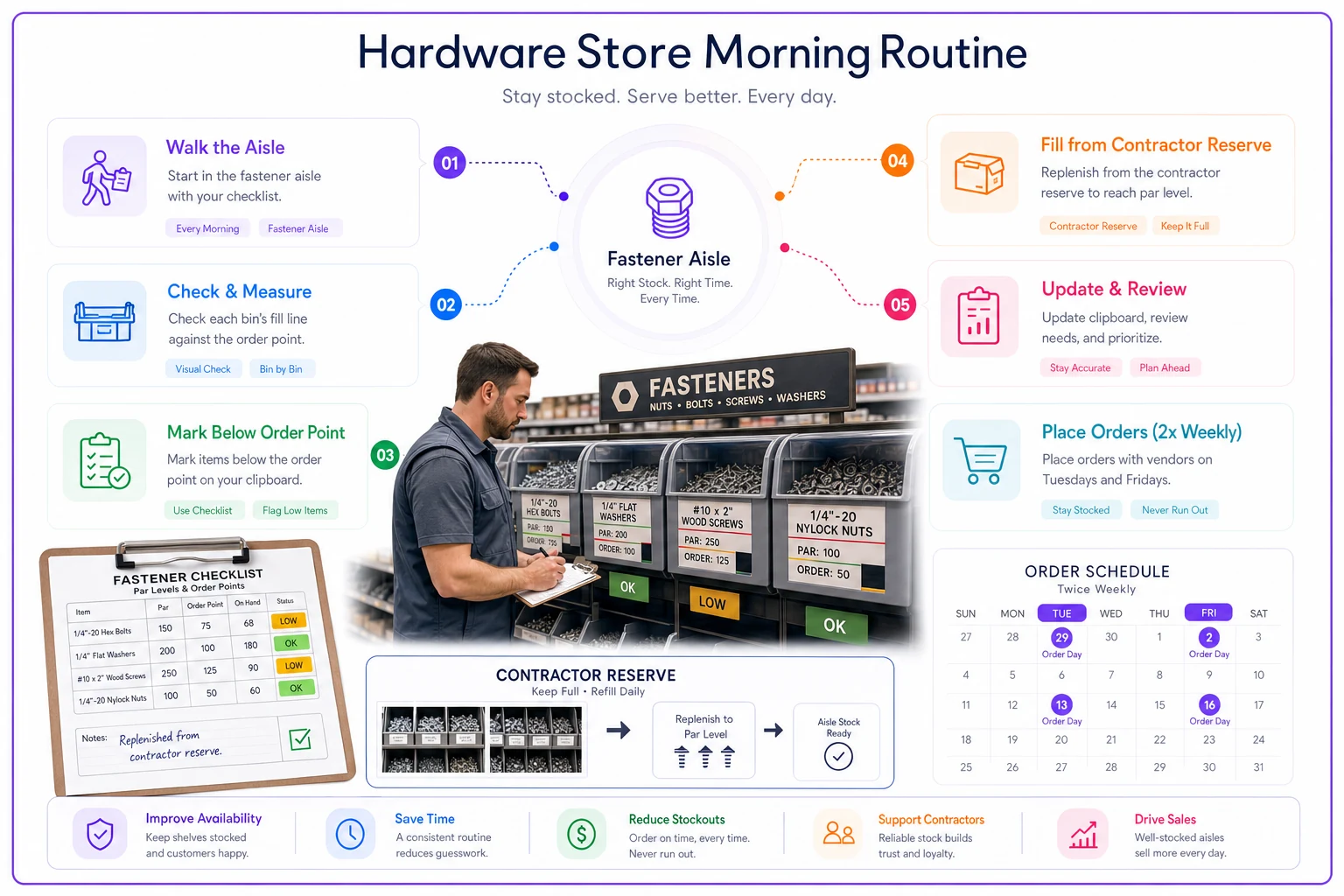
Mark fill lines inside bins with tape so the morning 15-minute check is fast and consistent.
The physical bin setup matters too. Mark fill lines inside bins with tape or a marker. When inventory drops below the line, it triggers a check. This visual system works even when the clipboard gets skipped during a busy day.
Seasonal transition timing that prevents dead stock
The transition between seasons is where profitability gets quietly destroyed. In March you're sitting on winter inventory. By May you need summer levels. Order too early and you're storing inventory for months. Too late and you're out of stock the first warm weekend everyone decides to build a deck.
Start transitions 6 weeks before the season changes. Increase orders by 25% each week for items moving to higher par levels. This gradual buildup avoids both cash flow shock and storage problems.
For items dropping to lower par levels, stop ordering 4 weeks before season end and let demand draw down inventory naturally. Mark down the last 20% to clear it rather than storing it through winter.
Calendar dates matter less than weather. Track the 10-day forecast and adjust accordingly. A warm spell in February means deck screws start moving. An early snow means construction adhesive sales stop—sometimes overnight.
When to completely ignore par levels
Supplier closeouts: When your distributor offers 70% off discontinued items, normal math doesn't apply. Buy what you can sell in 6 months, regardless of par levels. The margin covers the carrying cost.
Storm preparation: Hurricane or blizzard forecasts trigger panic buying. Ignore pars and order everything you can get. You'll sell every screw, nail, and tube of adhesive at full price.
Construction project intelligence: When a new hospital or apartment complex breaks ground nearby, specific fasteners will spike well above normal. Adjust those items immediately rather than waiting for the formula to catch up.
Distributor minimum changes: If a distributor suddenly requires $500 minimum orders, it forces batching multiple items together and breaks individual par levels. In that case, focus on total fastener inventory value rather than per-item pars.
Quick calculator formulas you can use today
Copy these into a spreadsheet and adjust the variables for your store:
=(AVERAGE(weeklysalesrange) leadtimeweeks 1.5) + (2 * STDEV(weeklysalesrange))
=Basic_Par * IF(month>=5 AND month<=8, 1.8, IF(month>=3 AND month<=4 OR month>=9 AND month<=10, 1.2, 0.6))
=Par_Level * 0.4
=CurrentInventory / (AverageWeekly_Sales / 7)
=CEILING((ParLevel - CurrentInventory) / CasePackSize) * CasePackSize
These formulas handle the math. The harder part is making sure someone actually runs them consistently, which is where most stores fall apart.
Where software actually helps
Manual tracking works until it doesn't. Most hardware stores hit the breaking point around 200 active fastener SKUs. The math becomes overwhelming, staff starts skipping counts, and you're back to ordering by instinct.
Inventory platforms built for hardware operations can handle par level calculations automatically—tracking sales patterns, adjusting for seasons, and flagging depletion rates without someone having to pull numbers manually. More importantly, they maintain discipline when the team gets busy, which is exactly when manual systems fall apart.
The real value is pattern recognition. Good software spots when contractors start buying unusual combinations of items, which often signals new construction projects before you hear about them directly. It flags adhesives approaching expiration and suggests markdowns before they become a write-off. It picks up that deck screw sales move with weather and adjusts accordingly.
These platforms also eliminate the Thursday afternoon scramble where someone realizes you're out of common sizes mid-week. Automated reorder suggestions based on real par levels mean consistent availability without constant manual checking—orders generate from actual depletion data, not a panicked call to your distributor.
Bottom line for profitable fastener inventory
Par levels for nails, screws and adhesives aren't about complex math. They're about consistent execution with the right adjustments. The formulas here come from actual hardware store operations where inventory costs dropped 25–35% while stockouts nearly disappeared.
Start with your top 20 selling items. Apply the base formula, add seasonal adjustments, and track results for one month. You'll see quickly which items need tweaking. Once those are stable, expand to the next 20.
The stores that do this well don't treat it as a one-time calculation. They review quarterly—especially after unusual sales patterns or season transitions. They maintain discipline during slow periods and resist the urge to override the system based on a feeling.
Fastener inventory is fundamentally different from other hardware categories. The combination of contractor spikes, seasonal swings, and case pack constraints requires its own approach. Standard retail formulas don't account for any of that, which is why so many stores stay stuck in the same cycle of overstock and stockouts year after year.
The difference between guessing and calculating proper par levels for nails, screws and hardware adhesives typically means $8,000–$15,000 less tied up in inventory with significantly fewer stockouts. For a small hardware store, that's not a rounding error—it's real working capital you can actually use.
Ready to elevate your hardware store management?
Join 500+ hardware stores using Hardzly to boost operational efficiency, reduce stockouts, and grow revenue.