



Every hardware store owner knows that sinking feeling when quarterly inventory counts come back way off. You're pretty sure some combination of theft, receiving errors, and misplaced items is bleeding you dry, but running full inventory audits every week would require doubling your staff.
Shrinkage in hardware stores follows predictable patterns. The same vulnerabilities keep showing up: high-value power tools walking out without receipts, receiving dock errors on bulk fastener orders, refund fraud on seasonal returns. You don't need expensive security systems or a dedicated loss prevention team. You need targeted procedures that focus on your actual risk points.
The shrinkage patterns killing small hardware margins
Hardware stores face a particularly rough shrinkage profile compared to other retail. Your inventory spans from 89-cent washers to $400 cordless drill sets. You've got bulky items that bypass checkout lanes, tiny parts that disappear into pockets, and hazardous materials with storage requirements that complicate tracking.
Most small hardware stores lose somewhere between 1.8% and 3.2% of revenue to shrinkage annually. On $1.2 million in sales, that's $21,600 to $38,400 straight off your bottom line. The breakdown typically looks something like:
-
Employee theft
35–42%
-
Customer theft
28–33%
-
Administrative errors
18–25%
-
Vendor fraud
8–12%
What makes this worse is how shrinkage concentrates. About 70% of losses come from just 15% of your SKUs. Power tools, copper fittings, specialty fasteners, and paint supplies account for the bulk of theft. Receiving errors tend to cluster around bulk orders where counting individual pieces gets tedious fast.
Seasonal swings amplify the problem. During spring rush when you're moving garden supplies and outdoor power equipment, your skeleton crew can't maintain normal routines. That's exactly when organized retail crime groups tend to show up.
Focused cycle counts that actually work with two people
Full inventory counts aren't realistic for small hardware stores. But targeted cycle counts on high-risk SKUs can be just as effective.
Stop losing sales due to inventory gaps.
Hardzly helps you manage stock levels, orders, and supplier interactions efficiently.
- Unified inventory and sales tracking
- Supplier and purchase order management
- Automated workflow and task scheduling
No credit card required
Start by figuring out where your losses are actually coming from. Pull the last three months of inventory adjustments from your POS and sort by dollar value of adjustments — not unit count. Patterns emerge quickly. Usually it's power tools, hand tools over $30, copper fittings, electrical wire, and whatever seasonal category is currently hot.
Build a rotating cycle count schedule that hits these categories weekly:
Monday morning (30 minutes): Count all cordless tools and batteries. Highest theft rate, highest street resale value. One person counts while another checks against the POS expected quantity.
Wednesday afternoon (25 minutes): Audit copper fittings and electrical wire. These get hit by both theft and mislabeling errors — contractors grabbing the wrong gauge or size.
Friday close (20 minutes): Check seasonal hot items. Summer means grills and outdoor power equipment. Winter is generators and snow blowers. Spring shifts to garden chemicals and seed.
The key difference from traditional cycle counting is what you do when something's off. When you find a discrepancy over $50, immediately check:
-
Recent receiving documents for that SKU
-
Any pending returns or exchanges
-
Security footage from that aisle for the past 48 hours
-
Whether items might be staged for pickup or delivery
Track findings in a simple spreadsheet:
| Date | SKU | Expected | Actual | Variance $ | Root Cause | Action Taken |
|---|---|---|---|---|---|---|
| 3/15 | DWT20V | 8 | 6 | -$398 | Theft suspected | Moved to locked cage |
| 3/17 | CPR34F | 47 | 52 | +$45 | Receiving error | Adjusted, retrained James |
| 3/22 | SEED-TG | 25 | 18 | -$84 | Found in garden center | Relocated, updated planogram |
A quick visual of the cycle count workflow.
Investigate discrepancies over $50 immediately while the trail is still warm.
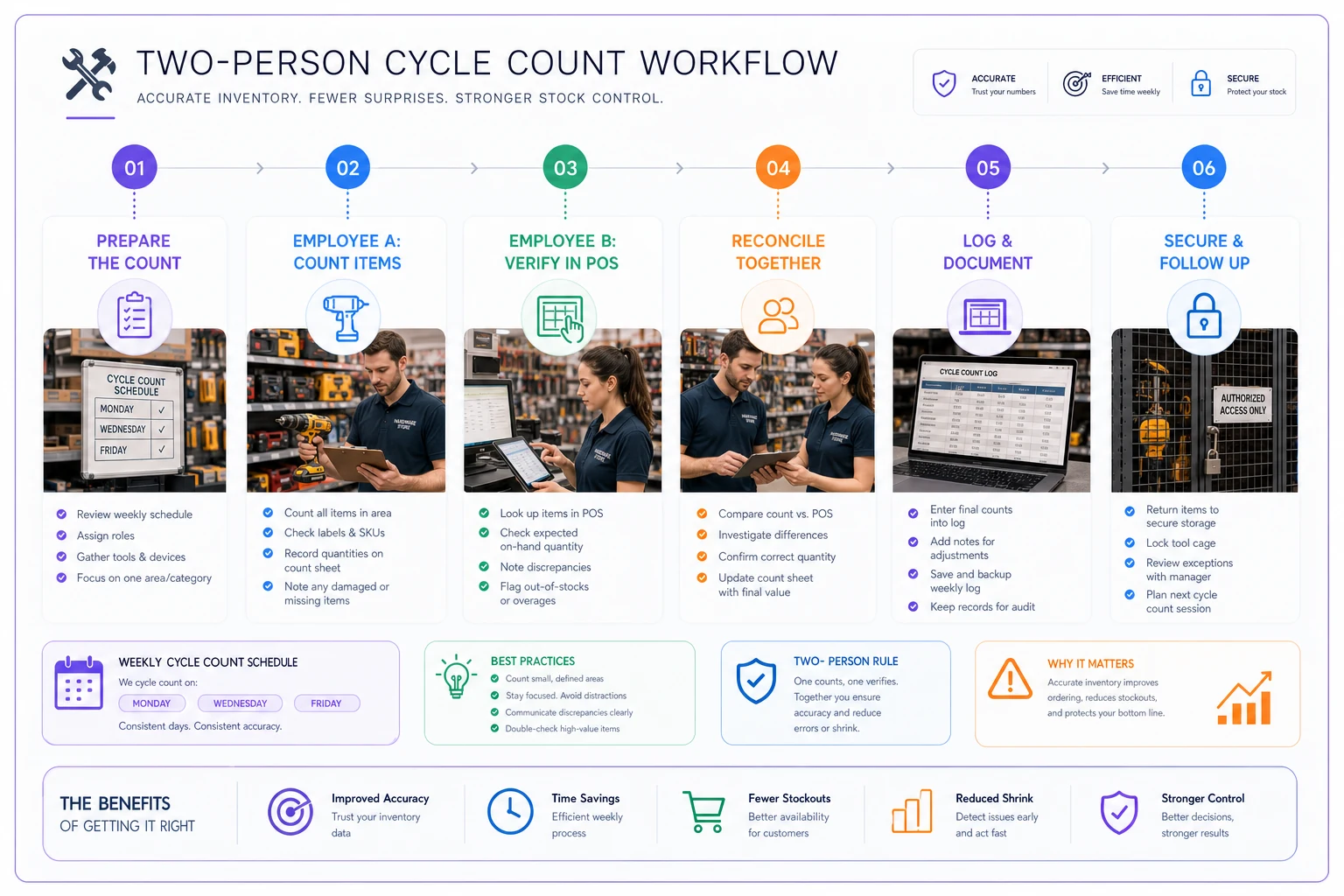
Investigating while the trail is still warm catches a majority of shrinkage causes. Either you find items miscounted in receiving, discover them in the wrong location, or identify suspicious activity worth following up on.
Blind receiving tests that catch vendor games
Receiving errors account for roughly 20% of shrinkage, but most stores never audit this. Vendors and drivers know which stores check deliveries versus which ones just sign and move on.
Run random blind receiving tests twice a month. Pick two deliveries at random — don't tell your receiving staff which ones. Have someone who doesn't normally handle receiving (you, or your assistant manager) quietly do a parallel count while your regular receiver processes the shipment normally.
Focus on:
-
Bulk fastener boxes (often short by 10–15%)
-
Mixed hardware assortments (wrong items substituted)
-
Special order items (missing pieces)
-
High-value tool shipments (empty boxes mixed in)
Compare your count to what the receiver documented. Variances over 2% point to either a training issue or something worse. One hardware store in Ohio found their receiver was consistently "missing" one DeWalt tool per shipment — buying it later with his employee discount and flipping it online.
Beyond catching problems, blind receiving changes behavior. When staff knows random audits happen, accuracy goes up noticeably. Just running two blind tests a month typically reduces receiving-related shrinkage by 40–50%.
Document everything in a receiving audit log, including photos of discrepancies. That documentation becomes critical if you ever need to dispute a vendor invoice or have a harder conversation with an employee.
Refund audit checks without antagonizing customers
Return fraud probably costs the average small hardware store somewhere in the range of $8,000–12,000 annually, concentrated in a handful of recurring scams. The challenge is catching fraud without making legitimate customers feel like suspects.
The most common patterns:
The seasonal swap: Customer buys a new snowblower in November, returns their old broken one in the new box come March. By then seasonal staff are gone and nobody remembers the original sale.
The contractor receipt collection: Contractors gather receipts from job sites, then "return" items they never bought, pocketing the cash refunds.
The cross-store returner: Someone steals from a big box store and tries the return at a small hardware store where staff might not recognize packaging differences.
Build refund protection into your process design rather than making it adversarial:
-
Under $25
Process normally
-
$25–75
Verify against POS history
-
$75–150
Manager approval required
-
Over $150
Photo documentation plus callback
For high-risk categories — power tools, generators, pressure washers — serialize everything at point of sale. Write the serial number on the receipt and log it in your POS. Takes about eight seconds per sale and stops most swap fraud cold.
Keep a "frequent returner" watch list. Anyone returning more than $200 monthly gets flagged for manager review. Plenty of legitimate contractors return that much, but you can verify they're buying corresponding amounts too.
The callback step stops receipt collection fraud almost immediately. For returns over $150 without a receipt, tell the customer you need to verify the purchase for warranty purposes. Scammers tend to disappear when you mention this.
Small-store deterrents that don't break the budget
Strategic changes to layout and process stop most opportunistic theft, which accounts for around 70% of customer shrinkage. You don't need an enterprise security setup for this.
The power tool cage retrofit: Instead of locking entire aisles, create a semi-open cage for items over $150. Wire grid panels — about $180 total from any fixture supplier — form a corral near your main register. Customers can see products but need staff assistance. Takes three hours to install, reduces power tool theft by roughly 65%.
Strategic height merchandising: Place high-theft items (drill bits, saw blades, measuring tapes) between 3 and 5 feet high. Harder to conceal, still easy to shop. Bulk fasteners and low-value items go on bottom shelves where theft matters less.
The contractor account audit: Theft rings sometimes open contractor accounts to case a store before doing anything. Review accounts opened in the last 90 days that haven't made a purchase. Call to verify the business license and job site address. Around 15% turn out to be dead ends.
Exit door receipt checks — but only for unbagged items: Checking every customer creates friction and wears out your staff. Post a sign: "Receipt required for unbagged merchandise." Train staff to check receipts only for customers carrying power tools, lumber, or bulk items without bags. You catch the high-value theft without annoying everyone who just grabbed a box of screws.
The loading dock timer: A $30 battery-powered timer light at your receiving door that runs for 20 minutes when activated. Receiving staff restart it while processing deliveries. Light off means door should be locked. Simple visual cue that prevents the back door from getting propped open and forgotten during busy stretches.
Quick audit templates you can actually maintain
Most loss prevention templates are designed for big-box stores. Here's something realistic for a two-person operation:
Weekly 15-Minute Audit (Every Monday)
Physical security check:
-
Back door locked and alarm set? (Y/N)
-
Power tool cage secured? (Y/N)
-
High-value items in correct locations? (Y/N)
-
Any new blind spots from moved displays? (Y/N)
Process verification:
-
Refunds over $75 properly documented? (Check 3 random)
-
Receiving logs completed for week? (Y/N)
-
Cycle counts performed on schedule? (Y/N)
Red flag review:
-
Any employees with 3+ voids this week?
-
Any customers with 2+ returns?
-
Any inventory adjustments over $100?
Monthly 45-Minute Deep Dive (First Tuesday)
Pull your POS exception report and look for:
-
Excessive voids or cancellations by any employee
-
Manual price overrides above 20%
-
No-sale register opens during slow periods
-
Returns without corresponding sales
Review security footage for:
-
Any cycle count variances over $100
-
High-traffic times in tool aisles
-
Receiving door activity outside delivery windows
-
Register blind spots during shift changes
Calculate your key shrinkage metrics:
-
Shrinkage rate = (Physical count - Book value) / Book value
-
Recovery rate = Value recovered / Value lost
-
Known vs unknown shrinkage ratio
Quarterly Loss Pattern Analysis (2 hours)
Aggregate three months of audit data to identify:
-
Which SKUs show repeated variances
-
Which employees coincide with shrinkage events
-
Which vendors have the most receiving discrepancies
-
Which days and times see the most suspicious activity
This is where systemic problems surface. Maybe Tuesday afternoon shifts consistently show higher shrinkage because that's your thinnest coverage. Or one vendor's deliveries reliably come up short on the same items.
KPI tracking that actually predicts problems
Tracking shrinkage after the fact is like checking your bank balance after the checks bounce — the damage is already done. Leading indicators let you catch problems while they're still fixable.
Void rate by employee: Normal is 0.5–1.5% of transactions. Above 2% suggests training problems or something else worth investigating. Track weekly, investigate spikes immediately.
Returns as a percentage of sales: Should stay between 2–4% for hardware retail. Sudden jumps often mean return fraud rings testing your systems.
Cycle count accuracy: Target 95% on your weekly counts. Below 90% means your inventory data is deteriorating, which makes shrinkage harder to detect and fix.
Average transaction value drift: If ATV drops 10% without a corresponding traffic increase, something's off at checkout.
Receiving variance rate: More than 3% variance between ordered and received quantities points to vendor issues or receiving breakdown.
Track it in a simple spreadsheet:
| Metric | Target | Week 1 | Week 2 | Week 3 | Week 4 | Alert? |
|---|---|---|---|---|---|---|
| Void Rate | <1.5% | 1.2% | 1.4% | 2.1% | 1.8% | CHECK |
| Return % | <4% | 3.2% | 3.5% | 3.3% | 5.2% | ALERT |
| Cycle Accuracy | >95% | 97% | 96% | 94% | 91% | CHECK |
| ATV Change | <10% | -2% | -3% | -8% | -12% | ALERT |
Watch the trends, not just the individual numbers. A gradually creeping void rate tells you something's developing before it becomes a real problem.
Making it work with your actual staffing
Small hardware stores run lean. Two people for opening, three on a busy Saturday, barely anyone for close. Traditional loss prevention assumes staffing you don't have.
Batch similar tasks: Don't spread loss prevention activity throughout the day — it never actually gets done that way. Monday morning before opening handles cycle counts and audit review. Friday after close covers deterrent checks and KPI tracking. Focused blocks mean tasks happen consistently instead of getting pushed back indefinitely.
Rotate responsibility: Don't designate one person as the loss prevention point. Rotate weekly accountability among your three most senior employees. Prevents gaming, builds broader awareness.
Integrate with existing routines: Receiving checks happen during normal receiving. Exit checks happen during customer loading assistance. Refund audits attach to daily cash reconciliation. If it requires a separate trip or a separate meeting, it eventually stops happening.
Use down-time strategically: Hardware stores have predictable slow windows — usually mid-afternoon on weekdays. That's when you run blind receiving tests and footage reviews, not during the Saturday morning rush.
Accept imperfection. You won't catch everything. Catching 70% of shrinkage with 20% of the effort required for full loss prevention is still a massive improvement over what most small stores are actually doing.
The stores that genuinely reduce shrinkage aren't running perfect systems. They're running simple systems they stick to. A basic weekly cycle count beats an elaborate daily process that gets skipped half the time.
Technology shortcuts worth the investment
You don't need enterprise software, but a few targeted investments pay back quickly:
Basic camera coverage ($400–600): Four wireless cameras covering your main register, tool aisle, receiving door, and paint desk catch the majority of theft activity. Obvious visibility deters more than hidden cameras catch.
Electronic article surveillance for power tools ($200): Spider wraps on anything over $150. Annoying to remove, but power tool theft drops significantly with visible tags.
Barcode scanners for receiving ($150): Scanning received items instead of counting by hand reduces errors meaningfully and speeds up the process. Your receiver can actually verify quantities instead of trusting the packing slip.
Under $1,000 total, and most stores see payback within 60–90 days through reduced shrinkage.
AI-powered operational software can tie these pieces together without a major implementation project. Platforms with built-in automation can flag unusual patterns in your POS data, surface refund anomalies before they compound, and predict which SKUs are most likely to show shrinkage based on your store's history. The better ones automate cycle count scheduling, track audit completion, and generate exception reports — removing the spreadsheet work that tends to get deprioritized when you're short-staffed. It's not a replacement for the fundamentals, but it makes consistent execution a lot easier when you're running a two-person operation.
The compound effect of small improvements
A hardware store in Michigan hit a 3.8% shrinkage rate that was eating through their profitability. They didn't hire security staff or install elaborate systems. They started weekly cycle counts on power tools, blind receiving tests twice a month, and basic refund verification.
Six months later:
-
Shrinkage dropped to 1.9%
-
They recovered roughly $31,000 in annual margin
-
Employee theft nearly disappeared
-
Vendor shortages dropped 70%
-
Customer satisfaction actually improved — faster checkouts with less of the ambient suspicion that makes shopping feel uncomfortable
The owner said the biggest surprise was how fast behavior shifted once consistent monitoring was in place. Not aggressive monitoring — just predictable verification that made theft not worth the risk.
Your store doesn't need elaborate loss prevention infrastructure. You need focused procedures that target real vulnerabilities, simple tracking that catches problems early, and consistent execution that becomes routine. Start with cycle counts on your top 20 high-theft SKUs. Add blind receiving tests the following month. Build your refund matrix after that. Within 90 days you'll see shrinkage trending down.
The choice isn't complicated: lose $20,000 or more annually to preventable shrinkage, or spend three hours a week on targeted procedures that protect your margins. For most hardware stores, that's the difference between barely surviving and running a business that actually builds toward something.
Ready to elevate your hardware store management?
Join 500+ hardware stores using Hardzly to boost operational efficiency, reduce stockouts, and grow revenue.