


Every small hardware store faces the same frustrating math problem. You need 50 units of 3/8" galvanized carriage bolts for the season, but your supplier only sells them in cases of 200. So you buy four times what you need, tie up $180 in dead inventory, and watch those extra 150 bolts collect dust for the next three years.
This isn't just about bolts. Walk through any independent hardware store's back room and you'll find the graveyard of MOQ decisions—cases of specialty hinges ordered for one contractor job, boxes of metric fasteners that move twice a year, seasonal chemicals bought in supplier-mandated quantities that exceed three seasons of demand.
The real damage goes beyond cash flow. That excess inventory eats shelf space, creates counting headaches during inventory, and forces you to mark down aging stock just to clear room for products that actually sell. Most hardware stores are sitting on somewhere between $15,000 and $30,000 in excess inventory purely from MOQ and pack-size mismatches.
Why MOQ strategies matter more for small retailers
Big box stores negotiate custom pack sizes and get direct-from-manufacturer pricing that makes MOQs essentially irrelevant. They order by the pallet and turn inventory fast enough that excess doesn't hurt them. Your local Ace or True Value has buying group advantages that reduce some of that pressure through consolidated ordering.
Independent hardware stores get squeezed from both sides. Suppliers enforce strict minimums because processing small orders costs them money. Meanwhile, your customer base is too small to absorb large quantities quickly, especially on specialty items.
The standard supplier response when you ask about breaking cases: "We can't open cases" or "There's a 35% upcharge for broken cases." What they don't mention is that these policies are negotiable, especially when you understand the actual economics behind their resistance.
The real math behind MOQ decisions
Total Holding Cost = (Excess Units × Unit Cost × 0.25) + (Shelf Space Value × Months to Sell)
Stop losing sales due to inventory gaps.
Hardzly helps you manage stock levels, orders, and supplier interactions efficiently.
- Unified inventory and sales tracking
- Supplier and purchase order management
- Automated workflow and task scheduling
No credit card required
That 0.25 represents your annual carrying cost—roughly 25% when you factor in tied-up cash, handling, space, and depreciation risk. Shelf space value varies by location in your store, but figure $2–5 per square foot per month for prime selling areas.
Take those carriage bolts. You need 50 units at $0.90 each. The supplier's case of 200 costs $180:
-
Excess inventory
150 units × $0.90 = $135
-
Annual holding cost
$135 × 0.25 = $33.75
-
Space cost (assuming 6 months to sell)
$3/sq ft × 2 sq ft × 6 months = $36
Total excess cost: $69.75
That's a 38% premium on what you actually needed. Suddenly that "35% upcharge" for case breaking doesn't look so bad.
Three decision rules that actually work
Watching small hardware stores wrestle with MOQ decisions, certain patterns become pretty obvious about what works and what doesn't.
Rule 1: The 6-month turnover test
If you can't sell through the full MOQ in 6 months, find an alternative. This seems aggressive, but anything longer ties up too much working capital. The only real exceptions are true commodity items—standard screws, nails—where demand is steady and storage is cheap.
Rule 2: The 30% threshold
When excess inventory cost exceeds 30% of the order value, it's time to negotiate, split, or walk away. This threshold accounts for your carrying costs while still recognizing that some excess is acceptable for maintaining selection.
Rule 3: Category-based flexibility
Your MOQ tolerance should vary by category:
-
High tolerance (accept 12+ month supply) Basic fasteners, standard electrical supplies, common plumbing fittings
-
Medium tolerance (6–9 months) Seasonal items with predictable demand, standard tools, paint supplies
-
Low tolerance (3 months max) Specialty items, slow-moving SKUs, anything with obsolescence risk
Your MOQ tolerance should vary by category:
Negotiation scripts that suppliers actually respond to
Generic negotiation advice tells you to "leverage your relationship" or "bundle orders for better terms." That's not wrong, but it lacks the specific language that actually moves suppliers.
Script 1: The commitment swap
"I need 50 units of [item] quarterly. Your case size of 200 means I'm carrying 9 months of inventory. If you can break cases or reduce to 100-unit cases, I'll commit to quarterly orders for the next year. That's 200 units guaranteed vs. me finding an alternative supplier who will work with my volumes."
Script 2: The category expansion
"I'm looking at adding your [related product line], which would be about $3,000 in annual volume. But I need flexibility on case quantities for slow movers. Can we work out a split-case arrangement for items under $X per case, with full-case pricing on everything else?"
Script 3: The prepayment angle
"I'll prepay for 6 months of orders if you'll allow mixed cases on items in the same category. I need 25 units each of four different SKUs—that's still a full case worth of product, just mixed. Your picking cost is the same, and you get paid upfront."
Notice what these scripts do: they solve a supplier problem—guaranteed volume, upfront payment, category expansion—while addressing your MOQ issue. This approach works far better than simply asking for exceptions.
Split-order coordination tactics
Sometimes the best MOQ strategy involves coordinating with other buyers. More work, but it can dramatically cut excess inventory costs.
The contractor pool approach
Create a simple shared document with 3–4 contractors who regularly buy from you. When someone needs a specialty item with a painful MOQ, they post it. Others can claim partial quantities. You place the order when you hit the minimum.
One store did this for Simpson Strong-Tie connectors. Instead of each contractor getting stuck with excess specialty hangers, they pooled orders monthly and cut excess inventory in that category by around 60%.
The retailer swap network
Partner with 2–3 other independent hardware stores in nearby markets—not direct competitors. Share your excess inventory lists monthly. What's dead stock for you might be a hot seller 30 miles away.
Structure it simply:
-
List items at 50% of wholesale cost
-
Buyer arranges pickup or shipping
-
Settle up monthly via check or credit toward your own purchases
Inter-store transfers (for small chains)
If you run multiple locations, build a simple excess inventory alert system. When one store is about to order something with a bad MOQ, the system checks if another location has excess. Transfer at cost plus 10% for handling.
The math almost always works out: paying $20 to transfer 50 units from another store beats buying 200 units for $180 when you only need 50.
Pack-break cost analysis for common hardware SKUs
Real examples with actual SKUs and numbers:
Example 1: Hillman 3/8-16 x 3" Hex Bolts
-
Case quantity
100 pieces
-
Case cost
$142
-
Your 3-month demand
25 pieces
-
Excess holding cost
$26.62
-
Break-case upcharge from supplier
30% ($10.65 on 25 pieces)
-
Decision
Pay the upcharge
Example 2: 3M Contractor Grade Duct Tape
-
Case quantity
24 rolls
-
Case cost
$168
-
Your 3-month demand
8 rolls
-
Excess holding cost
$28
-
Break-case option
Not available
-
Alternative
Stock consumer 3-packs instead (different SKU, similar margin)
-
Decision
Switch SKUs
Example 3: Liquid Nails Heavy Duty Construction Adhesive
-
Case quantity
12 tubes
-
Case cost
$47.88
-
Your 3-month demand
4 tubes
-
Excess holding cost
$7.98
-
Storage concern
Climate-controlled space required
-
Decision
Accept the MOQ
(low dollar risk, stable product)
Example 4: Milwaukee 7-1/4" Circular Saw Blades (specialty tooth count)
-
Case quantity
10 blades
-
Case cost
$140
-
Your 3-month demand
2 blades
-
Excess holding cost
$28
-
Obsolescence risk
High (model-specific)
-
Decision
Special order only, pass MOQ to customer
| Example | Case quantity | Case cost | 3-month demand | Excess holding cost | Break-case upcharge/option | Storage/Other | Decision |
|---|---|---|---|---|---|---|---|
| Hillman 3/8-16 x 3" Hex Bolts | 100 pieces | $142 | 25 pieces | $26.62 | 30% ($10.65 on 25 pieces) | Pay the upcharge | |
| 3M Contractor Grade Duct Tape | 24 rolls | $168 | 8 rolls | $28 | Not available | Stock consumer 3-packs instead | Switch SKUs |
| Liquid Nails Heavy Duty Construction Adhesive | 12 tubes | $47.88 | 4 tubes | $7.98 | Climate-controlled storage required | Accept the MOQ | |
| Milwaukee 7-1/4" Circular Saw Blades (specialty tooth count) | 10 blades | $140 | 2 blades | $28 | High obsolescence risk | Special order only, pass MOQ to customer |
Decision: Special order only, pass MOQ to customer
The weekly MOQ review routine
Most hardware stores make MOQ decisions randomly during ordering, which leads to inconsistent choices and accumulated excess. Batch these decisions into a weekly 20-minute review instead.
Every Wednesday afternoon (or whatever day precedes your main ordering):
-
Flag all items where planned order exceeds 6 months of demand
-
Calculate excess cost using the formula above
-
Check for split-order opportunities with contractors or other stores
-
Apply negotiation scripts to orders over $200
-
Document your decision and actual supplier response
Track three numbers monthly:
-
Total excess inventory from MOQs
-
Successful negotiations or splits (count and dollar value)
-
Items where you switched suppliers or SKUs because of MOQ
After three months, you'll have a pretty clear picture of which suppliers flex on MOQs, which categories cause the most problems, and where alternative strategies actually work.
When to actually accept bad MOQs
Sometimes eating the excess inventory makes sense. The key is recognizing those situations instead of just defaulting to acceptance out of habit.
Accept bad MOQs when:
-
It's a new product you're testing (need to show commitment to get supplier support)
-
There's a real shortage risk—seasonal items, supply chain disruptions
-
The supplier offers dating terms that offset carrying costs
-
You're building history for better terms later
-
The total dollar exposure is under $100
Never accept bad MOQs for:
-
Anything with expiration dates under 18 months
-
Customer special orders—pass the MOQ cost through
-
Items with rapid model changes
-
Suppliers who consistently refuse any flexibility
-
Products available from alternative sources
Sometimes eating the excess inventory makes sense. The key is recognizing those situations instead of just defaulting to acceptance out of habit.
Quick MOQ calculators and templates
Here's a simple Excel formula for the break-even upcharge percentage:
``
=((ExcessUnits UnitCost 0.25) + (SpaceValue MonthstoSell)) / (NeededUnits Unit_Cost)
``
Plug in your numbers. If the result is higher than the supplier's case-break upcharge, pay the upcharge. If it's lower, buy the full case.
For split-order coordination, use this template message to contractors:
"I need to order [quantity] of [specific item with full description] from [supplier]. Their minimum is [MOQ quantity]. If anyone needs some, claim your quantity by [day]. Price will be [your cost plus 10%]. Pickup after [date]."
Keep it simple. Don't overcomplicate with deposits or complex tracking. The 10% markup covers your handling time.
AI automation to prevent MOQ creep
The hardest part about managing MOQs isn't the individual decisions—it's catching them before you reflexively click "order" on that full case. Modern inventory management platforms with built-in AI automation can flag these situations automatically.
Here's a visual of that workflow.
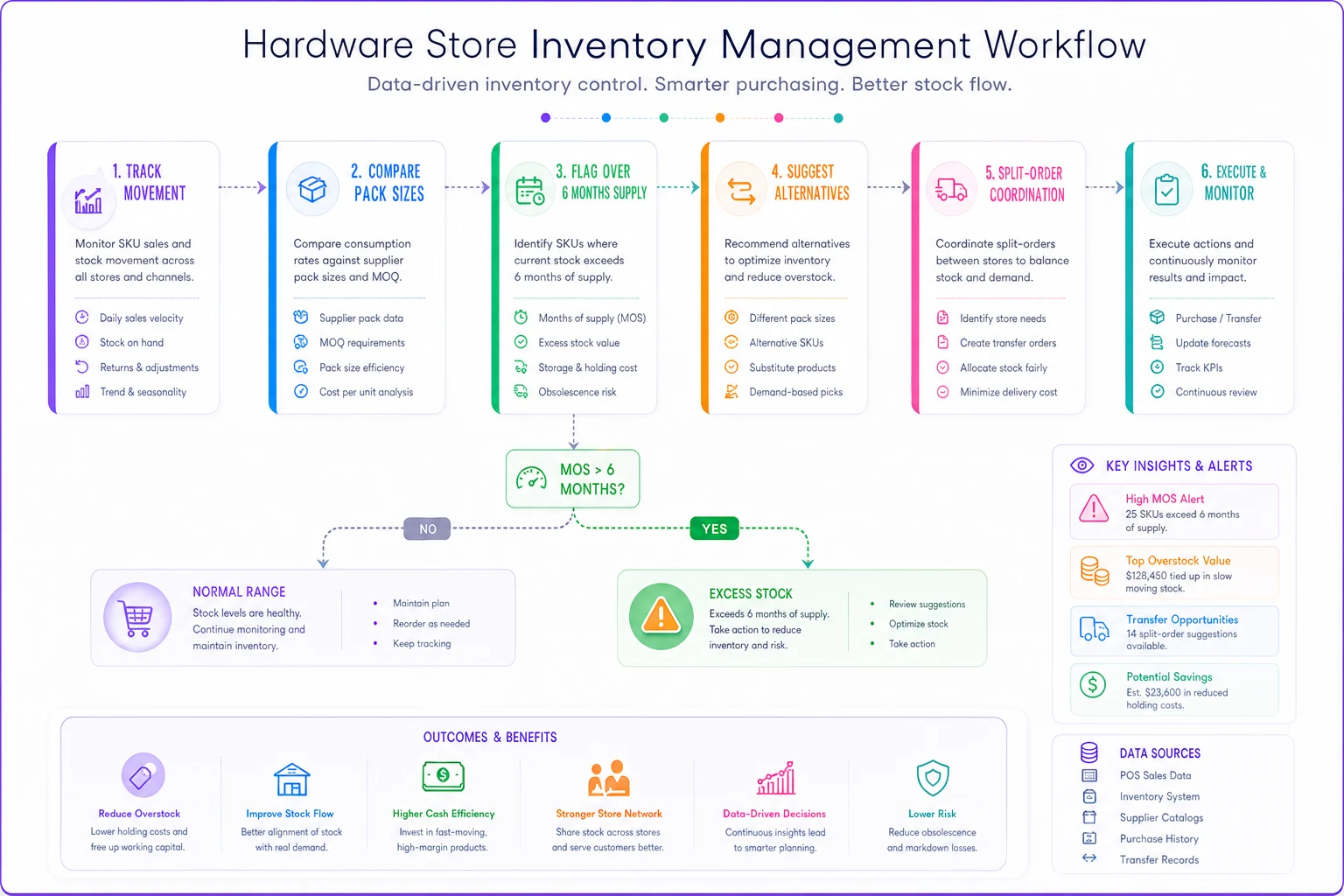
The system tracks your actual movement rate for each SKU and compares it against the supplier's pack size. When you're about to order more than 6 months of supply, it surfaces alternatives: different pack sizes, alternative SKUs, or split-order opportunities with other pending orders.
That kind of operational software is also useful for maintaining a running log of successful negotiations and supplier responses. When a similar MOQ situation comes up, the system can remind you which approach worked before—not replacing your judgment, just making sure you don't repeat expensive mistakes or forget tactics that have already proven out.
Some platforms now connect independent retailers for automated split-order matching. You mark items where you'd accept partial cases, and when another store in the network needs the same item, the system coordinates the split without manual outreach.
The compound effect of better MOQ decisions
A typical small hardware store makes somewhere around 200 ordering decisions weekly where MOQ matters. Improve even 10% of those decisions—paying upcharges instead of buying excess, coordinating splits, negotiating better terms—and you can free up $5,000 to $8,000 in working capital annually.
That freed capital means you can stock more of what actually sells, take advantage of early-pay discounts, or invest in improvements that drive traffic. The space you stop wasting on dead stock becomes room for profitable new categories.
The operational benefits stack up too. Inventory counts get cleaner when you're not constantly working around excess. Staff stop reorganizing overstocked sections. Your receiving and replenishment routines run smoother when you're not cramming surplus cases into already-full locations.
Start with your highest-dollar slow movers. Pull a report of items with over 6 months of supply on hand. Calculate the true cost of that excess using the formula above. Then work through alternatives systematically—negotiate, split, switch SKUs, or find new suppliers.
Most stores see real improvement within 60 days. The goal isn't perfect decisions on every order. It's applying these rules consistently instead of defaulting to "just buy the case." Your cash flow will notice the difference, and you'll finally have room for inventory that actually turns.
Ready to elevate your hardware store management?
Join 500+ hardware stores using Hardzly to boost operational efficiency, reduce stockouts, and grow revenue.