

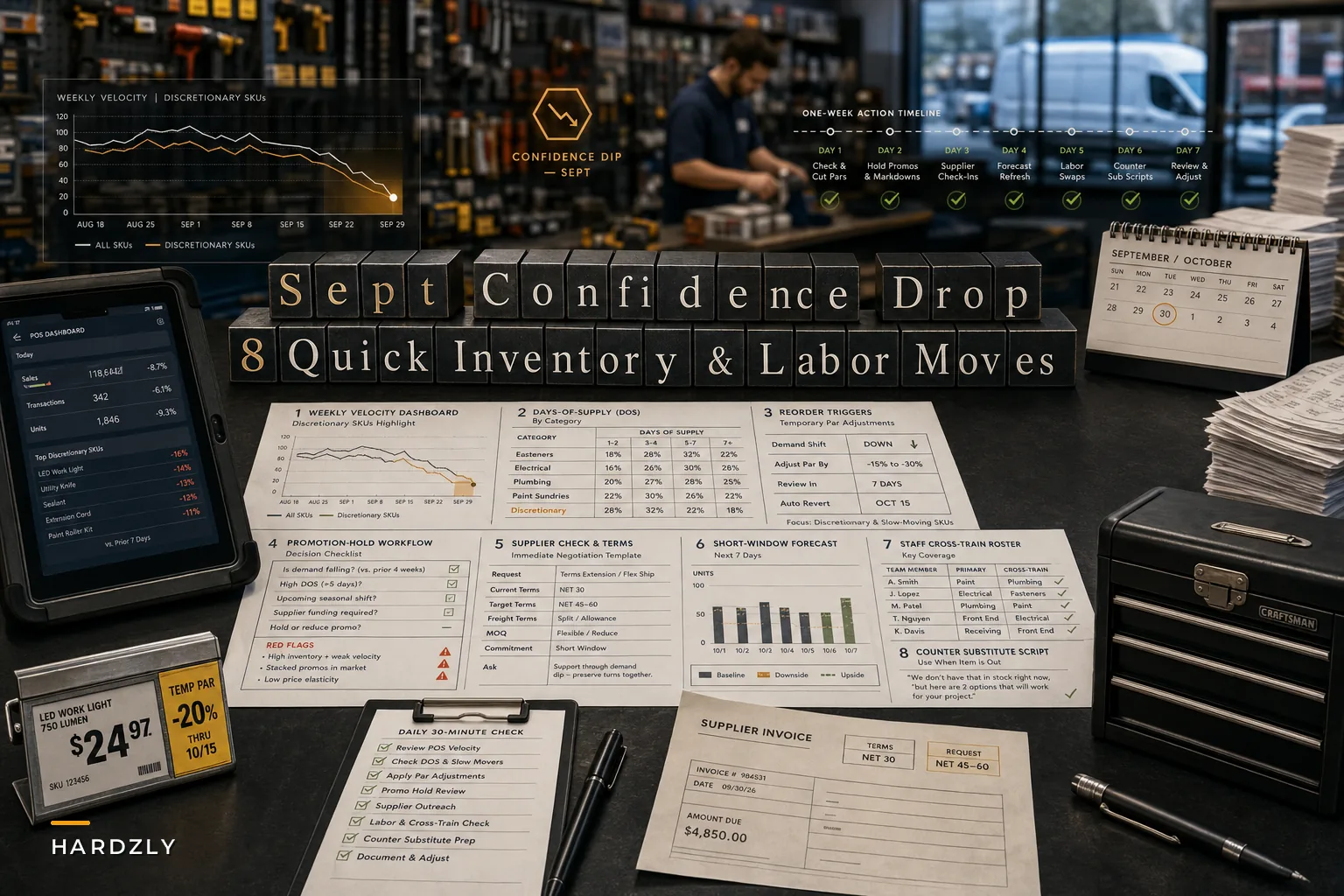

The Conference Board's September 2026 read landed at 81.9, down 6.7 points and the weakest number since 2014. The Reuters coverage of the release noted that the softness was concentrated in how people feel about future business and labor conditions — the "expectations" side, not just where things stand today. For a single-location hardware store, that's the part that actually stings. Expectations are what determine whether somebody pulls the trigger on a deck project in October or decides to wait until spring.
You don't need to panic over one survey. Confidence readings bounce. But the timing here is bad in a specific way: it hits right as you're committing to Q4 and holiday orders, right as you're locking in seasonal labor, and right as garden and outdoor stock is either moving out or quietly turning into deadstock. The stores that get hurt aren't the ones with soft demand — everybody deals with soft demand at some point. They're the ones who already bought for the demand they expected three weeks ago.
So this is a short, time-boxed list. Eight moves, each runnable inside a normal week without hiring anyone or buying anything. Protect cash, defend margin, and don't over-commit labor to a peak that might come in lighter than last year.
First, separate your "will buy anyway" SKUs from your "mood-dependent" ones
This is the single most useful thing you can do right now, and almost nobody does it cleanly.
Hardware demand is not one thing. A failing water heater, a broken window latch, a dead sump pump — that stuff sells regardless of how people feel about the economy. Consumer confidence barely touches it. People fix what's broken because they have to.
What does move with sentiment is the discretionary layer: the patio upgrade, the new grill accessories, the decorative hardware, the "I've been meaning to redo the mudroom" projects. When confidence drops, that's the first spending people postpone. The PR Newswire summary of the Conference Board's September report framed it around weaker expectations heading into Q4, and weaker expectations is exactly the psychology that kills a nice-to-have purchase.
Spend 30 minutes and tag your categories into three buckets:
| Demand type | Examples | Sentiment sensitivity | What to do this week |
|---|---|---|---|
| Non-discretionary / repair | Plumbing fittings, electrical basics, fasteners, adhesives, replacement parts | Low | Protect par levels, don't cut |
| Mixed | Paint, hand tools, storage, lighting | Medium | Hold, watch weekly velocity |
| Discretionary / project-driven | Outdoor decor, patio, premium grills, seasonal garden upgrades | High | Tighten reorders, pull back par |
The mistake that burns stores is treating a demand dip as uniform — cutting everything 10% across the board. That's how you end up out of stock on the $4 PVC coupling someone drove across town for while still sitting on three pallets of decorative solar lights. Cut where sentiment actually bites.
Pull your reorder cutoffs forward on the high-sensitivity stuff
Once you know which categories are mood-dependent, the next move is timing. For those high-sensitivity SKUs, move your reorder cutoff earlier and your reorder quantity lower — not because you're predicting a crash, but because the cost of being wrong is asymmetric right now.
Stop losing sales due to inventory gaps.
Hardzly helps you manage stock levels, orders, and supplier interactions efficiently.
- Unified inventory and sales tracking
- Supplier and purchase order management
- Automated workflow and task scheduling
No credit card required
Think about it from a cash standpoint. If you under-buy a discretionary item and it sells through, you lose a little upside. Annoying, but recoverable. If you over-buy it and sentiment stays soft through November, you're marking it down 30–40% in January just to free the shelf and the cash. The downside is much heavier than the upside, so your reorder logic should lean conservative on exactly the categories you flagged in bucket three.
-
For high-sensitivity SKUs, drop par levels by roughly 15–25% for the next 6–8 weeks.
-
Shorten the reorder window so you're buying smaller quantities more often instead of one big commitment.
-
Set a hard "no new discretionary SKU" rule until after the holidays unless it replaces something you're already discontinuing.
-
Keep non-discretionary par levels untouched — don't let caution bleed into repair categories.
This is the whole premise behind tying POS signals to supplier lead-time buckets and reorder scenarios, which is covered in more detail in the seasonal forecasting and cashflow routine. Short version for this week: shorter commitments on soft categories, normal commitments on the stuff people can't skip.
Reprice promos to protect margin, not chase traffic
A lot of stores react wrong here. Confidence drops, foot traffic feels slow, and the instinct is to run aggressive promos to get people in the door. In a soft-sentiment stretch, blanket discounting usually just donates margin on sales you were going to make anyway.
The better play is targeted, margin-aware promotion. Instead of 20% off a whole category, build a couple of bundles that move your at-risk discretionary stock without touching the price on your bread-and-butter items.
A useful pattern:
-
Bundle a slow discretionary item with a fast non-discretionary one at a modest combined discount. The fast item pulls the traffic; the slow item rides along.
-
Protect the price on repair categories entirely. Someone buying a shutoff valve is not price-shopping — don't discount what already converts.
-
Use spend-threshold promos ($10 off $75) instead of percentage-off. It nudges basket size up rather than just shaving margin.
Build bundles around items that reliably increase ticket size in past sales rather than guessing which discretionary SKUs will draw traffic.
Quick example. Say you'd normally do a flat 20% off outdoor storage. On a $90 bin you give up $18 and sell roughly the same volume you would've anyway. Swap that for a bundle — the $90 bin plus a fast-moving $12 organizer kit at $95 total. You've moved slow stock, lifted the ticket, and your margin hit is a fraction of the straight discount. Same goal, far less bleed.
Reset labor to the demand you now expect, not last year's peak
Labor is where soft Q4 demand quietly eats you alive, because the schedule got built on optimism weeks ago.
If discretionary traffic comes in lighter, you don't need the same peak coverage you ran last holiday. But you also can't slash hours blindly — you still need coverage for the repair-driven traffic that doesn't care about sentiment, and you still need someone who can handle a contractor's bulk order the second it walks in.
-
Identify your genuine peak windows — Saturday mornings, weekday contractor rush — and keep those fully staffed.
-
Thin the soft midday and late-evening slots where discretionary browsing lives.
-
Lean harder on cross-training so one person can cover counter, receiving, and paint instead of scheduling a separate body for each.
-
Hold off on any new seasonal hires you haven't already committed to until you see two or three weeks of actual Q4 velocity.
When this makes sense: when your high-sensitivity categories are a meaningful chunk of revenue and your schedule was built before the confidence read.
When it's a bad idea: if you're already running skeleton crews. Cutting further just degrades service and pushes customers to the big box — the exact opposite of what you want when every basket matters more.
Accelerate the supplier conversation now, while you still have leverage
Soft sentiment doesn't just affect your customers — it affects your suppliers' whole order book. If demand is coming in light across independents, your reps are feeling it too, which means this is a reasonable window to have a frank conversation about terms.
Two things worth pushing on:
-
Payment timing. Ask about stretching terms on the soft-season order from net-30 to net-45 or net-60. Even one extra cycle of breathing room on a large seasonal invoice protects cash when sales are uncertain.
-
Smaller, more frequent drops. Instead of one big pre-holiday commitment, see if you can split it. You pay a slightly higher per-unit cost in exchange for not tying cash up in stock that might not move.
Suppliers would rather adjust terms than lose the order to a competitor or get it canceled outright. When the whole market feels cautious, your willingness to still place orders — just structured more conservatively — has real value to them.
Tighten short-window forecasting and customer communication
When demand gets unpredictable, the stores that hold margin are the ones watching weekly velocity instead of relying on seasonal muscle memory.
Nothing fancy required. A weekly check on your top discretionary SKUs — units sold, days of supply remaining, whether velocity is trending down — tells you within two weeks whether sentiment is actually hitting your shelves or whether this particular dip is noise for your specific market. A lot of stores assume the national number applies to them and over-correct. Your local foot traffic might be completely fine. Let the POS confirm it before you make big moves.
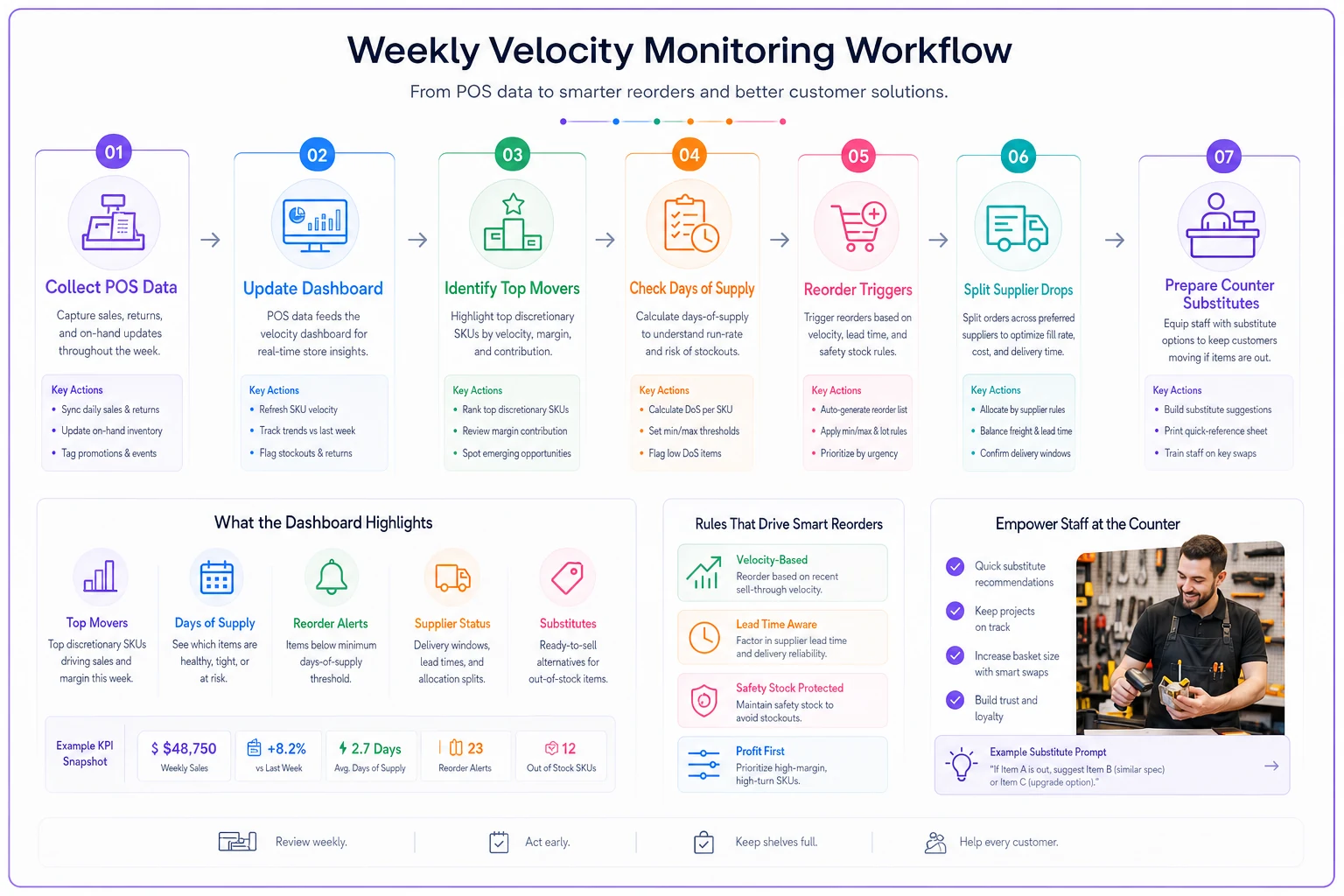
A compact workflow like this makes it easy to check velocity and decide whether to push a split shipment or tighten reorders.
On the communication side, soft periods are when backorder and substitution handling matters most, because every walk-out is a sale you can't afford. Make sure your counter team has pre-approved substitutes ready for the repair categories so a stockout doesn't turn into a lost customer who drives to the big box and doesn't come back.
A short real scenario
A single-location store — repair, paint, and a decent seasonal outdoor section — went into last Q4 having committed heavily to patio and decor stock before sentiment softened. They ended up carrying somewhere around $9k–$11k of discretionary inventory into the new year and marked most of it down 35% in January just to clear the floor. It tied up cash through the slowest months of the year.
This year, after flagging the September read, they split their outdoor reorder into two smaller drops, cut discretionary par by about 20%, and left repair categories completely alone. Mid-season they were slightly under on one grill accessory that sold through — minor lost upside. But they went into January with maybe a third of the prior deadstock and kept the cash that would've been frozen in markdowns. Noticeably healthier start to the slow quarter, with service levels on the repair side untouched.
This week's checklist
-
[ ] Tag categories into non-discretionary / mixed / discretionary buckets
-
[ ] Cut par levels 15–25% on high-sensitivity SKUs only
-
[ ] Freeze new discretionary SKU additions until post-holiday
-
[ ] Rebuild promos as bundles and spend-thresholds instead of blanket discounts
-
[ ] Re-map labor to likely traffic shape; hold uncommitted seasonal hires
-
[ ] Call top suppliers on terms and split large seasonal orders
-
[ ] Set a weekly velocity check on top discretionary SKUs
-
[ ] Confirm counter substitutes are ready for repair stockouts
That's the whole trade. A little lost upside on soft categories in exchange for not bleeding cash and margin when it matters most.
Bottom line
One confidence reading isn't a forecast, and your local market may hold up fine. But the asymmetry is real right now — the cost of over-committing on mood-dependent stock and labor is a lot higher than the cost of staying lean and buying again in two weeks. Protect the repair categories that pay your bills, stay conservative on the discretionary stuff, keep cash flexible, and let your own POS numbers tell you whether the national mood is actually showing up at your counter. Most of these moves take an hour or two each, and they're far cheaper to run this week than to unwind in January.
Ready to elevate your hardware store management?
Join 500+ hardware stores using Hardzly to boost operational efficiency, reduce stockouts, and grow revenue.