



Most hardware stores run their seasonal forecasting completely backwards. They look at last year's sales, bump numbers up or down based on gut feel, then wonder why they're sitting on $40,000 of unsold snow blowers in March while the bank account dips into the red. The real problem isn't the forecasting itself. It's that seasonal forecasting, cashflow planning, and reordering all happen in separate silos. Your POS shows what's selling. Your supplier tells you lead times jumped from 3 weeks to 8 weeks. Your promotional calendar says the spring sale starts April 1st. But none of these signals actually talk to each other until you're already in trouble.
When seasonal forecasting breaks down into expensive guessing games
Picture a hardware store in early February. The owner pulls last year's garden supply numbers, sees they sold 800 bags of mulch between March and May, and orders 900 bags to account for growth. Seems reasonable enough.
Except the supplier's lead time jumped from 2 weeks to 6 weeks due to trucking issues. The spring promotion that drove 40% of those sales got moved from mid-March to early April. And January's mild weather means customers are already asking about garden supplies three weeks ahead of schedule.
By the time those 900 bags arrive in late March, competitors have already captured the early-season demand. The promotional timing mismatch means you're overstocked going into your own sale. And because you tied up $18,000 in mulch inventory, you can't afford to stock the grills customers actually want in April.
This plays out with paint in summer, generators before storm season, snow equipment in fall. The pattern is always the same - disconnected planning leads to mistimed inventory and cashflow problems that feel like bad luck but are really just bad process.
The three buckets that control your seasonal cashflow reality
Seasonal forecasting in hardware retail means juggling three different time horizons that rarely line up on their own.
Stop losing sales due to inventory gaps.
Hardzly helps you manage stock levels, orders, and supplier interactions efficiently.
- Unified inventory and sales tracking
- Supplier and purchase order management
- Automated workflow and task scheduling
No credit card required
Immediate signals (0-4 weeks out): POS data, foot traffic patterns, current weather. These tell you what's happening right now but don't help much with orders that need 6-8 week lead times.
Supplier reality (4-16 weeks out): Lead times vary wildly by category and season. Fertilizer might take 3 weeks in January but 8 weeks in March. Power tools stay consistent year-round. Import fasteners can swing from 6 to 14 weeks based on port congestion.
Promotional and seasonal anchors (8-26 weeks out): Your spring sale date, competitor promotional patterns, local home shows, weather transitions. These drive demand spikes but need inventory positioned months in advance.
The stores that get this right aren't necessarily better at predicting. They're better at connecting these three buckets into coherent reorder scenarios instead of treating each one as its own separate planning exercise.
Building your monthly forecasting routine
Here's the routine that works for stores doing $2-5 million annually. Not the idealized version from a consultant deck, but what stores can actually maintain month after month without burning out.
Week 1: Gather your three signals
Pull POS data for the last 8 weeks and focus on category velocity changes. You're looking for early indicators - are people buying grass seed two weeks earlier than last year? Are generator inquiries starting even though storm season is months away?
Update your supplier lead time matrix. Don't rely on standard lead times - actually check current quotes. One store discovered their deck stain supplier had moved production overseas, jumping lead time from 4 weeks to 12 weeks, right before deck season. Nobody caught it because they were still using the old numbers.
Review your promotional calendar for the next 16 weeks. Include competitors' likely promotion dates based on historical patterns. That Memorial Day grill promotion everyone runs? It affects your charcoal and propane sales whether you participate or not.
Week 2: Run your scenarios
This is where most stores go wrong. They create one forecast and treat it like gospel. Instead, build three scenarios:
Conservative scenario: Last year's sales with current lead times, no growth, no decline. This is your cashflow floor - the minimum you need to order to avoid stockouts.
Expected scenario: Adjust for known factors. Earlier spring? Bump March garden supplies by 20%. Competitor closed? Add their estimated volume. New housing development nearby? Factor in those new homeowners.
Aggressive scenario: What happens if everything goes right - good weather, successful promotions, strong foot traffic. This isn't fantasy, it's your ceiling for inventory investment.
Here's what this looked like for one store's lawn mower category:
| Scenario | Units Needed (Mar-May) | Reorder Date | Cash Required | Expected Return |
|---|---|---|---|---|
| Conservative | 45 units | Feb 5 | $13,500 | $20,250 |
| Expected | 62 units | Jan 28 | $18,600 | $27,900 |
| Aggressive | 78 units | Jan 20 | $23,400 | $35,100 |
The eight-day difference in reorder dates between scenarios seems minor until lead times jump unexpectedly. That buffer determines whether you're stocked for the first warm weekend or watching customers walk to the competitor down the road.
Week 3: Check against cashflow reality
This is the step everyone skips, then wonders why they're cash-crunched in April. Map your scenarios against actual cashflow projections.
Start with your bank balance today. Add expected collections from accounts receivable. Subtract fixed costs for the ordering period - rent, payroll, utilities. What's left is your real inventory budget.
Now overlay the reorder scenarios. The aggressive scenario might project great returns, but if it requires $60,000 in inventory investment when you only have $35,000 available, it's not a plan. This is where you make trade-offs. Maybe you go aggressive on fast-turning garden supplies but conservative on outdoor furniture.
Week 4: Create reorder triggers and templates
Turn your scenarios into actual reorder triggers. When mulch hits 200 bags in stock (roughly 2 weeks of conservative scenario sales), trigger the reorder. When lawn mower inventory drops to 8 units, place the expected scenario order. These triggers account for lead time variability and cashflow reality instead of relying on someone remembering to check.
Build templates for common seasonal orders. That 6-SKU fertilizer order you place every March? Template it with quantities for each scenario. Adjust quantities based on current conditions, but keep the SKU mix consistent. This cuts ordering time from hours to minutes and reduces errors.
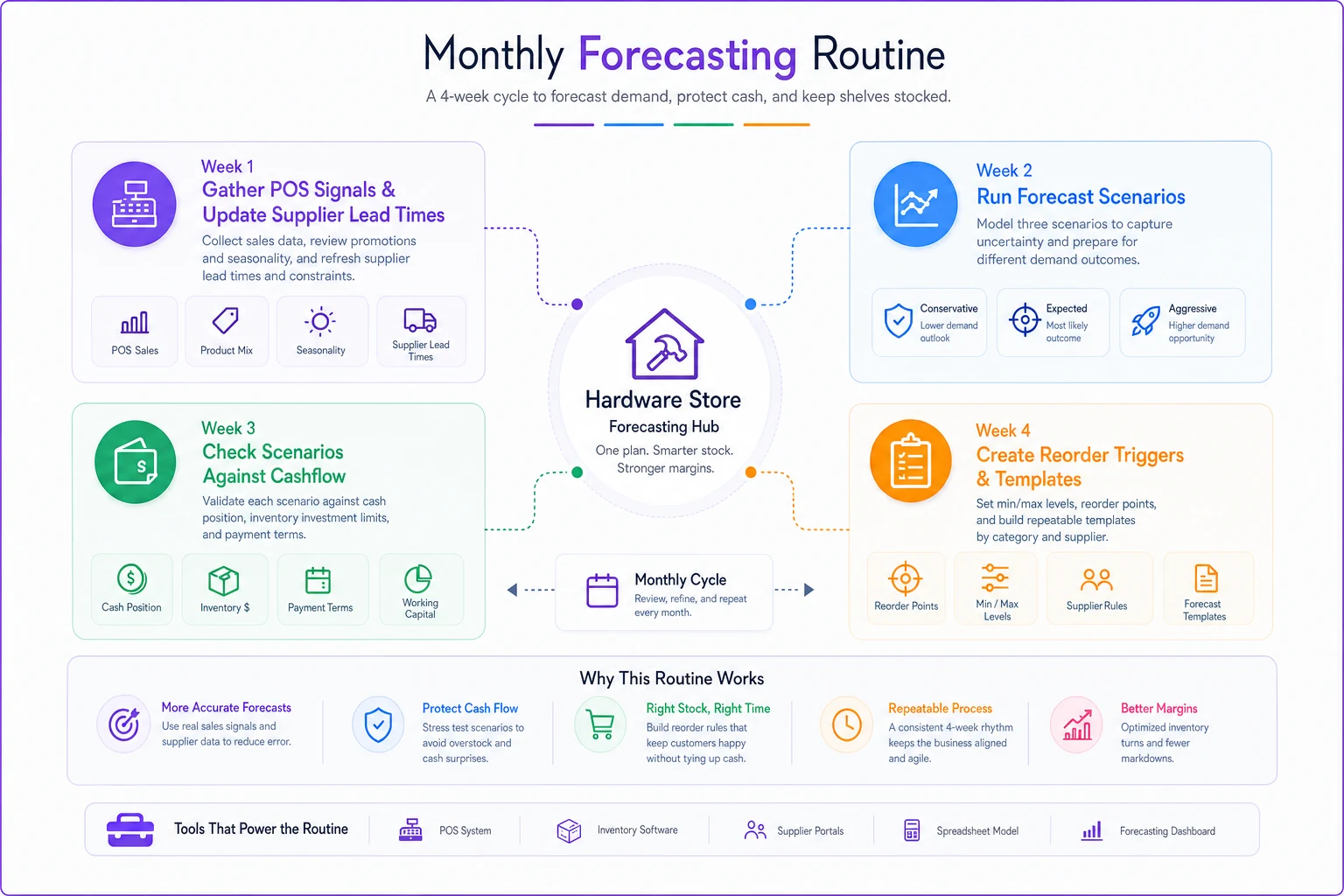
A quick visual of the monthly routine.
The POS signals everyone ignores until it's too late
Your POS throws off early warning signals about seasonal shifts constantly. Most stores only look at what sold yesterday. The valuable signals are in category transitions and velocity changes.
Watch for category bleeding - when customers start buying across traditional seasonal boundaries. Paint sales picking up in February instead of March. Customers buying fertilizer and ice melt in the same transaction. These transitional purchases happen 2-3 weeks before the full seasonal shift.
Velocity changes matter more than volume early in the season. If you typically sell 3 chainsaws per week in August but suddenly sell 3 in two days, fall prep is starting early. The absolute number is small, but the velocity change predicts the coming surge.
Track attachment rates for seasonal anchors too. When customers buy a lawn mower, what else goes in the cart? If mower buyers typically add oil, spark plugs, and trimmer line, you need 1.5x those supplies for every mower you stock.
Track attachment rates for seasonal anchors too.
Miss this and you'll have mowers to sell but nothing to maintain them with.
Supplier lead-time buckets that match reality, not wishes
Building realistic lead-time buckets means accepting that suppliers quote optimistically. That "4-6 week" lead time becomes 8 weeks when their factory has equipment problems or port congestion hits.
Fast-turn domestic (2-4 weeks actual): Basic hardware, common fasteners, standard lumber, most paint. Local distribution and predictable fulfillment.
Standard domestic (4-8 weeks actual): Power tools, seasonal chemicals, brand-name goods. Usually reliable but subject to demand surges that stretch lead times.
Import standard (8-14 weeks actual): Outdoor furniture, many fastener types, import tools. Port delays, customs holds, and container availability all affect timing.
Import seasonal (12-20 weeks actual): Holiday decorations, seasonal furniture, specialized seasonal tools. These require ordering in the opposite season - Christmas lights in July, patio sets in December.
One store mapped their actual lead times versus quoted times over 18 months. The results changed their entire ordering calendar: Quoted 2-3 weeks → Actual 3-5 weeks (87% of orders) Quoted 4-6 weeks → Actual 5-9 weeks (72% of orders) Quoted 8-10 weeks → Actual 10-16 weeks (68% of orders)
They now use actual historical delivery performance for seasonal planning instead of supplier quotes. That single change eliminated most of their spring stockouts.
Promotional calendar integration without the usual chaos
Most hardware stores treat promotions as separate from inventory planning. Marketing picks dates, buying orders inventory, and somehow they're supposed to align. Then you wonder why you're out of stock two days into your biggest sale.
Lock promotional dates into your forecasting routine. Not just your promotions - your competitors' too. If the local True Value runs their spring sale the second weekend of March every year, it affects your traffic whether you match it or not.
Build promotional scenarios into your forecasting. A typical spring promotion might drive 3x normal weekly sales for featured items, but it also suppresses sales the week before (customers waiting) and the week after (customers already bought). Your reorder triggers need to account for this wave pattern, not just the spike.
Connect promotional inventory to your cashflow scenarios directly. If the spring promotion requires $25,000 in extra inventory investment but your conservative cashflow scenario only supports $15,000, you need to either scale back the promotion, negotiate longer payment terms, or find additional financing. Making this connection in February prevents the April cash crunch.
When forecast scenarios become reorder templates
The real payoff comes when your scenarios stop being spreadsheets and become actual reorder templates. Each month's forecasting routine should produce ready-to-go purchase orders for different scenarios, not just numbers in a report.
A solid reorder template includes:
-
SKU list with primary and alternate suppliers
-
Quantities for conservative, expected, and aggressive scenarios
-
Lead time buffers built into reorder points
-
Cashflow impact clearly shown
-
Promotional tie-ins flagged
When April garden supply season approaches, you don't rebuild from scratch. You pull the April garden template, check which scenario matches current conditions, adjust for specific factors, and submit orders. What used to take days of analysis becomes a two-hour monthly task.
The monthly routine that actually sticks
Forecasting routines that take more than one day per month won't happen consistently. The stores with good forecasting discipline keep it simple and systematic.
First Monday: Pull reports, update lead times, review promotional calendar (2 hours)
First Tuesday: Run scenarios, build reorder templates (3 hours)
Second Monday: Review scenarios against actual sales, adjust if needed (1 hour)
Third Monday: Check cashflow projections, approve reorder templates (2 hours)
Eight hours per month to avoid seasonal cashflow crunches and stockouts. The stores that try to build elaborate weekly forecasting models burn out after two months. The ones that stick to this monthly rhythm maintain it year after year.
Common scenario planning failures
Even with good intentions, certain patterns kill seasonal forecasting effectiveness:
The "last year plus 10%" trap: Blindly bumping last year's numbers ignores fundamental changes. New competition, construction patterns, weather shifts, and economic conditions all break historical patterns.
Single-scenario tunnel vision: Running only one forecast, usually the "expected" scenario, leaves no flexibility when conditions change. You need boundaries to make good decisions under uncertainty.
Ignoring cash conversion cycles: That fertilizer order might project great margins, but if it ties up cash for 12 weeks while rent is due in 4, the math doesn't work regardless of the gross profit number.
Category isolation: Forecasting each category independently misses the connections. When grill sales spike, so do propane, charcoal, grill tools, and outdoor furniture. Miss these relationships and you'll have grills to sell but no accessories to profit from.
Making it work with your actual team
Small hardware stores don't have dedicated forecasting analysts. The owner handles buying, the manager runs operations, maybe there's one office person managing the books. Seasonal forecasting has to work within this reality.
The monthly routine above can be split between people. The manager pulls POS reports and tracks velocity changes. The office person updates lead times and checks cashflow projections. The owner makes scenario decisions and approves orders. Total time stays the same, but no one person carries the whole burden.
Document the process simply - not a 50-page manual, but a one-page checklist for each person's tasks. When someone's sick or quits, the routine continues. This connects to the operational challenges covered in our post about par-level formulas, where documentation prevents knowledge loss.
Software that connects the dots automatically
Everything described above can work with spreadsheets and basic POS reports. But the stores that really nail seasonal forecasting use operational software that connects these pieces without the manual data gathering.
AI-powered platforms can pull POS signals, track lead time patterns, and build cashflow-aware scenarios in the background. They catch velocity changes faster than weekly reviews. They adjust reorder triggers automatically when lead times shift.
More importantly, they maintain templates and scenarios even when you're deep in daily operations. Instead of running scenarios manually, the software flags when triggers hit or when cashflow projections conflict with inventory needs - so you can focus on the actual decisions rather than the data assembly.
This isn't about replacing judgment with algorithms. Should you go aggressive on grills given the new housing development nearby? Should you scale back snow equipment given last year's mild winter? Those calls require local knowledge that no software has. The software handles the data work so the decision-making can actually be strategic.
Beyond the monthly routine
Once the basic routine runs smoothly - usually after 3-4 months of consistency - you can add sophistication without adding complexity.
Start tracking forecast accuracy, not to punish bad predictions but to improve future scenarios. If your conservative scenario consistently undershoots by 20%, adjust the formula. If certain categories always outperform during promotional periods, build that into the template.
Layer in seasonal deadstock strategies into your scenarios. When planning fall inventory, simultaneously plan the exit strategy for unsold items. Build markdowns into your cashflow projections from the start rather than treating them as an emergency measure in January.
Connect your forecasting to vendor negotiations over time. When you can show suppliers consistent ordering patterns and accurate forecasts, you gain leverage for better terms, priority allocation during shortages, and occasionally consignment arrangements for seasonal goods.
The bottom line on seasonal forecasting routines
Every hardware store owner knows the pain of seasonal mismatches - too much inventory when cash is tight, empty shelves when demand spikes, promotional disasters when inventory arrives late. These feel like separate crises but they share a root cause: disconnected planning.
The monthly routine here isn't revolutionary. It's just systematic. It forces POS data, supplier lead times, and promotional calendars to actually inform each other instead of existing in separate spreadsheets. It turns wishful forecasts into cashflow-aware scenarios and makes reordering a strategic decision rather than a reactive scramble.
The stores handling seasonal transitions well aren't necessarily better at predicting the future. They're better at building systems that handle multiple possible futures. When spring arrives three weeks early or winter drags into April, they have scenarios ready. When suppliers extend lead times or competitors launch surprise promotions, the framework adapts instead of breaking.
That's what a proper seasonal forecasting routine actually buys you - not perfect predictions, but systematic preparation that keeps your cashflow healthy and your shelves stocked through every seasonal transition.
Every hardware store owner knows the pain of seasonal mismatches - too much inventory when cash is tight, empty shelves when demand spikes, promotional disasters when inventory arrives late. These feel like separate crises but they share a root cause: disconnected planning.
That's what a proper seasonal forecasting routine actually buys you - not perfect predictions, but systematic preparation that keeps your cashflow healthy and your shelves stocked through every seasonal transition.
Ready to elevate your hardware store management?
Join 500+ hardware stores using Hardzly to boost operational efficiency, reduce stockouts, and grow revenue.