



Contractor accounts represent a significant chunk of revenue for successful independent hardware stores — often well over half — yet most single-location stores treat their contractor programs like an afterthought. They either run no program at all and keep losing regulars to big-box competitors, or they build such a complicated approval process that contractors give up halfway through the paperwork.
The sweet spot sits somewhere in between: a structured program that's simple enough for a three-person team to actually manage, but solid enough to protect your cashflow. Plenty of hardware stores struggle with contractor receivables that balloon past $40k while others run clean 30-day collection cycles. The difference almost always comes down to the same things — clear tiers, straightforward credit checks, and a billing cadence built around how contractors actually operate.
Why single-location stores struggle with contractor programs
Most hardware store owners know they need contractor accounts. These guys buy regularly, purchase in bulk, and become loyal customers when you treat them right. But execution falls apart because owners try to replicate what larger chains do without the infrastructure to back it up.
A typical scenario: Tom runs a 4,800 square foot hardware store with two full-time employees. He decides to launch contractor accounts after losing his third regular customer to Home Depot's Pro Xtra program. He downloads a generic credit application, sets net-30 terms for everyone, and starts extending credit. Four months later he's carrying $28,000 in receivables, half of it past 60 days, and he's spending his mornings calling contractors who won't pick up.
The fundamental problem isn't the concept — it's trying to run a credit program without the right framework. Large chains have credit departments, collections teams, and automated systems. Your single-location store has you, maybe a bookkeeper who comes in twice a week, and whoever's working the register.
The contractor account playbook that actually works for small hardware stores strips away the complexity while keeping the essential protections. It accepts that you're not a bank, you don't have time for deep credit analysis, and most of your contractors are small operations themselves who need reasonable flexibility.
Building your tiered account structure
The most common mistake is offering the same terms to every contractor. The guy spending $800 a month shouldn't have the same credit limit as someone dropping $4,500. But creating 15 different account levels just creates confusion.
Stop losing sales due to inventory gaps.
Hardzly helps you manage stock levels, orders, and supplier interactions efficiently.
- Unified inventory and sales tracking
- Supplier and purchase order management
- Automated workflow and task scheduling
No credit card required
A three-tier system works well for stores under $3M in annual revenue:
Bronze Tier (Starter Accounts)
-
Credit limit
$1,500
-
Terms
Net-15
-
Requirements
Business license, basic application
-
Monthly purchase minimum
None
-
Typical user
Handymen, small residential contractors
Silver Tier (Regular Accounts)
-
Credit limit
$5,000
-
Terms
Net-30
-
Requirements
Two trade references, business insurance verification
-
Monthly purchase minimum
$500 averaged over 3 months
-
Typical user
Established contractors with 3–10 employees
Gold Tier (Premium Accounts)
-
Credit limit
$10,000+
-
Terms
Net-30 with 2% early payment discount
-
Requirements
Bank reference, D&B check, or 6-month purchase history
-
Monthly purchase minimum
$2,000 averaged over 3 months
-
Typical user
Commercial contractors, property management companies
The beauty of this structure is progression. Everyone starts at Bronze unless they can show strong established credit. After three months of on-time payments and consistent purchasing, they can move to Silver. Gold is invitation-only based on payment history and volume.
You're not trying to be their primary lender — you're extending reasonable credit that matches their buying patterns while protecting your cashflow. The tiers also create a natural incentive for contractors to consolidate more purchases with you to reach higher levels.
Simple credit checks that actually protect you
Forget the 10-page credit applications. For a single-location store, your credit check process should take under 15 minutes per applicant and focus on the signals that actually matter.
Your Bronze tier application needs five things:
-
Business name and structure (LLC, Corp, Sole Prop)
-
Owner name and personal guarantee
-
Business address (not a PO Box)
-
A phone number you can actually reach them at
-
Copy of business license or tax ID
That's it. You're extending $1,500 in credit, not financing a house. The personal guarantee is your real protection — most small contractors will pay to protect their personal credit even when the business is struggling.
For Silver tier, add two trade references. Call them. The conversation takes three minutes: "Does [contractor name] have an account with you? Are they generally current on payments? Would you extend them $5,000 in credit?" If both say yes, you're probably fine.
Gold tier requires either a bank reference letter or six months of clean payment history with you. A bank reference tells you they maintain decent balances. Your own payment history tells you more than any credit report could.
Skip the expensive bureau pulls for accounts under $5,000. The $30–75 per report isn't worth it at smaller credit lines, and most small contractors won't have meaningful commercial credit files anyway. Save formal credit checks for accounts requesting limits above $10,000 or anyone who's repeatedly late.
Invoice schedules that match contractor cashflow
Contractors don't get paid like regular businesses. They work on project cycles, deal with retention holdbacks, and often wait 45–60 days to collect from general contractors. Your invoice schedule needs to acknowledge that reality while still protecting your business.
Instead of sending invoices randomly or waiting until month-end, set up a consistent twice-monthly billing cycle:
1st of the month billing:
-
Captures all purchases from the 16th–31st of the previous month
-
Due date
15th (Net-15) or 30th (Net-30)
-
Includes itemized transaction list
15th of the month billing:
-
Captures all purchases from the 1st–15th
-
Due date
30th (Net-15) or 14th of the following month (Net-30)
-
Includes running account balance
This gives contractors predictability. They know exactly when invoices arrive and can plan payments around their own collection cycles. It also prevents the "surprise" $8,000 invoice at month-end that catches people off-guard and pushes your payment out another 30 days.
For your operations, twice-monthly billing is completely manageable even with minimal staff. Block two hours on the 1st and 15th to run all contractor invoices. With 30 accounts, that's roughly 4 minutes per account.
Collection cadence without burning relationships
Collections will make or break your contractor program. Too aggressive and you lose good customers. Too passive and receivables spiral fast. The key is a consistent escalation process that makes sense.
A collection cadence that maintains relationships while protecting cashflow:
Day 1 (Due Date): Automatic email reminder Simple message: "Invoice #XXX for $X,XXX is due today. Pay online at [link] or stop by the store."
Day 5: Friendly phone call "Hey Jim, just checking if you received the invoice from the 1st. Any issues with the charges?"
Day 10: Second email with account status "Your account is past due. Please pay within 48 hours to maintain charging privileges."
Day 15: Account suspension warning Phone call: "Your account will be suspended tomorrow if we don't receive payment. Can we work something out?"
Day 16: Account suspended No more charges until paid current. No exceptions.
Day 30: Final notice letter Sent certified mail, copying any personal guarantor.
Day 45: Small claims or collections For amounts over $1,000, file in small claims. Under $1,000, write off or send to a collections agency.
The critical piece is consistency. Every contractor gets the same treatment, every time. No special deals for the "good guys" who are just having a tough month — that's exactly how you end up carrying $40,000 in receivables.
Most contractors will pay by day 10 if you stay consistent. They learn your pattern and adjust accordingly. The ones who don't respond to this cadence were never going to be good accounts anyway.
Account benefits that actually matter to contractors
Contractors don't care about loyalty points or branded coffee mugs. They care about things that save them time and money on the job. Your tiered benefits should reflect what actually matters to working contractors.
Bronze benefits are purely functional:
-
Charge account (no more tracking receipts)
-
Monthly statements for bookkeeping
-
Phone orders for will-call pickup
-
Access to contractor pricing on volume items
Silver adds convenience:
-
Priority will-call (orders ready in 2 hours)
-
Direct delivery for orders over $500
-
Special order capability without prepayment
-
Quarterly volume rebates (2% on purchases over $5,000)
Gold provides real business value:
-
Same-day delivery on in-stock items
-
Net-45 terms available for large projects
-
Direct vendor special orders
-
Dedicated account rep (usually the owner)
-
5% volume rebate on annual purchases over $50,000
Notice what's missing: complicated point systems, rewards catalogs, and marketing fluff. Every benefit directly impacts their operation. Priority will-call saves hourly labor costs. Direct delivery keeps crews on-site. Volume rebates improve their margins.
The delivery benefit for Silver and Gold accounts seems expensive but typically isn't. Most contractors buying at that level are already sending someone to pick up orders. You're often just redirecting that trip into a delivery run you're making anyway. For true same-day delivery to Gold accounts, partner with a local courier or use your own truck during slow afternoon periods.
Managing the daily workflow
The best playbook falls apart without clean daily execution. Your team needs clear responsibilities and simple tools to manage accounts without constant owner oversight.
Here's what a functional daily routine actually looks like:
Morning routine (15 minutes):
-
Check overnight phone and email orders from contractors
-
Review any past-due accounts hitting suspension today
-
Print will-call orders for preparation
Transaction flow at the register:
-
Contractor provides account number or phone number
-
System shows current balance and available credit
-
If approved, process the charge
-
If declined, offer
pay down the balance, pay cash, or speak to a manager
-
Print receipt showing new balance
End-of-day routine (10 minutes):
-
Review all contractor charges for proper coding
-
Flag any accounts approaching their credit limits
-
Note any special orders or delivery requests
This workflow handles the vast majority of contractor account situations without manager involvement. The remaining cases — credit line increases, payment plans, disputes — escalate to the owner for case-by-case handling.
Your daily operations are already complex enough without contractor accounts adding chaos. Building account management tasks into existing routines keeps the program from becoming its own full-time job.
Batch will-call prints and past-due checks to the same two daily timeblocks to minimize context switching.
A quick visual of the daily workflow helps teams follow the routine consistently.
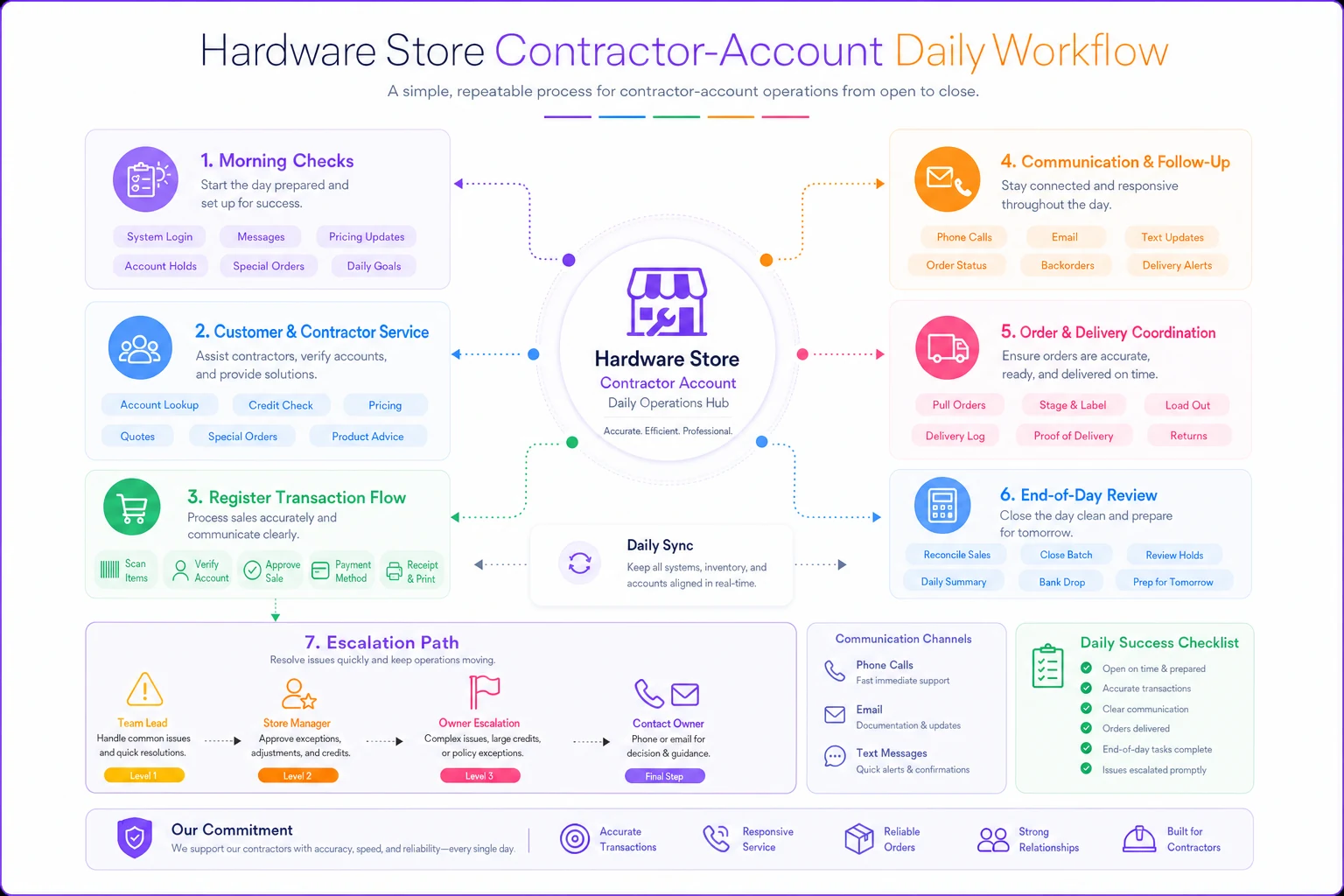
The visual should be easy to print and post behind the register for quick staff reference.
When to say no (and how)
Not every contractor deserves an account, and not every existing account deserves to stay open. Knowing when to cut someone off is probably the hardest part of running this kind of program.
Automatic disqualifiers for new accounts:
-
No verifiable business entity
-
Disconnected phone numbers on the application
-
Previous bankruptcy involving hardware or construction debts
-
Bad references from other suppliers
Warning signs for existing accounts:
-
Suddenly doubled monthly purchases (often signals cash flow problems)
-
Frequent disputed charges
-
Only pays when threatened with suspension
-
Employees charging personal items
When you need to reject or terminate an account, be direct but keep it simple: "Based on our credit criteria, we can't extend terms right now. We'd love to serve you on a cash basis and revisit it in six months." Don't over-explain or cite specific reasons that open the door to arguments.
For existing accounts going sideways, the conversation is similar: "We need to move your account to cash-only while you get caught up. Once the balance is cleared and you've maintained cash purchases for 90 days, we can talk about reinstating terms."
Some owners worry about losing revenue from cutting off accounts. But a contractor who owes you $3,000 at 60 days past due isn't revenue — it's an accidental loan. Better to lose the sale than lose the cash.
Tracking success and adjusting the program
Your contractor program needs regular tuning based on actual results. Track these metrics monthly:
| Metric | Bronze Target | Silver Target | Gold Target |
|---|---|---|---|
| Average days to payment | ≤15 days | ≤30 days | ≤28 days |
| Receivables over 30 days | Under 10% | Under 8% | Under 5% |
| Write-offs as % of sales | Under 1% | Under 0.75% | Under 0.5% |
| Monthly purchase minimum | None | $500 | $2,000 |
If Bronze accounts are averaging 22 days to payment, your Net-15 terms aren't working — either extend to Net-30 or tighten credit limits. If Gold accounts are consistently paying in 8 days to capture the early payment discount, consider bumping the discount to 3% to accelerate cashflow further.
Watch for tier progression too. If nobody's moving from Bronze to Silver after six months, your requirements might be too strict or the benefits aren't compelling enough. If everyone's hitting Gold, you're probably too lenient and exposing yourself to unnecessary risk.
A well-run program should generate 60–70% of revenue with receivables under 2% of annual sales and write-offs below 0.5%. Those aren't hard targets, just useful benchmarks to check yourself against.
Operational software and the contractor account edge
Running a contractor account program with paper applications, Excel invoicing, and manual collections is doable but genuinely painful. It tends to consume 10–15 hours weekly for a store with 30 or more contractor accounts — time better spent on vendor negotiations, customer relationships, or anything more valuable than chasing payments.
This is where operational software designed for small hardware stores changes the picture. Modern platforms integrate credit management, automated invoicing, and collection workflows directly into your existing point-of-sale and accounting flow.
The automation handles the repetitive work: checking credit availability at point-of-sale, generating twice-monthly invoices, sending payment reminders, escalating past-due accounts. Your team focuses on relationships and exceptions while the system manages the routine stuff.
Beyond efficiency, AI-powered platforms can surface problems before they get out of hand. When a usually-reliable contractor suddenly doubles their purchasing, the system flags it for review. When multiple contractors from the same general contractor go quiet on payments at the same time, you get an alert worth paying attention to.
The real value isn't just time savings — it's consistency. Every contractor gets the same professional treatment. No forgotten invoices, no missed collection calls, no informal deals that quietly undermine your program.
Making it work in your store
A solid contractor account program for a single-location hardware store doesn't require complex systems or a big team. It requires clear tiers, simple credit checks, consistent billing, and firm collections. The framework can flex for your market — construction-heavy areas might need higher credit limits, while residential-focused stores might lean more toward handyman-friendly Bronze accounts.
Start small if you're launching from scratch. Open five Bronze accounts with contractors you already know. Run them through the full cycle: application, approval, purchasing, invoicing, collection. Work out the operational kinks before you scale to 30 or 50 accounts.
If you have an existing program, audit your current accounts against this framework before adding new ones. How many are sitting at 60+ days past due? How many have exceeded their credit limits? How many haven't purchased in three months but still have open credit? Clean up the existing mess first.
The point isn't to compete with big-box stores on selection or price. It's about being the reliable partner who makes contractors' businesses run smoother. When a contractor knows they can call in an order at 7 AM, pick it up at 7:30, and get a clean invoice on the 1st and 15th, you become part of their operation.
That kind of relationship — built on a solid operational foundation — is worth more than any loyalty program or discount structure. Your contractor customers are betting their business on your reliability. With the right structure, clear processes, and appropriate tools, you can run a program that drives revenue while keeping cashflow healthy. The contractors get a reliable supplier who understands how they work. You get loyal customers driving predictable revenue. And everyone avoids the receivables chaos that sinks small hardware stores every year.
Ready to elevate your hardware store management?
Join 500+ hardware stores using Hardzly to boost operational efficiency, reduce stockouts, and grow revenue.