

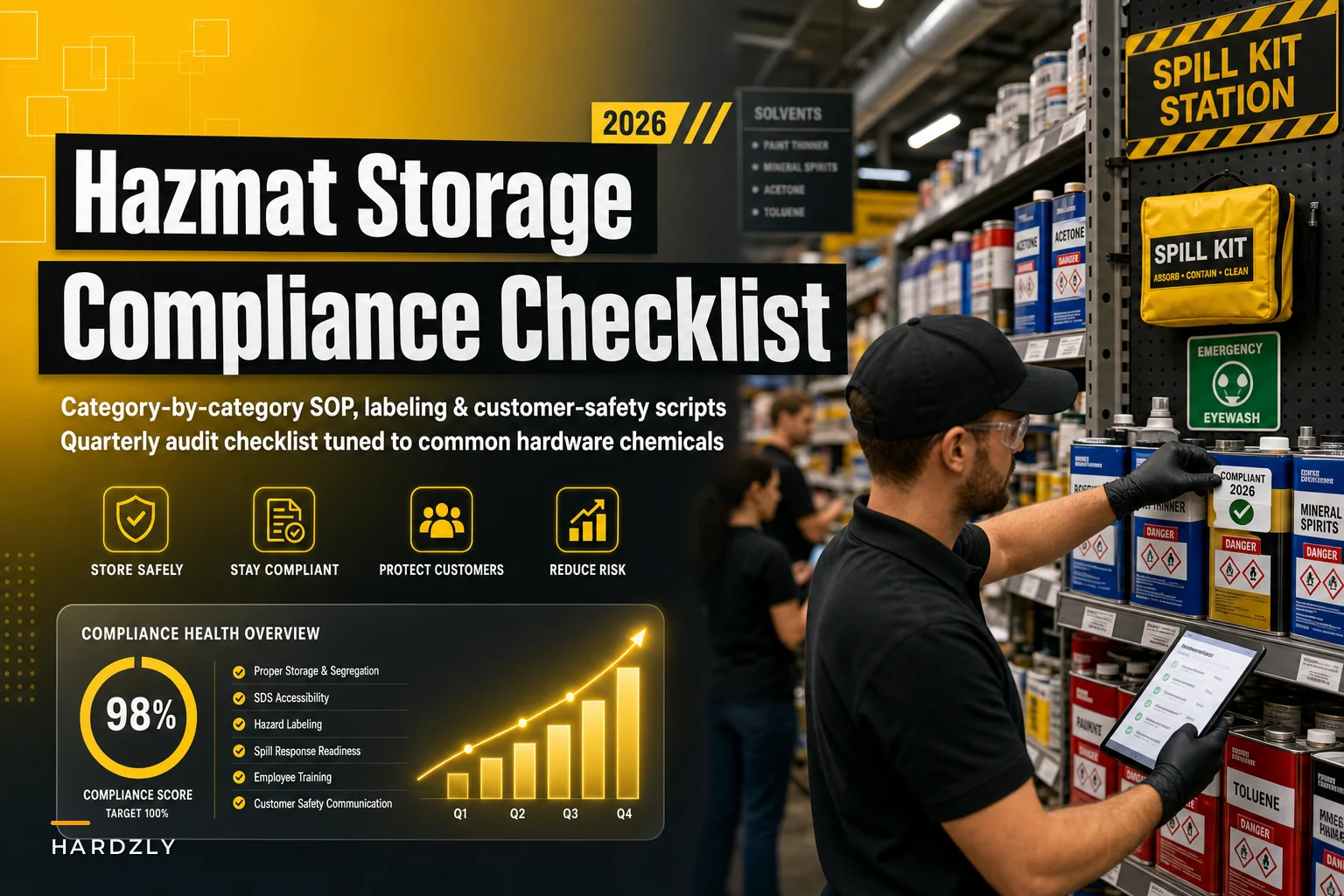

Running a hardware store means juggling about sixteen different things at once. Between customers asking for the right drill bit and managing inventory that spans from plumbing fixtures to pesticides, chemical storage compliance tends to slip through the cracks until something goes wrong.
Most small hardware stores carry somewhere between 200 and 400 different chemical products. Paint thinners in aisle three, pool chemicals near the garden center, automotive fluids by the front register because that's where customers expect them. The setup usually works fine until an inspector shows up — or worse, two incompatible chemicals stored next to each other start reacting.
The problem isn't that store owners don't care about safety. It's that hazmat storage checklist hardware store requirements feel like they were written for massive warehouse operations with dedicated compliance teams. Meanwhile, you're trying to figure out if that half-empty container of muriatic acid can legally sit next to the chlorine tablets while also helping three customers find the right fence post anchors.
Category segregation that actually works in tight spaces
Hardware stores rarely have the luxury of separate storage rooms for each chemical category. You're working with maybe 2,800 to 4,500 square feet total, and most of that needs to be customer-accessible selling space. The key is understanding which chemicals absolutely cannot be stored together versus which ones just shouldn't be neighbors if you can avoid it.
Start with your oxidizers — things like pool shock, hydrogen peroxide cleaners, and certain fertilizers. These need their own zone, even if it's just a dedicated shelf unit with proper spacing. A store in Ohio learned this the hard way when pool chemicals stored above automotive fluids caused a reaction that evacuated the block. The fire marshal's report showed temperatures hit around 180°F from the chemical reaction alone — no actual fire needed.
Flammables get complicated because you're probably selling everything from acetone to camping fuel. Federal regulations kick in at specific quantities — 120 gallons for a Category 3 flammable liquid storage area, for instance. Most stores stay well under those thresholds by keeping only display quantities on the floor with backup stock in proper cabinets.
A practical segregation approach for a typical small store:
-
Zone 1 — Oxidizers (usually back corner) - Pool chemicals (chlorine, shock treatments) - Hydrogen peroxide products - Certain fertilizers with nitrates
-
Zone 2 — Flammables (near loading dock for ventilation) - Paint thinners and solvents - Automotive fluids - Fuel additives
-
Zone 3 — Corrosives (middle storage, away from metals) - Muriatic acid - Rust removers - Drain cleaners
-
Zone 4 — General chemicals (flexible placement) - Pesticides and herbicides - Non-corrosive cleaners - Lubricants
The zones don't need walls between them. Even just different shelving units with 10-foot separation handles most compatibility issues. Label each zone clearly — not for customers, but so your Tuesday night crew knows exactly where returns go without accidentally creating a chemistry experiment.
Labeling that survives real-world hardware store chaos
GHS labels and safety data sheets are legally required, yes. But the labeling system that actually prevents accidents is the one your part-time weekend staff understands and follows. The official diamond-shaped hazard labels matter for compliance, but they don't stop someone from putting brake fluid next to the pool chlorinator because "there was space on the shelf."
Stop losing sales due to inventory gaps.
Hardzly helps you manage stock levels, orders, and supplier interactions efficiently.
- Unified inventory and sales tracking
- Supplier and purchase order management
- Automated workflow and task scheduling
No credit card required
A dual-labeling approach works better. Keep the required GHS labels visible, but add a store-specific system in plain English. Color-coded shelf tags outperform expecting everyone to memorize hazard symbols. Red tags for "absolutely no other chemicals here," yellow for "check the chart before adding products," green for "generally safe to mix storage."
A Connecticut hardware store put magnetic hazard boards at the end of each chemical aisle. Takes about two minutes to update when products move, and inspectors appreciate seeing proactive measures beyond the minimum. Their system:
-
Red magnets
No mixing zone — one chemical type only
-
Yellow magnets
Compatible families only (all acids together, all bases together)
-
Blue magnets
Requires ventilation — keep container caps tight
-
Green magnets
General storage okay
The real test is during receiving. New shipments arrive Tuesday and Friday mornings when you're already stretched thin. Pre-labeled shelf spaces mean the receiving crew doesn't need a chemistry degree to know where things go — they match the incoming product's hazard class to the shelf label color.
Customer interaction scripts that prevent DIY disasters
Customers mixing incompatible chemicals at home causes more ER visits than any storage issue at your store. But lecturing someone about chemical safety while they're trying to buy drain cleaner doesn't work — they tune out, get annoyed, or just go to the big box store where nobody asks questions.
Build safety checks into normal conversation instead. When someone buys muriatic acid, skip the generic warning. Ask: "You working on a pool project or concrete cleaning?" Their answer tells you whether they know what they're doing. Pool project — probably fine. First-time concrete cleaning — worth a 30-second explanation.
For combination purchases that raise flags, keep it casual: "Just so you know, if you're using both of these today, run the drain cleaner first and flush thoroughly before using the bleach. Mixing them creates chlorine gas." Most customers appreciate it. The ones who push back were going to do something dangerous regardless.
-
Ammonia cleaner + bleach purchase
"These work great for different jobs — just use them in separate rooms or on different days. The fumes don't mix well."
-
Multiple pool chemicals
"Which one are you adding first? Shock should go in at night, algaecide in the morning. Never mix them dry."
-
Paint stripper + other solvents
"That stripper's strong on its own. If you need to clean up after, wait for it to dry completely first."
-
Rust remover + drain cleaner
"Both of these are acids, so definitely don't mix them. Pick whichever matches your main problem."
The goal is making safety sound like professional advice, not a liability disclaimer. Customers trust expertise.
The quarterly audit routine that catches problems before inspections do
Fire marshals and OSHA inspectors don't schedule convenient visits. They show up when you're already dealing with a flooded basement display and two call-outs. Stores that pass inspections consistently are the ones running their own audits quarterly — not comprehensive reviews, but targeted checks that catch the common violations.
A realistic quarterly audit for a small hardware store takes about 90 minutes. Schedule it for the third Tuesday of March, June, September, and December. Tuesdays tend to be slower, and staying consistent means it actually happens.
Here's a reasonable sequence for getting through the audit without losing half your day:
-
Walk the entire chemical floor and flag anything that looks visually off — leaks, missing labels, products in the wrong zone
-
Check container integrity across all chemical categories
-
Verify segregation zones haven't drifted since last quarter
-
Test ventilation systems and confirm airflow direction
-
Inspect emergency equipment — eyewash stations, spill kits, signage clearance
-
Pull documentation and confirm SDS sheets are current for your top hazard products
-
Photograph everything with your phone and log the date
Start with container integrity. Chemical containers degrade, especially where temperature swings between summer and winter storage hit 40-degree differences. Look for:
-
Rust rings on metal containers
-
Bulging plastic bottles (pressure buildup)
-
Crystallization around caps (slow leaks)
-
Faded labels you can't read anymore
-
Any container older than two years
Then check your segregation zones. Products migrate during busy seasons. The pool chemical display you set up in May is probably mixed in with garden chemicals by September. Your audit checklist should cover:
-
Physical spacing checks - Oxidizers still separated from flammables? - Acids and bases on different shelves? - Leaking container containment still intact?
-
Ventilation verification - Fan systems actually running? - Vent covers clear of dust and debris? - Air flow direction still away from customer areas?
-
Signage and labels - Zone markers still visible? - Emergency shower/eyewash signs unobstructed? - Spill kit location markers in place?
create an image depicting a step-by-step quarterly audit workflow for a small hardware store: a person walking the chemical aisle inspecting containers, checking labels, photographing issues, testing ventilation, inspecting eyewash and spill kit locations, and logging findings on a mobile device. Use a clear, sequential layout with arrows connecting each step and include icons for inspection, camera, ventilation, eyewash, and documentation.
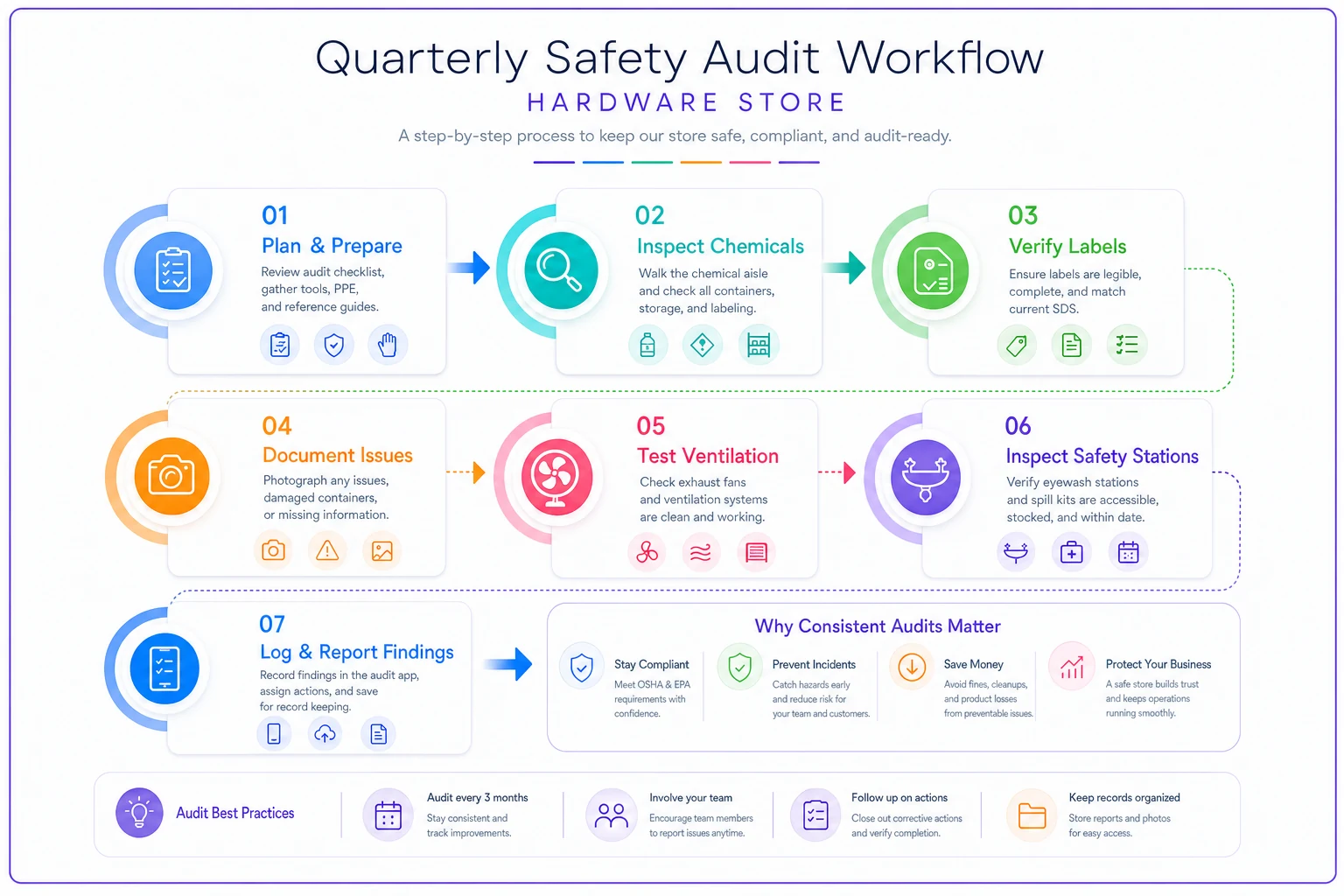
Document everything with photos on your phone — not for corporate, but for yourself. When an inspector asks about your last safety review, showing dated photos of quarterly walkthroughs beats trying to remember what you checked six months ago.
Building documentation that satisfies inspectors without overwhelming operations
Regulatory agencies love paperwork. Your store needs safety data sheets for every chemical product, but a physical binder with 400+ SDS sheets that nobody reads doesn't prevent accidents. It just takes up space and goes out of date.
A more practical approach combines digital accessibility with targeted physical copies. Keep paper SDS sheets only for your top 20 highest-hazard chemicals — the ones where seconds matter if there's exposure. Everything else goes in a tablet or computer at the customer service desk. Modern SDS management tools let you scan a barcode and pull up the sheet in seconds, faster than flipping through a binder.
More importantly, create a single-page quick reference for each chemical category. These aren't official documents — they're operational tools. A laminated sheet for "Pool Chemical Emergencies" posted in that aisle is far more useful than expecting someone to find the right SDS during an actual emergency.
Your documentation system needs:
-
Digital components - SDS database (searchable by product name or UPC) - Inspection history with photos - Training records for each employee - Incident reports (even near-misses)
-
Physical components - Emergency response sheets by category - Spill cleanup procedures (laminated) - Emergency contact numbers (fire, poison control, hazmat cleanup) - Current inventory list of regulated chemicals
The split between digital and physical isn't just about convenience — it's about what works under pressure. Nobody's searching a tablet while their eyes are burning from a chemical splash. Physical laminated sheets in the right spots handle emergencies. The digital system handles everything else.
Common inspection failures and how to prevent them
The failures are surprisingly consistent. It's rarely about major safety hazards — inspectors cite technical violations that are easy to prevent if you know what they're looking for.
| Violation | Why It Happens | Fix |
|---|---|---|
| Improper secondary containment | Containers stored directly on shelves | $30 spill containment pallets under liquid chemicals |
| Missing or expired eyewash stations | Nobody tracks the two-year expiry, inventory blocks access | Monthly checks, clear path markings, calendar reminders |
| Incompatible storage | New products added wherever there's space over time | Quarterly zone audits, labeled shelving systems |
| Outdated SDS sheets | Products change formulas, nobody updates the binder | Digital SDS management with barcode scanning |
| Unlabeled secondary containers | Decanted chemicals in unmarked bottles | Store policy: nothing goes in an unlabeled container |
The number one citation is improper secondary containment. Regulations require liquid chemicals to have containment capable of holding 110% of the largest container. Stores get cited because that 5-gallon bucket of muriatic acid sits directly on a shelf. A $30 spill containment pallet fixes it, but nobody thinks about it until the inspector points it out.
Second most common is missing or expired eyewash stations. The portable bottles expire after two years and nobody tracks the dates. Even worse, stores install them and then stack inventory in front of them. Inspectors check whether someone could reach the eyewash within 10 seconds of exposure — that means clear paths, obvious signage, and monthly checks that they actually work.
Third is incompatible storage that develops gradually. The layout made sense five years ago, but new products get added wherever there's space. That organic pest control product seems harmless until an inspector points out it's an oxidizer sitting next to paint thinner. Regular seasonal inventory reviews help catch these gradual shifts before they become violations.
Making compliance manageable with limited staff
Small hardware store staffing means hazmat compliance can't depend on a dedicated safety manager. It needs to work when you're down to two people on a Saturday, or when your most experienced employee calls in sick during inventory week.
Break compliance tasks into daily, weekly, and monthly chunks that take under 10 minutes each. Daily tasks are just visual checks — any leaks, strange smells, products in obviously wrong places? Weekly tasks cover spill kit supplies and eyewash station clearance. Monthly tasks go deeper: container dates, ventilation systems, zone integrity.
Assign each department lead their own categories to spread knowledge and remove single points of failure.
Stores that maintain solid compliance without burning out their teams use rotating responsibility. Instead of one person owning all chemical safety, assign each department lead their own categories. Paint department handles flammables, garden center manages pesticides and fertilizers, plumbing owns corrosives. This spreads knowledge and removes single points of failure.
Some stores have moved to simple mobile inspection apps where staff complete chemical storage checks from their phones. Takes about 3 minutes per zone, automatically date-stamps everything, and creates an audit trail inspectors genuinely appreciate. AI-powered operational platforms built around this kind of workflow turn what used to be a clipboard process into something that actually gets done consistently.
The unexpected benefit of distributed responsibility is that employees start catching problems before they become serious. When the paint department lead owns flammable chemical compliance, they notice that leaking acetone container during normal stocking runs — not during a formal inspection.
Turning compliance into competitive advantage
Good chemical management actually drives sales. Customers notice when chemicals are organized logically, labeled clearly, and stored safely. It makes your store feel professional compared to competitors with haphazard chemical aisles.
More practically, preventing one chemical incident pays for years of compliance effort. The average hazmat cleanup runs $3,000 to $8,000 for a small spill. Add potential fines, lost inventory, and closed store time, and you're looking at $15,000 to $20,000 total impact — before considering lawsuits if someone gets hurt.
Insurance companies increasingly offer discounts for documented safety programs. Show quarterly audits, training records, and a working SDS management system, and you might qualify for 10–15% off liability premiums. On typical hardware store policies, that's somewhere around $1,800 to $3,200 saved annually.
The deeper win comes from employee confidence. Staff who understand chemical safety sell more effectively. They answer customer questions better, recommend compatible products, and prevent dangerous combinations. That expertise becomes part of your store's reputation.
One Virginia hardware store started posting their inspection scores in the window: "Last safety inspection: PASSED — Zero violations." Customers mention it regularly, especially contractors who need to document where they buy chemicals for their own compliance requirements. That one sign has driven commercial accounts worth over $40,000 annually.
The sustainable compliance system
Building a hazmat storage checklist hardware store system that works long-term means accepting what you can realistically maintain. A perfect system that falls apart after three months helps nobody. Basic compliance that happens consistently beats elaborate procedures that get ignored.
Start with the non-negotiables: proper segregation, current SDS sheets, working emergency equipment. These form a baseline that never gets compromised regardless of how busy things get. Then layer on improvements as they become sustainable — better labeling one quarter, improved staff training the next. Each addition becomes part of standard operations before you add the next.
The most successful stores tie compliance tasks to existing routines. Chemical segregation checks happen during Tuesday morning restocking. SDS updates get pulled while processing chemical purchase orders. Emergency equipment gets tested when changing smoke detector batteries. Compliance happens automatically rather than requiring special effort.
Regulations exist because real accidents happened to real people. Every requirement traces back to an injury, evacuation, or environmental disaster someone wanted to prevent from happening again. When compliance feels overwhelming, focus on the actual safety outcome rather than the paperwork. A store where employees go home safe every day is succeeding at what actually matters.
A store where employees go home safe every day is succeeding at what actually matters.
Ready to elevate your hardware store management?
Join 500+ hardware stores using Hardzly to boost operational efficiency, reduce stockouts, and grow revenue.