

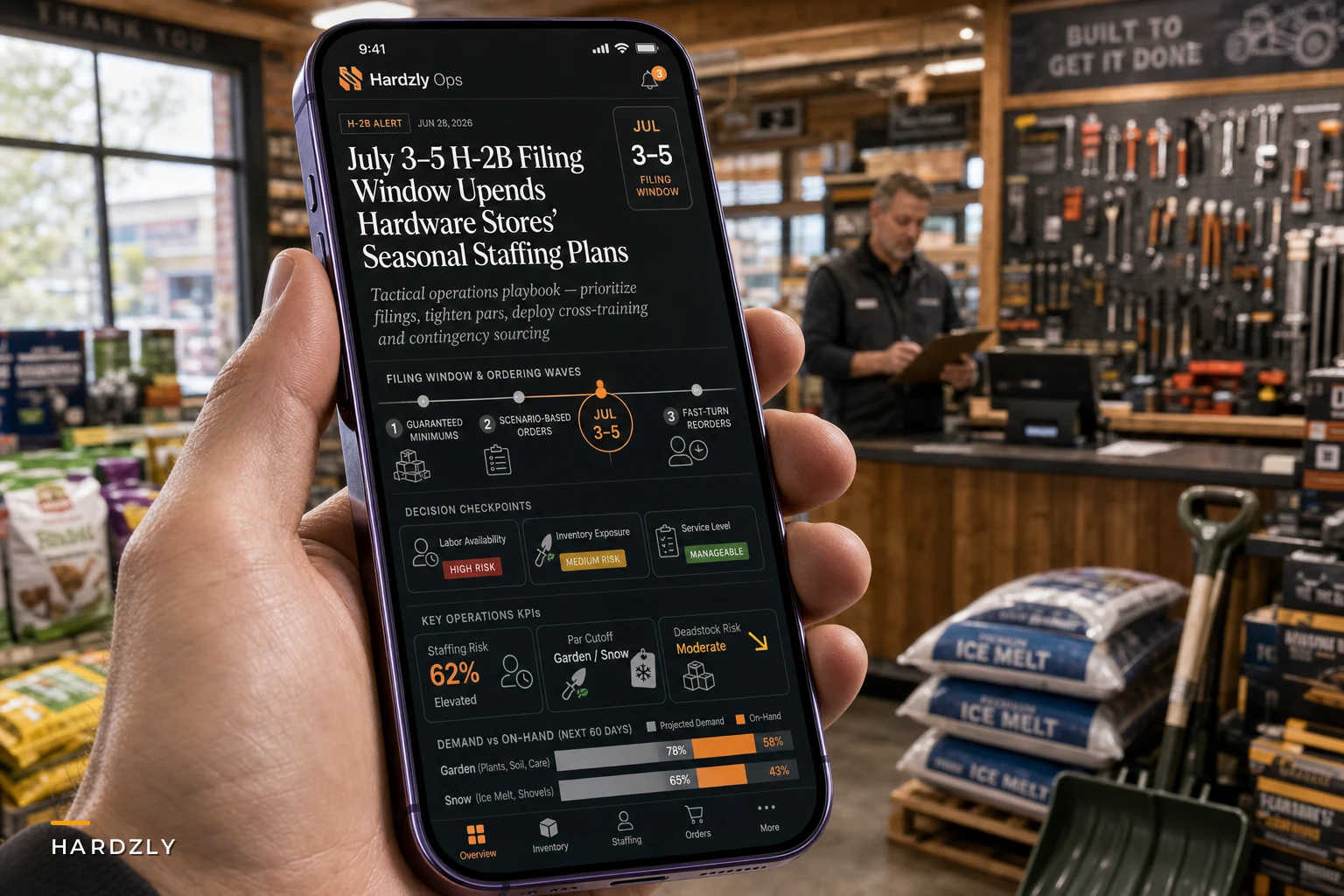

The Department of Labor just announced the H-2B filing window for October 1, 2026 work start dates opens July 3-5. Three days to submit applications that determine whether you'll have enough hands to handle snow blower assembly, salt distribution, and holiday merchandise during your busiest quarter.
Most hardware store owners treat this like an HR checkbox. File the paperwork, hope for approval, scramble if it doesn't work out. But the H-2B window actually triggers a chain of operational decisions that affects everything from your August snow blower orders to your November promotional calendar.
The real problem isn't just whether you get approved. Waiting until July to know your October staffing levels means you're making critical inventory commitments essentially blind—betting tens of thousands in seasonal merchandise on a government lottery with a 45% denial rate in some regions.
Why hardware stores get stuck between staffing and stocking
Hardware stores face a seasonal staffing challenge that most other retailers don't. When Home Depot needs holiday help, they hire cashiers and floor associates. When you need seasonal staff, you need people who can operate a key cutting machine, mix paint, assemble grills, load salt bags, and explain the difference between ice melt products to contractors at 6 AM.
A typical independent hardware store runs 4-7 full-time employees year-round. Come October, you need to roughly double that just to handle snow prep, holiday merchandise, and contractor rush orders. Local hiring pools have dried up in a lot of markets—every teenager who might have stocked shelves is now delivering for DoorDash.
So you turn to H-2B workers. Experienced, reliable, willing to work split shifts during storm prep. The application requires proving you tried hiring locally first, setting wage rates, arranging housing. All for a three-day window where thousands of employers compete for around 33,000 visa slots.
Here's where things break down. You're committing to snow blower orders in June and July without knowing if you'll have the staff to assemble and deliver them in November. You're planning Black Friday tool promotions without knowing if you'll have enough people to handle the register lines. You're setting par levels for ice melt based on last year's sales, assuming you'll have the same crew to load contractor trucks at dawn.
The inventory cascade that starts with one staffing decision
Missing the H-2B window or getting denied doesn't just mean being short-staffed. It fundamentally changes your inventory strategy for the entire season.
Stop losing sales due to inventory gaps.
Hardzly helps you manage stock levels, orders, and supplier interactions efficiently.
- Unified inventory and sales tracking
- Supplier and purchase order management
- Automated workflow and task scheduling
No credit card required
A store in Vermont got their H-2B application partially approved last year—3 workers instead of the 6 they'd requested. They had already ordered 85 snow blowers based on prior year sales. With half the assembly crew, they could only build 4-5 units per day instead of 8-10. By the time the first real snow hit in late November, they had 30 unassembled units sitting in the back while competitors were selling floor models.
-
Reduced snow blower sales meant less attachment revenue on oil, covers, and spare shear pins
-
Contractors went elsewhere for bulk salt because loading took too long
-
Holiday tool displays stayed half-empty because nobody had time to reset the floor
-
Online orders got pushed to next-day pickup instead of same-day, losing sales to big box stores
Total revenue impact was roughly $47,000 over the season. Not from lacking inventory—from lacking the hands to move it.
Your three-scenario staffing plan
The H-2B filing window forces you to plan for three distinct scenarios simultaneously. Each drives different inventory, scheduling, and operational decisions that need to start now, not in October.
Scenario A: Full approval (all requested H-2B workers)
-
This is your aggressive inventory position. Order based on last year's peaks plus 15-20% growth. Set up assembly stations for maximum throughput. Plan promotional calendars around having full floor coverage. Schedule contractor appreciation events knowing you can handle the volume.
-
Key inventory decisions
-
- Stock 25-30 days of fast-moving winter items
-
- Order snow blowers for 3 full resets through January
-
- Build promotional displays for every weekend
-
- Maintain regular receiving schedule
Scenario B: Partial approval (50-70% of requested workers)
-
Probably the most likely outcome based on recent allocation patterns. You get some help but not enough to run at full capacity. This requires selective inventory reduction and schedule optimization.
-
Operational adjustments
-
- Reduce snow blower SKUs from 12 models to 6-7 bestsellers
-
- Cut low-margin bulk items that require heavy loading
-
- Shift to appointment-based contractor sales for large orders
-
- Pre-build season displays in September when things are slower
Scenario C: Denial or minimal approval
-
Your defensive position. Focus on margin over volume. Partner with other local businesses for overflow capacity. Potentially close certain services temporarily.
-
Survival mode tactics
-
- Drop snow blower assembly, sell in-box only with assembly referrals
-
- Eliminate dawn contractor hours
-
- Focus inventory on high-margin, low-touch items
-
- Consider closing Sundays December through February
None of these scenarios are ideal, but having them mapped out before July means you're not making panicked decisions in October when the first storm is two days out.
The procurement timeline that H-2B uncertainty disrupts
Traditional hardware store seasonal planning follows a predictable sequence: snow product decisions in May-June, orders placed in July, first shipments arrive September, full floor set by mid-October. The H-2B window lands right in the middle of this, creating a clash of conflicting deadlines.
| Timeline | Traditional Approach | H-2B-Adjusted Approach |
|---|---|---|
| May | Review last season's sales | Create three staffing scenarios |
| June | Set seasonal budgets | Place minimum guaranteed orders only |
| Early July | Place main seasonal orders | Submit H-2B application (July 3-5) |
| Late July | Confirm delivery schedules | Wait for H-2B preliminary decision |
| August | Arrange seasonal staff | Adjust orders based on H-2B outcome |
| September | Receive and stage inventory | Execute scenario A, B, or C plan |
| October | Full seasonal changeover | Adapt operations to actual staffing |
The stores managing this well now split their seasonal ordering into three waves: guaranteed minimums in June on things you know you'll sell regardless, scenario-based orders in late July after initial H-2B feedback, and fast-turn reorders in September once you know your actual headcount.
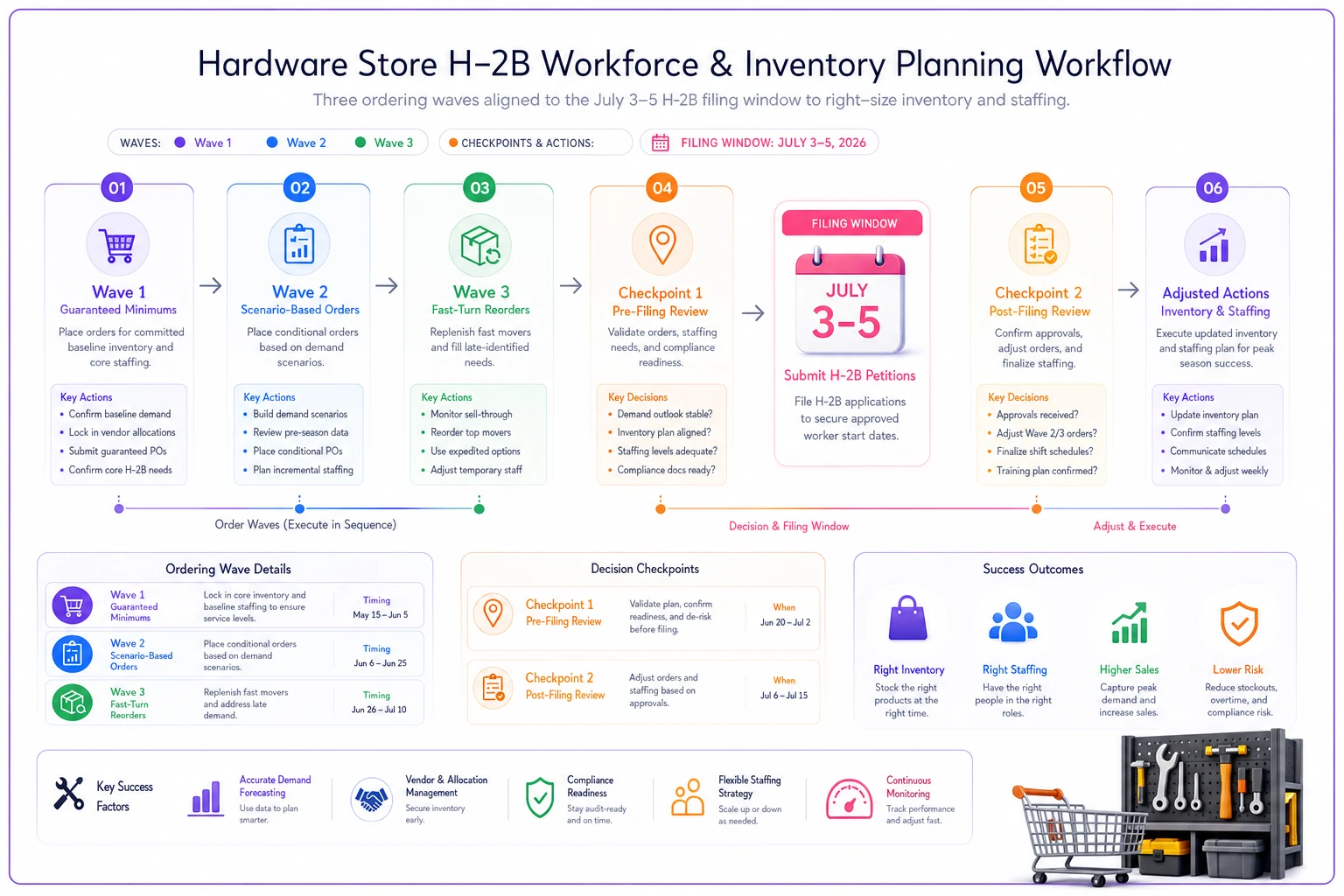
This visual captures the decision flow from early planning to final execution so you can map orders to staffing outcomes instead of guessing in October.
Building flexibility into rigid seasonal plans
Most hardware stores operate on vendor programs that penalize order changes. Cancel a snow blower order in August and you're paying a 15% restocking fee. Reduce your ice melt commitment and you lose your volume discount. The system assumes you know your needs months in advance.
Vendor negotiation tactics: Start conversations in May about conditional ordering tied to staffing outcomes. Many regional distributors will work with you if you explain the situation upfront. Request 30-day confirmation windows on large orders. Negotiate return agreements for unsold seasonal merchandise if staffing falls through.
Try to secure a short 'staffing contingency' clause that allows a modest reduction without full restocking penalties.
Cross-training existing staff now: Your current team needs backup skills before October. The paint desk person should know basic key cutting. Yard staff should be able to run register during rushes. Build redundancy while you have time, not during the first winter storm warning.
Partnership alternatives: Local landscaping companies often have workers with reduced winter hours. Retired contractors sometimes want part-time work during storm prep. High school shop classes might handle basic assembly for store credit. These aren't perfect solutions, but they're better than empty shelves in November.
The technology bridge for staffing gaps
When staffing falls short, operational software becomes important for stretching your existing team—not as a replacement for workers, but as a way to get more out of the staff you do have.
Inventory allocation systems prevent your limited crew from hunting for products. When a contractor calls for 50 bags of ice melt, the system shows exact pallet locations, quantity on hand, and scheduled incoming shipments. What used to take 15 minutes of searching takes 30 seconds.
Automated reorder triggers handle routine purchase orders your team doesn't have time to build from scratch. Set par levels for seasonal items, let the system generate orders when you hit minimums. Your manager reviews and approves instead of starting from zero.
Customer communication platforms cut down on the constant phone calls asking whether snow shovels are in stock. Automated inventory updates on your website, text alerts when special orders arrive, email confirmations for will-call orders—each automated message saves a 3-minute phone call your team doesn't have time for.
These tools matter even more during partial staffing scenarios. When you're running with 70% of planned workers, every efficiency gain keeps you functional. The difference between barely surviving the season and actually maintaining service levels often comes down to having the right operational systems in place before the rush hits.
The real cost of staffing uncertainty
The financial impact goes well beyond paying overtime to existing staff. Hardware stores typically see hidden costs pile up across several areas.
Inventory carrying costs: When you can't move product fast enough due to staffing, you're paying to store snow blowers through January that should have sold in November. That's roughly 2-3% monthly carrying cost on seasonal inventory that was supposed to be gone.
Lost contractor relationships: When commercial customers can't get loaded quickly during storm prep, they find suppliers who can. Losing one major contractor account can mean $30,000-$50,000 in annual bulk sales.
Margin erosion: Desperate for sales in January, you mark down seasonal inventory 30-50% that would have sold at full price in November with proper staffing and display maintenance.
Employee burnout: Your core team works 60-hour weeks through the holidays, leading to January turnover. Replacing an experienced hardware store employee runs somewhere around $4,000-$6,000 in recruiting and training costs alone.
One Massachusetts store tracked their true cost of H-2B denial at around $67,000 for the season—not from unfilled positions, but from all the downstream operational damage. That number is always higher than people expect.
Early warning signals to watch
By July 15: If your H-2B application hasn't received initial acknowledgment, assume complications. Start negotiating flexible terms with vendors now.
By August 1: Regional H-2B approval rates become clearer. If your area is showing below 60% approval, shift to Scenario B planning immediately.
By August 15: Final staffing plans need to lock. Either you have H-2B confirmation, local hiring lined up, or you're cutting services. No more waiting at this point.
By September 1: Inventory commitments become irreversible. Whatever staffing you have by now is what you're working with for the season.
These checkpoints let you adjust gradually instead of panicking in October when nothing can be changed.
Connecting staffing to seasonal merchandise planning
The H-2B filing window directly impacts your approach to seasonal inventory—especially items requiring assembly, heavy lifting, or technical knowledge. Your seasonal planning (particularly for managing garden and snow supplies) needs to account for realistic staffing levels from the start.
Without adequate staffing, even careful seasonal merchandise planning falls apart. You can't maintain proper rotation schedules, run regular inventory counts, or execute markdowns on schedule. The timelines for pre-season, in-season, and post-season inventory management all assume you have people to actually move product.
Pre-season: Can't clear old inventory fast enough to make room for new seasonal goods.
In-season: Can't maintain displays, assist customers, or process special orders efficiently.
Post-season: Can't mark down and clear inventory before the next seasonal change.
This is why the July H-2B window matters beyond just headcount. It's about whether you have the operational capacity to execute your entire seasonal strategy—and whether the plan you built in the spring can actually survive contact with a busy November.
Making the July window work for your store
The USCIS announcement about supplemental visa allocations suggests some flexibility in the program, but the core challenge stays the same: you need to be ready for that three-day window.
-
Document your local recruitment efforts (required for H-2B eligibility)
-
Calculate exact staffing needs by week for October through March
-
Identify which roles absolutely require H-2B workers vs. temporary local help
-
Prepare housing arrangements and transportation logistics
-
Build relationships with H-2B agencies that specialize in retail and hardware
Don't treat H-2B as your only option. It's one tool in your seasonal staffing toolkit, not the whole plan. The stores that consistently get through winter seasonality plan for multiple outcomes, build operational flexibility, and use technology to stretch whatever staffing they manage to secure.
Moving forward with uncertainty
The July H-2B filing window captures a lot of what's frustrating about running a hardware store right now. Government timelines that don't match business cycles. Critical decisions made on incomplete information. Competition for resources with larger operations that have dedicated HR teams handling all of it.
But this is seasonal retail. The successful stores aren't necessarily the ones that get lucky with H-2B approvals every year—they're the ones that build operations flexible enough to handle whatever comes back. Map out what each staffing level means for inventory, hours, services, and promotions. Build the infrastructure to execute any scenario. Don't let uncertainty stall your planning entirely, because the season starts whether you're ready or not.
The July 3-5 filing window is just three days. What you do in the weeks before and after it shapes your entire fall and winter season.
The July 3-5 filing window is just three days. What you do in the weeks before and after it shapes your entire fall and winter season.
Ready to elevate your hardware store management?
Join 500+ hardware stores using Hardzly to boost operational efficiency, reduce stockouts, and grow revenue.