

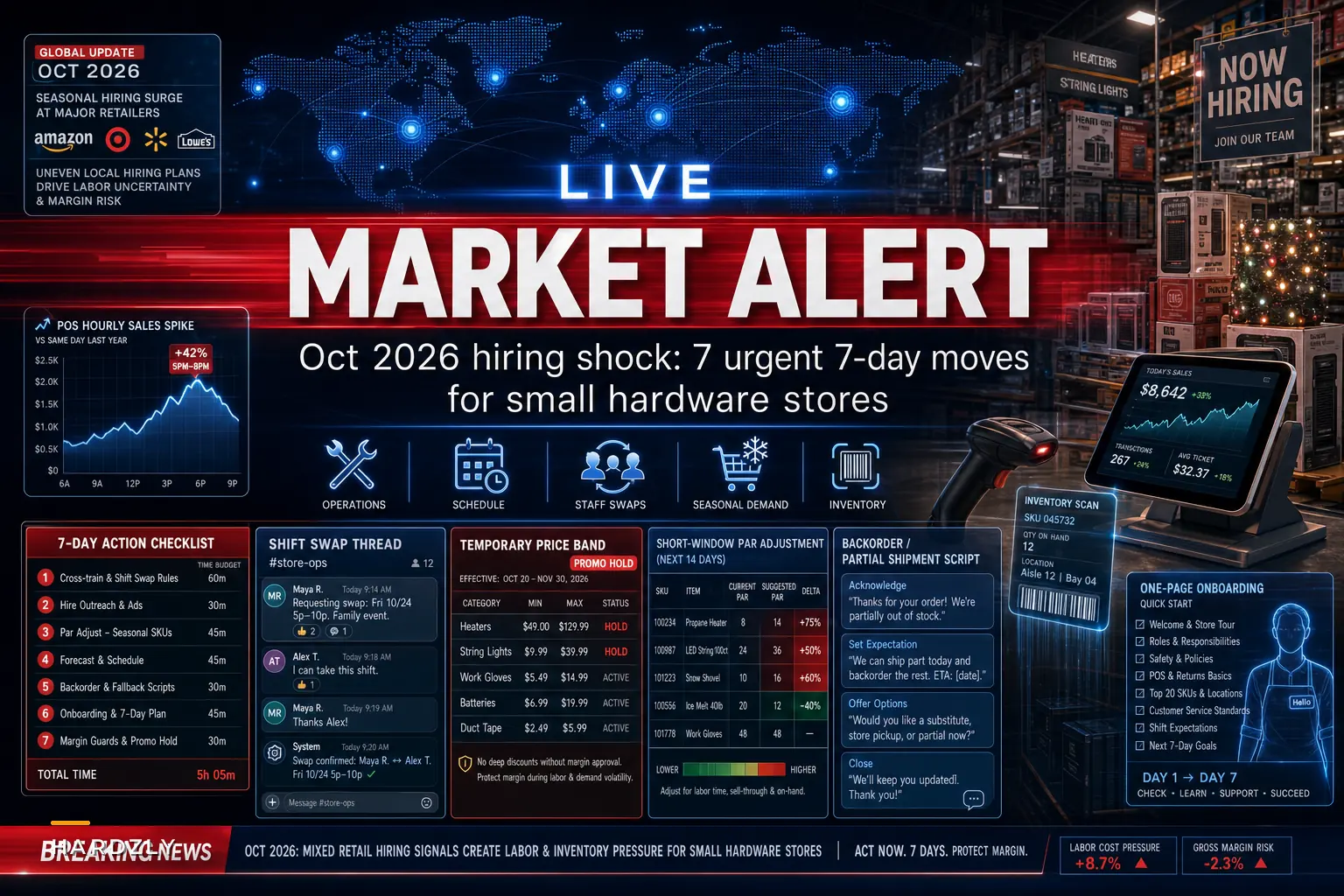

The headlines this October told two completely different stories at once. Amazon announced it's creating over 300,000 seasonal jobs with higher pay and expanded benefits, while a chunk of traditional retailers quietly trimmed their seasonal headcount plans. CNBC called the overall picture "mixed signals" — some employers leaning in hard, others pulling back and waiting to see how shopping shakes out.
For a single-location hardware store, that split matters more than the raw numbers suggest. When a warehouse two towns over bumps its starting wage and throws in benefits, it doesn't just pull from the applicant pool — it resets the local wage floor. The 19-year-old who used to take your $15/hr counter shift now has a $20/hr option with a predictable schedule and no customer complaints about return policies.
The real problem isn't "fewer applicants." It's that you're competing for short-term labor on terms set by companies with budgets you can't match. You can't out-pay Amazon. What you can do is out-plan them — tighten how few people you actually need, when you need them, and what happens when one of them doesn't show.
That's what this is about. Not hiring faster. Hiring less, scheduling tighter, and building the kind of coverage that doesn't collapse when your newest seasonal hire ghosts you the Saturday before Christmas.
Start by assuming you'll be short
The mistake most owners make heading into a tight labor market is building the holiday plan around the staff they hope to have. Then November hits, two hires fall through, and the whole month becomes improvisation.
Flip it. Build your December coverage plan around the headcount you're reasonably confident you can keep. If you normally run holidays with six people and realistically think you can land four reliable ones this year, plan for four — and treat anyone above that as upside, not foundation.
This changes everything downstream. A four-person plan forces you to answer uncomfortable questions early: Which hours actually need two people on the floor versus one? Which days can the register run solo with the owner floating? What breaks if your snow-shovel rush and your click-and-collect pickups land in the same 90-minute window?
Planning for scarcity means you find the pressure points before they find you.
The seven moves, in the order they actually matter
Here's the sequence, front-loaded so the highest-leverage work happens first.
Stop losing sales due to inventory gaps.
Hardzly helps you manage stock levels, orders, and supplier interactions efficiently.
- Unified inventory and sales tracking
- Supplier and purchase order management
- Automated workflow and task scheduling
No credit card required
1. Map your coverage to demand, not to the calendar
Pull your POS transaction counts by hour for the last two holiday seasons. Not revenue — transaction count, because that's what drives how many hands you need on the floor. You're looking for the real peaks, which almost never line up with a clean 9-to-5 staffing grid.
A typical hardware store pattern looks something like this: a steady contractor rush from open until around 9:30am, a dead stretch mid-morning, a lunch bump, then a long heavy run from roughly 3pm to close as homeowners come through after work. Weekends are their own animal.
Once you see the shape of demand, you staff the shape — not the clock. That's the whole premise behind forecast-driven labor scheduling: matching bodies to the hours that actually generate transactions, instead of spreading thin coverage evenly across a day where half the hours don't need it.
2. Cross-train before you hire, not after
In a tight market, your most valuable asset isn't a new hire — it's an existing employee who can cover three stations instead of one. If your paint-counter person can also run the register and pull click-and-collect orders, you've effectively added half a person to every shift without a single new W-4.
Spend the first two weeks of November running deliberate cross-training. Pick the three functions most likely to bottleneck during peak — usually register, curbside/pickup, and the service or key-cutting counter — and make sure at least two people can run each one.
The cross-training that actually pays off isn't "show them once." It's having each person run the station during a slow weekday while someone shadows, then flip it. Twenty minutes of real reps beats an hour of explanation every time.
3. Trim labor-intensive SKUs before the season, not during it
This is the inventory move most owners skip, and it's directly tied to staffing. Some product categories eat labor disproportionately — anything that requires mixing, cutting, assembling, loading, or heavy explanation at the point of sale.
| SKU type | Staff time per sale | Holiday labor risk |
|---|---|---|
| Pre-packaged fasteners, hand tools | Low (~1 min) | Safe to stock deep |
| Paint (tinted to order) | High (5–10 min) | Risky if counter is thin |
| Cut-to-size chain, rope, cable | Medium–high | Risky at peak hours |
| Garden/snow equipment (assembly + loadout) | High | Plan loadout coverage |
| Boxed power tools | Low | Safe to stock deep |
The move isn't to stop selling paint. It's recognizing that if you're down a person, a wall of custom-tint jobs during your 4pm rush backs up your entire register line. Consider narrowing tint options during peak weeks, staging pre-mixed popular colors, or shifting your heaviest custom work to defined windows when you know you've got two people up front.
4. Build a shift-swap system people will actually use
Turnover and no-shows spike in December, especially with short-term hires who have better options. The stores that survive this don't prevent every absence — they absorb it fast.
Set up a dead-simple swap process before the season starts. One shared thread (text group, whiteboard, whatever your team actually checks), a rule that any swap gets confirmed by both people and acknowledged by you, and a short list of who's willing to pick up extra hours and at what notice. The point is making a coverage gap a 10-minute problem instead of a frantic three-hour one.
Require both people to confirm swaps in the thread and tag the manager so coverage can be verified quickly.
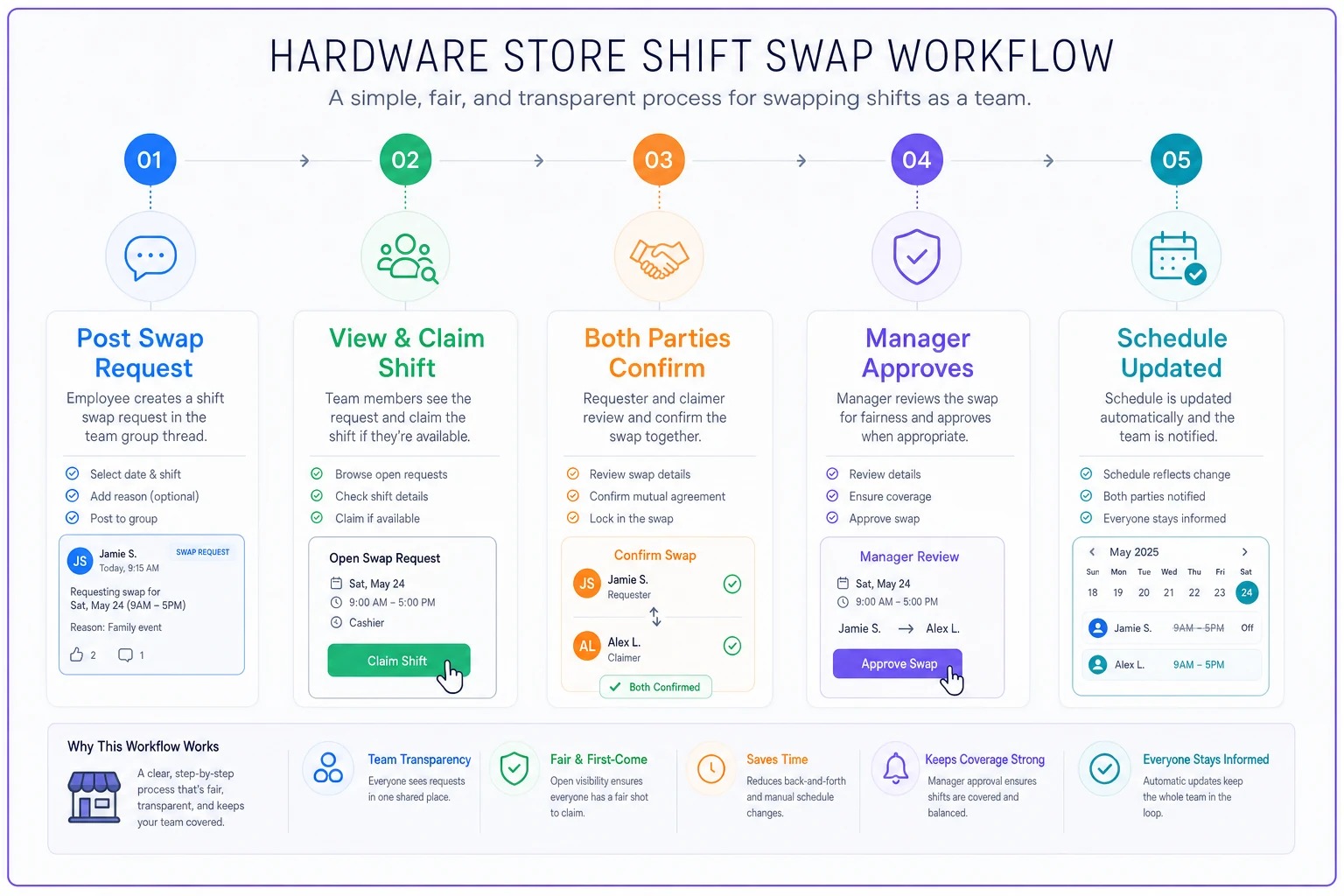
Here's a simple visual of the swap process.
The owners who get burned are the ones where every absence routes through a panicked phone call. Make coverage a system, not an emergency.
5. Thin out the staffing-dependent services during peak
If your store runs rentals, tool sharpening, screen repair, or key programming, those services need dedicated hands — and they're the first thing to collapse when counter staff get pulled to the register.
Decide ahead of time: during your peak two weeks, which services run on reduced hours, which pause entirely, and which stay full? A rental counter that promises same-day turnaround with one person on duty is a customer-complaint generator. Better to post "rental returns processed within 24 hours during the holiday rush" than to overpromise and blow it.
This isn't giving up revenue. It's protecting your core retail throughput — where the holiday money actually is — from being strangled by lower-volume services.
6. Pre-stage your click-and-collect around thin coverage
Pickup orders are deceptively labor-hungry. Each one is a pick, a stage, a hold, and a handoff — and if that handoff happens during your afternoon rush with one register running, it clogs everything.
-
Set honest pickup-ready windows (not "in an hour" when you know you're short)
-
Stage picked orders in one clearly labeled, easy-grab location so any staffer can complete a handoff
-
Batch your picking into slow periods — build tomorrow morning's pickups during tonight's quiet stretch
-
Cap same-day promise times during peak days so you don't create a backlog you can't clear
A few adjustments that help when staff is thin:
7. Write a one-page "short day" playbook
This is the piece almost no one has, and it's the one that saves December. Write down — before it happens — exactly what the store does when you're down to minimum bodies.
What closes. What pauses. Who covers the register when the one person up front has to run to the back. Which services go on hold. What the sign on the rental counter says. Which tasks get dropped entirely (restocking the back wall can wait; an unmanned register cannot).
When you've decided this in advance, a short day becomes a known mode you switch into — not a crisis you scramble through.
A quick real scenario
A single-location hardware store, roughly four full-timers plus two seasonal hires in a normal year. Last December they planned for six, lost two seasonal applicants to warehouse jobs that paid more, and spent the month reacting. Register lines backed up during the afternoon rush, two custom-paint jobs during one Saturday peak created a 20-minute wait, and they estimated losing somewhere in the low thousands in walkaways over the month — people who set down their cart and left.
This year they ran the scarcity plan. Built December around four reliable people, cross-trained everyone on register and pickup in early November, staged popular pre-mixed paint colors for the peak weeks, and wrote the short-day playbook. They still ended up down a person on two key Saturdays. But it didn't matter much — the cross-trained team flexed, the paint bottleneck never formed, and the register stayed covered. No heroic late nights, no obvious lost sales, and payroll actually came in a bit lower than the year before because they weren't paying for coverage during hours that didn't need it.
They didn't hire better. They hired less and planned harder.
When this approach is right — and when it isn't
This makes sense when you're genuinely constrained on labor, your holiday peak is concentrated into predictable windows, and you've got at least a couple of employees capable of learning a second station. Most single-location hardware stores fit this exactly.
This is the wrong call when your demand is truly flat across the day with no real peaks to staff against, or when you're so short that even a tight plan leaves you below a safe minimum — at which point the honest answer is reduced hours, not a cleverer schedule. Running one exhausted person through a 10-hour peak day isn't a plan, it's a liability.
Don't lean on this if your team is already stretched thin year-round and burning out. Cross-training a crew that's already underwater just spreads the exhaustion. Fix the baseline staffing first.
The underlying problem the hiring news actually exposes
The mixed signals from this season aren't really the story. Wage pressure and thin applicant pools will ease and tighten in cycles — they always have. What the headlines actually expose is that most small hardware stores schedule from habit, not from data, and that habit works fine right up until labor gets scarce.
A store that already knows its demand curve by hour, already has a cross-trained bench, and already has a coverage plan for short days doesn't panic when the labor market shifts. It just adjusts the inputs. The stores that struggle every December are the ones rediscovering their own demand patterns from scratch, every single year.
You don't beat a tight labor market by winning the wage war. You beat it by needing fewer people in the right hours — and knowing exactly what to do when even those don't show up.
Ready to elevate your hardware store management?
Join 500+ hardware stores using Hardzly to boost operational efficiency, reduce stockouts, and grow revenue.