


The moment a customer asks for a specific SKU you don't have on the shelf, one of three things happens. Your counter person guesses at a substitute and gets it wrong. They say "sorry, we're out" and the customer drives to the big box. Or they call you over, and now you're pulled off whatever you were doing to solve a $9 fastener problem.
None of those are good. And the frustrating part is that most out-of-stock moments are completely predictable. You know which paint bases run low in spring. You know the deck screw sizes that vanish every weekend. What's missing isn't inventory foresight — it's a decision the person at the register can make in ten seconds without guessing, without hurting margin, and without steering someone toward a product that'll cause a callback.
That's what a real substitution playbook does. Not a binder nobody reads. A tight set of pre-approved swaps by category, plus a couple of scripts that keep margin intact when the obvious substitute costs more or less than what the customer wanted.
Why counter substitutions go sideways
The wrong-substitute problem almost never comes from laziness. It comes from the person behind the register having partial knowledge and no authority.
A typical example: a weekend employee sells someone a general-purpose interior latex when the customer actually needed a kitchen-and-bath formula because they're painting a steamy bathroom. It looks like a fine swap on the shelf. Three weeks later the customer's back, paint's peeling, and now you're eating a gallon plus the goodwill hit. The swap wasn't crazy — it just wasn't approved, because nobody ever wrote down that bathroom jobs don't get standard latex.
The margin side goes wrong just as often. Customer wants a $6.49 box of screws you're out of. Employee grabs the nearest equivalent, which happens to be a premium coated box at $11.99, and — trying to be nice — sells it at the price of the one you were out of. You just gave away five bucks and trained a customer to expect it.
The core issue is that substitution is a judgment call being made by whoever happens to be standing there, with no shared reference. Everyone substitutes differently. Some overpay to be nice, some steer customers wrong, some just refuse and lose the sale. A playbook removes the judgment and replaces it with a lookup.
The three things every swap table needs
Before the category tables, here's the anatomy of a swap entry that actually works at the counter. Each pre-approved substitution needs exactly three pieces of information, and if any one is missing, your counter person is back to guessing.
Stop losing sales due to inventory gaps.
Hardzly helps you manage stock levels, orders, and supplier interactions efficiently.
- Unified inventory and sales tracking
- Supplier and purchase order management
- Automated workflow and task scheduling
No credit card required
-
The out-of-stock item (what they asked for)
-
The approved substitute(s) in priority order
-
The margin rule — do you match the original price, sell at the substitute's price, or something in between?
That third piece is the one everyone forgets, and it's the one that quietly bleeds margin all year. A swap table without a pricing rule is just a product cross-reference. A swap table with one is an actual policy your team can execute.
Category swap table: paint
Paint is where wrong substitutions cause the most callbacks, because the failure shows up weeks later on the customer's wall, not at your register. Keep the swaps conservative and note the disqualifiers.
| Out of stock | Approved substitute (in order) | Do NOT substitute with | Pricing rule |
|---|---|---|---|
| Interior flat, contractor grade | Same brand eggshell in same base → competing brand flat | Exterior paint, ceiling-only paint | Match original if within ~15% cost; else substitute price |
| Kitchen & bath / bathroom formula | Higher-tier mildew-resistant interior | Standard interior latex | Substitute price (no downgrade allowed) |
| Exterior semi-gloss, specific color | Same line, tintable base + custom tint | Interior paint of any kind | Substitute price + tint |
| Primer (stain-blocking) | Another stain-blocking primer, any brand | General-purpose primer | Match if within 10% |
| 5-gal contractor white | Two 2.5-gal of same product | Different sheen to make quantity | Match per-gallon rate |
The pattern worth noting: for paint, the rule is never downgrade the functional spec to hit a price. A cheaper substitute that fails is far more expensive than the few dollars you'd save. The bathroom-formula row exists specifically because that's the swap employees get wrong most.
Category swap table: fasteners
Fasteners are the opposite problem. The swaps are technically easy but happen dozens of times a day, so tiny margin leaks add up fast. The trap here is coating and material, not size.
| Out of stock | Approved substitute (in order) | Do NOT substitute with | Pricing rule |
|---|---|---|---|
| Exterior deck screw, coated | Same length stainless → same length in next box size | Zinc/interior screw for outdoor use | Substitute price |
| #8 x 1‑1/4 wood screw, 1lb box | Same screw in 5lb box, priced per-lb | Drywall screw as "close enough" | Per-lb match, break pack if needed |
| Galvanized nail, specific size | Same size hot-dipped galv, different brand | Bright/uncoated for outdoor | Match if within 10% |
| Structural lag bolt, specific length | Next length up, same diameter | Smaller diameter | Substitute price, note length change |
| Concrete anchor, specific size | Equivalent anchor, different system + correct bit | Wrong anchor type for base material | Substitute price |
The material downgrade — bright or zinc screws going into an outdoor job — is the fastener version of the bathroom-paint mistake. It looks fine on the counter and rusts in a season. Bake "no material downgrade for exterior use" into the rule and you've eliminated the most common callback.
Category swap table: plumbing
Plumbing substitutions carry a specific risk: fitting compatibility. A swap that's dimensionally close but wrong on thread type or material creates a leak, and a leak becomes a warranty argument fast.
| Out of stock | Approved substitute (in order) | Do NOT substitute with | Pricing rule |
|---|---|---|---|
| 1/2" copper coupling | Same size push-fit → same size compression | Mismatched pipe material fitting | Substitute price, explain install difference |
| PVC to threaded adapter | Same schedule, verify thread (NPT vs other) | Wrong schedule PVC | Match if same brand line |
| Wax ring, standard | Reinforced wax ring (upsell functional) | Foam ring without confirming fit | Match standard, note upgrade option |
| Supply line, braided 3/8 x 3/8 | Same connectors, longer length | Different connector size | Substitute price |
| Compression fitting, specific size | Same size, different brand | "Close" size | Match if within 10% |
Note the push-fit substitution for copper: it's more expensive and installs completely differently. The pricing rule here is substitute price, but the script matters more than the price, because you're changing how the customer's job works.
The margin-preserve decision flow
This is the part that turns a lookup table into a policy. When the substitute doesn't cost the same as the original, your counter person needs a single flow to follow — not a mood-based decision.
-
Is there an approved substitute? No → offer to order it / check the supplier-disruption playbook for emergency sourcing. Yes → continue.
-
Does the substitute cost within ~10–15% of the original? Yes → match the original price, sell it, done. No → continue.
-
Is the substitute more expensive? Yes → sell at substitute price using the "upgrade script." Never eat the difference by default.
-
Is the substitute cheaper? Yes → sell at substitute price (customer saves money — say so, it builds trust). Do not pocket the difference; that's how you lose a regular.
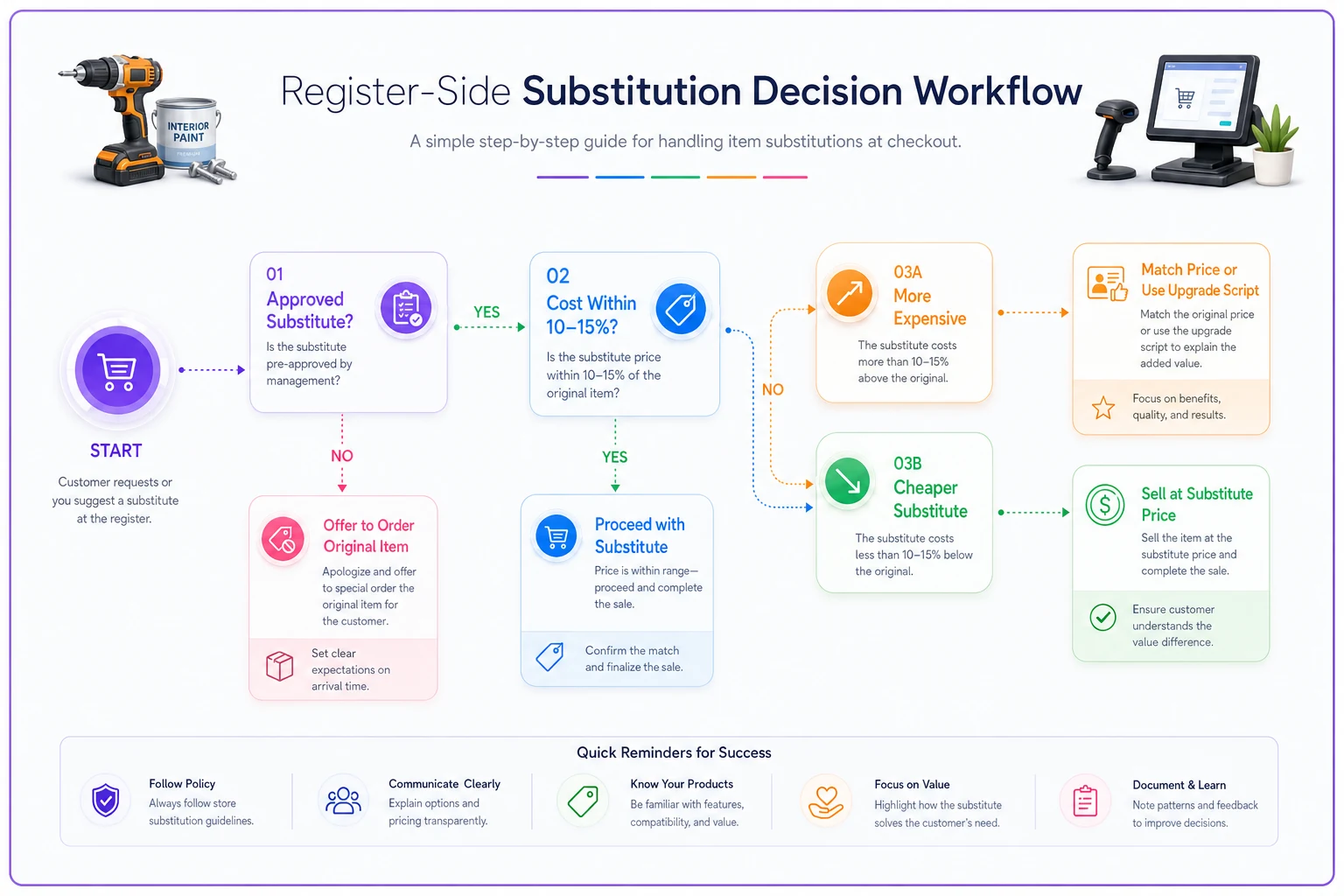
This diagram shows the decision steps your register staff should follow quickly and consistently.
The counter scripts that hold margin
Scripts feel silly until you realize the alternative is your employee apologizing their way into giving away five dollars. Here are the three that cover almost every situation.
When the substitute costs more (the upgrade script):
> "We're out of the exact one you wanted, but I've got something that'll actually work a little better for this — it's a few dollars more at $11.99. Same job, holds up longer outside. Want me to grab it?"
Framing it as better, not just more expensive, is the difference between a sale and a lost customer. And it's usually true — the substitute often is a higher spec.
When the substitute costs less:
> "Good news — we're out of that exact one, but this does the same thing and it's actually a couple bucks cheaper. Want to go with it?"
You lose nothing and you build a customer who trusts that you're not squeezing them.
When there's a functional reason not to downgrade:
> "I could sell you the standard one, but for a bathroom you really want the mildew-resistant formula — it's a bit more but it won't peel on you. I'd rather you not have to come back."
That last line does more for retention than any loyalty program.
A real scenario
A single-location store — decent traffic, four people on the floor on a Saturday — was losing walk-out sales on fasteners and paint every weekend because whoever was on the register when the owner was busy would just say "we're out." The owner figured maybe 8–12 lost sales a weekend, small tickets mostly, but they added up.
They built three laminated swap sheets — paint, fasteners, plumbing — and taped the margin-preserve card to the register. Nothing fancy, just printed from a spreadsheet. Within about a month, walk-outs on those categories dropped noticeably. The part the owner didn't expect: the average substitution ticket went slightly up, because employees stopped defaulting to price-matching everything and started using the upgrade script when it applied. Rough estimate on recovered margin was somewhere in the $300–$500 a month range, mostly from not giving away the price difference on premium swaps.
The bigger win was the owner not getting pulled to the counter every time someone asked about a missing SKU.
When a formal playbook makes sense — and when it doesn't
It makes sense when: you have part-timers or weekend staff making substitution calls, you carry deep enough assortments that near-equivalents exist, and you've noticed either callbacks from wrong swaps or margin leaking on price-matched substitutions.
It's overkill when: you're a two-person shop where the owner is always at the counter and knows every swap by heart. The knowledge already lives in your head — though writing it down still matters the day you get sick or hire someone.
Who should be careful: stores that try to make the swap tables exhaustive. If your paint table has 60 rows, nobody uses it. Cover the 15–20 SKUs that actually go out of stock and cause problems. The rest can be a judgment call, because the rare stuff isn't where the money leaks.
Keeping the tables from going stale
A swap table is only useful if it matches what's actually on your shelf. The fastest way to make employees distrust the whole system is to have them look up an approved substitute that you're also out of. Review the tables when you review your reorder points — the two go together. When a product gets discontinued or a supplier line changes, the swap entry has to change with it.
This is where clean product data actually earns its keep. If your system already flags which SKUs are running low and which have near-equivalents in the same category, the swap tables mostly maintain themselves — you're just confirming the priority order and the pricing rule. Keep the product master current and the substitution logic stays honest.
The one thing to take away
Substitution isn't a knowledge problem, it's an authority problem. Your counter people usually know enough to find a close product. What they don't have is permission to price it correctly and a script to explain the swap without apologizing. Give them the pre-approved list, the margin band, and three sentences to say — and "we're out of that" stops being a lost sale and starts being a normal, profitable transaction.
Start with your top out-of-stock offenders in paint, fasteners, and plumbing. One sheet each. The card at the register. That's the whole playbook, and it'll pay for the twenty minutes it takes to build within the first busy weekend.
Start with your top out-of-stock offenders in paint, fasteners, and plumbing. One sheet each. The card at the register. That's the whole playbook, and it'll pay for the twenty minutes it takes to build within the first busy weekend.
Ready to elevate your hardware store management?
Join 500+ hardware stores using Hardzly to boost operational efficiency, reduce stockouts, and grow revenue.