

Every hardware store has a short list of items that, if they vanish from the shelf, cause real pain. Not the decorative garden stakes. The stuff contractors and homeowners walk in specifically to buy — the 3/4" PVC couplings, the common breaker your local electricians standardize on, the propane exchange, the exterior wood screws in the two sizes everybody wants.
When a supplier on one of those items suddenly can't deliver — allocation, a plant fire two states away, a freight mess, or just a rep who stops returning calls — most small stores react the same bad way: they wait. They assume the truck will show up next week. Then next week the shelf is empty, the phone starts ringing, and the counter staff are improvising substitutions with no rules and no backup plan.
This post is about building the thing you pull out before that happens: a supplier risk heatmap for your critical SKUs, plus the substitution logic, temporary order rules, safety bundles, and customer scripts that let a two- or three-person team respond in an hour instead of a week.
Start by ranking which stockouts actually hurt
Not all stockouts are equal, and treating them like they are is the first mistake. A store carrying 12,000 SKUs cannot build a contingency plan for every line. You don't need to. What you need is a heatmap that separates the items where a supplier failure quietly costs you real money from the ones nobody will notice.
Two axes do almost all the work here:
-
Revenue/margin impact — how much this SKU (and the basket it drags along) contributes
-
Substitutability — how easy it is to swap in another product without losing the sale or the customer
An item that's high-impact and hard to substitute is your danger zone. A common example: a specific brand of contractor-grade construction adhesive that your regular framing crews insist on. It's not expensive per tube, but those crews buy it by the case, grab lumber and fasteners on the same trip, and if you're out, they drive to the box store and often don't come back that week.
Here's a simplified version of the heatmap most small stores can build in an afternoon:
| SKU / group | Monthly revenue pull | Substitutable? | Risk tier |
|---|---|---|---|
| Contractor adhesive (Brand X) | High (+ attached basket) | Hard — crews are loyal | Critical |
| Common 20A breaker (local standard) | Medium-high | Medium — cross-ref exists | Critical |
| Propane exchange | Steady, high traffic | Low — single supplier | Critical |
| Exterior deck screws, 2 top sizes | High | Easy — many equivalents | Watch |
| Decorative cabinet knobs | Low | Easy | Ignore |
The insight most owners miss: substitutability is a business fact, not a technical one. Two adhesives can be chemically interchangeable, but if your customer base won't accept the swap, they're not substitutes. Rank based on customer behavior, not the spec sheet.
Once you've tagged your Critical tier — for most single-location hardware stores that's somewhere between 40 and 120 SKUs, not thousands — you build the actual playbook only for those.
Build the substitution decision tree before you need it
Counter staff make bad calls during a stockout because they're deciding and selling at the same time, under pressure, with a customer watching. Take the deciding part off their plate ahead of time.
Stop losing sales due to inventory gaps.
Hardzly helps you manage stock levels, orders, and supplier interactions efficiently.
- Unified inventory and sales tracking
- Supplier and purchase order management
- Automated workflow and task scheduling
No credit card required
For each Critical SKU, write a short substitution decision tree. It doesn't need to be fancy — an index card or a shared doc entry works fine. A typical one looks like this:
If [Brand X adhesive] is out:
-
Offer [Brand Y, same cure type] at same price → approved auto-swap, no manager needed
-
If customer refuses brand swap → offer to hold their name and call when Brand X lands (log in backorder list)
-
If crew needs it today and won't swap → sell what we have of Brand Y at cost to keep the relationship, flag for owner
-
Never substitute across cure type or load rating without telling the customer explicitly
That last line matters more than the rest. The dangerous substitution isn't the one that loses a sale — it's the one where you quietly swap a structural-rated product for a general-purpose one and the customer never finds out. In hardware, a bad silent substitution on a load-bearing fastener or an electrical component isn't just a return; it's a liability.
-
Pre-approve the safe swaps so staff never have to hunt down the owner for a $6 tube of adhesive.
-
Mark the "must disclose" swaps clearly — anything involving load rating, amperage, pressure rating, or code compliance.
-
Keep the tree to one screen or one card. If it's a two-page document, nobody reads it mid-transaction.
Stores consistently have equivalent products sitting on the shelf during a stockout, but staff don't know they're approved equivalents, so they just say "we're out" and the sale walks. The decision tree turns "we're out" into "here's what works instead."
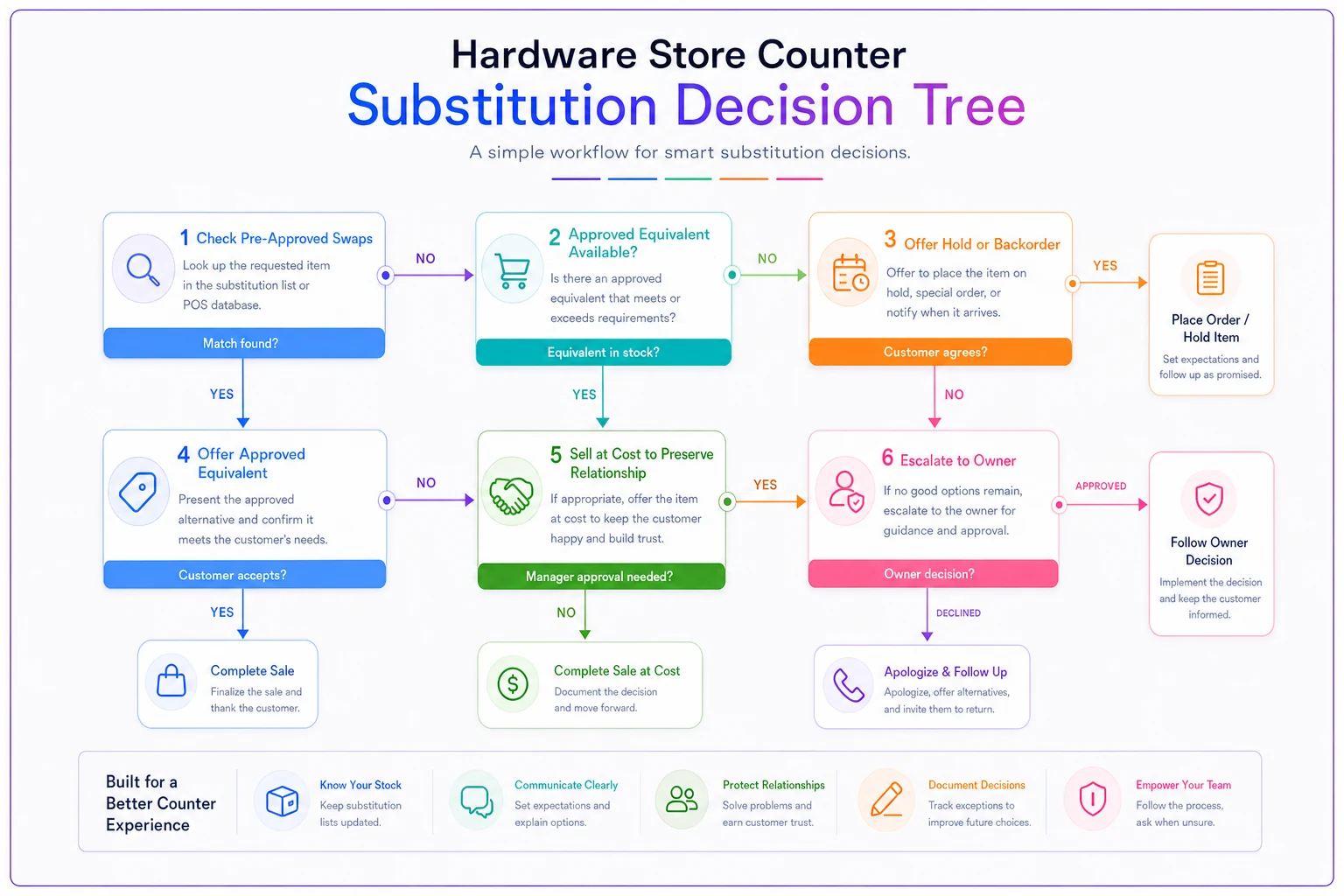
A quick visual makes the steps easier to scan on a single card.
Temporary order rules: change your buying the moment a supplier wobbles
When a critical supplier signals trouble — a missed delivery, a partial fill, an allocation notice — your normal reorder logic is now wrong. The par levels and reorder points you set for calm conditions will either leave you dry or make you panic-buy. You need a second set of rules that switch on during disruption.
A practical temporary ruleset for a Critical SKU under supplier stress:
-
Freeze the normal reorder point. Stop trusting the automatic "order 2 cases when we hit 1" logic — the lead time it assumes no longer exists.
-
Ration on-hand stock if needed. For truly scarce items, cap per-customer quantities so one contractor doesn't clear the shelf and strand ten homeowners. A simple "limit 4 per customer" sign works.
-
Open a second source at a worse price, on purpose. Have the backup distributor's part number already mapped so you can place an order in minutes, not after an afternoon of phone tag.
-
Buy to a defined bridge, not to "as much as I can get." Decide how many days of coverage you're trying to bridge — say, 21 days — then order to that number. Overbuying a disrupted SKU is how stores end up with deadstock once supply normalizes.
The overbuy trap is real and expensive. When a shortage clears, everyone who panic-ordered dumps inventory at once and you're stuck sitting on six months of a slow item you paid a premium for. Buying to a bridge number keeps you covered without creating your next problem.
This is also where clean lead-time tracking pays off. If you already track suppliers by realistic lead-time ranges — the way we laid out in the seasonal forecasting and cashflow routine — you'll spot a wobbling supplier faster because their actual delivery will start drifting outside its normal range before it fully fails.
Safety bundles: the emergency stock you pre-decide, not pre-hoard
"Safety stock" for a whole store is a blunt instrument. Carrying extra of everything ties up cash and shelf space. Safety bundles are narrower: small, pre-defined reserve quantities held only for your Critical, hard-to-substitute SKUs — and, importantly, for the items that travel with them.
Think in baskets, not single items. If propane exchange is critical for your foot traffic, the safety bundle isn't just tanks — it's tanks plus the grill igniters, regulators, and connectors people buy on the same trip during grilling season. If the common local breaker is critical, the bundle includes the wire nuts and cable that electricians grab alongside it.
How to size a safety bundle without over-committing cash:
-
Base the reserve on the SKU's normal daily velocity times your realistic emergency-sourcing time. If you move around 8 units a day and your backup source takes 10–14 days, a reserve in the 80–110 unit range covers the bridge.
-
Cap total dollars tied up in safety bundles to something you can actually absorb — many small stores keep this under a few thousand dollars total, concentrated on the handful of SKUs that genuinely can't be swapped.
-
Physically separate and label the reserve so it doesn't get sold down as regular stock and disappear right when you need it.
That last point is where safety bundles quietly fail. The reserve gets mixed into the regular bin, sells through on a busy Saturday, and the "safety" existed only on paper. Keep it in a marked back-stock location with a simple rule: reserve is only opened when front stock hits zero and a disruption is confirmed.
Customer communication: the part that saves the relationship
A stockout you handle well can actually build loyalty. A stockout you handle silently loses the customer permanently. The difference is almost entirely in the communication.
The contractors and repeat homeowners who make up most of your margin don't expect you to have everything. They expect you to be honest and to save them a wasted trip. So the goal of your scripts is simple: tell them early, give them an option, and set a real expectation.
Counter script (in person):
> "We're out of [item] right now — supplier delay, should be back around [date]. I've got [equivalent] in stock that works the same for [use], or I can text you the minute [item] lands. Which is easier?"
Contractor account text:
> "Heads up before your run — we're short on [item] this week ([supplier issue]). Got [equivalent] on the shelf, or I can hold [X units] of the original for you when it arrives [date]. Want me to set some aside?"
Proactive call for known bulk buyers:
Reach out before they show up, not after they find an empty shelf. A two-minute call saves a lost job order.
The pattern behind all of these: proactive beats reactive every time. Customers forgive shortages. They don't forgive showing up, loading a cart, and discovering at the register that the one thing they came for isn't there and nobody warned them.
A quick real scenario
A single-location hardware store — three people on the floor, roughly $2M annual — relied on one distributor for a line of exterior structural screws that framing crews bought constantly. The distributor hit allocation over a busy stretch in late spring and started short-shipping with no warning.
For the first ten days the store just waited and told people "should be in soon." Crews stopped asking and started buying the full package — screws, brackets, fasteners — elsewhere. The owner later estimated the lost basket sales ran into the low thousands over that stretch, and most of it wasn't the screws themselves but everything those crews would have grabbed on the same trip.
The fix afterward wasn't complicated. They tagged about 60 Critical SKUs, wrote one-card substitution trees for the top 20, mapped a backup distributor's part numbers, and set small safety bundles on the four items crews refused to substitute. Next time a supplier wobbled — a plumbing fitting line, a few months later — the response took under an hour: switch to the pre-approved equivalent, text the three contractors who buy it heaviest, ration front stock, and order to a 3-week bridge from the backup source. Almost no walkouts that time.
When this level of prep is worth it — and when it isn't
Building substitution trees and safety bundles for every SKU would be a waste of a small team's time. This whole system is meant to be narrow.
It makes sense when:
-
You have a clear set of high-margin, high-loyalty items customers come specifically for
-
A single supplier controls one of those items
-
Losing the item drags a larger basket with it (the propane/breaker/adhesive pattern)
It's overkill when:
-
The item is easily substitutable and customers don't care about brand
-
You already carry three equivalents on the shelf
-
The SKU is low-velocity or low-margin — just let it lapse and note it
Who should skip most of this: a store whose sales are spread thin across thousands of interchangeable commodity items with multiple suppliers each. Your risk is diluted enough; spend the effort on turns and shelf space instead.
Keeping the playbook alive
The trap with any contingency plan is that it rots. Part numbers change, backup distributors get bought out, the "equivalent" gets discontinued, and the crew that swore by Brand X switches allegiances. A dead playbook is almost worse than none, because staff trust it and act on stale info.
Fold a short review into whatever operational cadence you already run — the same rhythm you'd use for receiving and cross-dock checks in the no-tech receiving routine works fine. Once a quarter, walk the Critical list: confirm each substitution is still valid, each backup source still stocks the part, and each safety bundle is actually sitting where it's supposed to be.
Put the quarterly check on the same calendar as your receiving audits so it becomes part of a known routine.
Where operational software helps here is mostly quiet, behind-the-scenes work — keeping supplier part numbers and their mapped equivalents linked so a swap doesn't require anyone to remember cross-references from memory, flagging when a supplier's delivery times start drifting outside their normal range, and holding the backorder list so the "I'll text you when it lands" promise doesn't get lost on a sticky note. The judgment stays with you; the tooling just makes sure the right information is in front of whoever's at the counter when a supplier goes dark.
The real win isn't avoiding every stockout — that's impossible. It's turning a supplier failure from a week-long scramble that bleeds basket sales into a one-hour, pre-scripted response your smallest crew can run without you standing over them. That difference, over a year of the inevitable disruptions, is worth far more than the afternoon it takes to build the list.
Ready to elevate your hardware store management?
Join 500+ hardware stores using Hardzly to boost operational efficiency, reduce stockouts, and grow revenue.