



A hardware store owner in Wisconsin showed me their POS system a few weeks back. They had 47 different SKUs for standard 3-inch deck screws. Not 47 different types — literally 47 ways to ring up the exact same product. Some were labeled "DK SCR 3IN," others "DECK SCREW 3"," and my personal favorite: "SCREW THING BOB ORDERED."
This isn't unusual. Most small hardware stores accumulate SKU chaos over years of vendor changes, employee turnover, and quick fixes that quietly become permanent. The real damage happens when you can't tell if those 200 boxes of fasteners in receiving match the "FSTMR-2.5-ZN" in your system or if they're actually the "2.5 ZINC FAST" that Karen created last month.
The hidden operational cost of messy SKUs
SKU chaos creates three specific problems that compound daily. First, your reorder points become meaningless when the same product exists under multiple codes. You'll order 500 units of something you already have 800 of, just filed under a different name.
Second, vendor reconciliation turns into a nightmare. When your supplier sends an invoice for "HILTI-DX460-MX" but your system has it as "POWDER ACTUATED TOOL," matching becomes manual detective work. One store I worked with spent around 4 hours every week just matching vendor invoices to internal SKUs.
The third hit comes at the register. Employees waste time searching for the right code, customers wait longer, and you end up with inaccurate sales data. That seasonal item report showing zero sales? It might have sold 50 units spread across three different SKUs nobody thought to check.
Start with vendor-SKU mapping templates
Before touching your POS system, build a simple vendor translation table. This becomes your rosetta stone for the whole cleanup.
Stop losing sales due to inventory gaps.
Hardzly helps you manage stock levels, orders, and supplier interactions efficiently.
- Unified inventory and sales tracking
- Supplier and purchase order management
- Automated workflow and task scheduling
No credit card required
Create a spreadsheet with these columns:
-
Vendor Name
-
Vendor SKU
-
Vendor Description
-
Your Current SKU(s)
-
Proposed Clean SKU
-
Category
-
Subcategory
-
Notes
Pull your top 5 vendors first — they probably represent around 70% of your inventory movement. Export their current catalog and start matching. You'll spot patterns quickly. Simpson Strong-Tie might use "LSTA24" while you've been calling it "STRAP-24IN-GALV."
Here's what a realistic mapping looks like for one product:
| Vendor | Vendor SKU | Vendor Desc | Current SKUs | Clean SKU | Category | Subcategory |
|---|---|---|---|---|---|---|
| Simpson | LSTA24 | 24" Strap Tie | STRAP-24, 24STRAP, SIMP-LSTA | SIMP-LSTA24 | Fasteners | Structural |
| Simpson | LSTA24 | 24" Strap Tie | GALV-STRAP-2FT | SIMP-LSTA24 | Fasteners | Structural |
One vendor SKU mapping to four different internal codes. That's your consolidation opportunity right there.
Discovery heuristics that actually work
Finding duplicate SKUs is about pattern recognition, not perfection. Run these discovery rules monthly:
Same first 5 characters rule: Export your SKU list and sort alphabetically. Anything starting with the same 5 characters probably needs a closer look. "DRILL-3/8" and "DRILL-0.375" are likely the same item.
Price clustering check: Sort items by price within each category. Products within 5% of each other with similar descriptions are consolidation candidates. Those three different $4.99 wood glues? Probably duplicates.
Vendor prefix pattern: If half your fasteners start with "FAST-" and half don't, you've found an inconsistency worth fixing. Same with brand prefixes — some items have "DEWALT-" while others just start with the model number.
Dead SKU detection: Any SKU with zero movement in 180 days but positive on-hand quantity needs review. Often these are duplicates where sales quietly shifted to a different code.
The goal isn't finding every duplicate at once. It's building repeatable discovery patterns you can run without disrupting operations.
Consolidation rules that prevent chaos
Never consolidate SKUs during peak hours or without a rollback plan. Here's a process that minimizes disruption:
Phase 1: Tag and Monitor (2 weeks) Mark consolidation candidates in your system but don't merge yet. Add a note like "MERGE TO: SIMP-LSTA24" in the item description. Train staff to use the target SKU for new receipts.
Phase 2: Redirect at Register (1 week) Keep both SKUs active but train cashiers to use only the clean SKU. Print a simple conversion sheet for the register. This catches unexpected issues before anything becomes permanent.
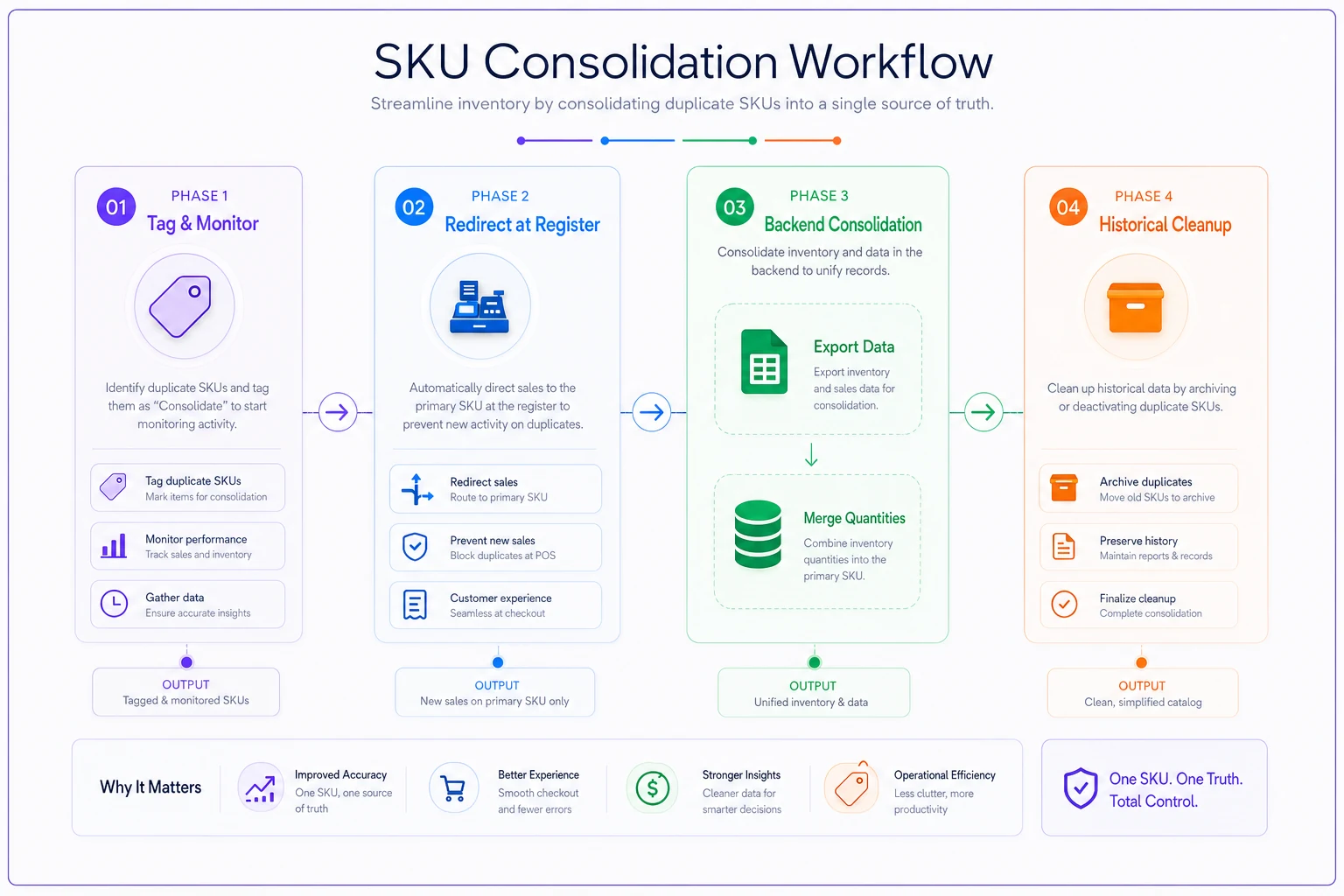
This flow shows the low-risk steps stores should follow to move from tagging to full consolidation without disrupting sales.
Phase 3: Backend Consolidation
-
Schedule for Sunday night or early Monday (lowest traffic)
-
Export current quantities for both SKUs
-
Sum the on-hand amounts
-
Update the clean SKU with total quantity
-
Set old SKU to inactive (don't delete yet)
-
Update reorder points based on combined history
Phase 4: Historical Cleanup (30 days later) After a full inventory cycle, merge historical sales data and remove inactive SKUs. Keep an archive spreadsheet of what merged into what.
Department-specific cleanup priorities
Different departments need different approaches. Your fastener aisle generates hundreds of SKUs but relatively low individual dollar volume. Power tools have far fewer SKUs, but there's a lot of capital tied up in each one.
Fasteners & Hardware: Focus on bulk items first. Contractor packs of screws, nails, and anchors often have 3-4 SKUs for identical items. Use weight as your primary identifier — "1LB BOX 2.5" DECK SCREWS" is cleaner than multiple cryptic codes.
Paint & Sundries: Consolidate by brand and type before worrying about colors. "BEHR-PREM-GAL" works for all Behr Premium gallons, with color as a suffix or attribute. It simplifies vendor ordering while keeping enough specificity.
Lumber & Building Materials: Stick to actual dimensions and treatment. "2X4X8-PT" beats "TREATED LUMBER 8FT" every time. Your par-level calculations for commodities become more reliable when SKUs reflect actual product attributes.
Electrical & Plumbing: Don't consolidate different amperage or pipe sizes, even if prices look similar. These need distinct SKUs for safety and code compliance. Focus instead on description consistency — "CONDUIT-EMT-0.75" not "3/4 METAL PIPE."
Building a lightweight governance checklist
Post this checklist at every workstation where employees might create new items:
Before Creating Any New SKU:
-
Search for the item three ways
by the vendor's exact part number, by a generic description (like "deck screw 3 inch"), and by the first word a customer might actually use.
-
Check the vendor SKU mapping sheet — keep printed copies at receiving.
-
If it's truly new, follow this format
[BRAND PREFIX]-[KEY IDENTIFIER]-[SIZE/VARIANT]. Example: MILW-DRILL-0.375, not "Milwaukee 3/8 drill bit."
-
Complete all required fields
vendor name, vendor SKU (call them if you have to), category from the approved list, reorder point (even if zero initially), and primary supplier.
-
Take a photo and attach it — this single step prevents more "what is this?" confusion than any policy document will.
Weekly SKU Review Tasks (15 minutes):
-
Check for new SKUs created without vendor mapping
-
Look for items with similar descriptions
-
Verify category assignments make sense
-
Flag anything with suspicious naming patterns
Monthly Cleanup Sprint (2 hours):
-
Run the discovery heuristics
-
Update vendor mapping for new products
-
Consolidate obvious duplicates
-
Archive SKUs with 6+ months of no movement
Post this checklist at every workstation where employees might create new items:
The vendor negotiation angle nobody mentions
Clean SKU data gives you unexpected leverage with suppliers. When you can pull accurate purchase history by vendor SKU quickly, you can spot price creep. One store discovered their main electrical supplier had raised prices on conduit fittings three times in six months — but only on the SKUs with messy descriptions they figured wouldn't be caught.
Share your clean vendor-SKU mapping with sales reps. They'll often help maintain it because it makes their commission calculations easier. Some will even provide their catalog in your format, which saves hours of manual work.
During vendor transitions, clean SKU mapping prevents the classic "we don't carry that anymore" runaround. You can prove exactly what you've been buying and push for equivalent replacements at similar margins.
Common consolidation mistakes that backfire
Merging similar-looking items without checking vendor relationships creates ordering disasters. Two brands of construction adhesive might both cost $5.99, but they come from different suppliers with different lead times. Consolidate the SKUs and your auto-reorder system suddenly sends everything to the slower vendor.
Another mistake: consolidating items with different PLU codes or UPC requirements. Some products need specific codes for manufacturer rebates or warranty tracking. That DeWalt drill might look identical to the display model, but the warranty SKU needs to stay separate for claim processing.
And the worst one — consolidating rental items with retail inventory. Your serialized rental tracking breaks immediately when the system can't distinguish between sellable and rentable units.
Practical timeline for small store cleanup
Realistically, cleaning up years of SKU chaos takes 3 to 4 months for a typical hardware store. Here's a pace that's actually sustainable:
Month 1: Build vendor mapping for your top 5 suppliers. Start the discovery process. Train the team on new SKU creation rules. No actual consolidation yet.
Month 2: Start consolidating obvious duplicates in lower-risk categories like fasteners and basic hardware. Create and test register conversion sheets. Update receiving procedures.
Month 3: Tackle the more complex departments — paint, electrical, plumbing. Begin historical data cleanup. Get the weekly review rhythm going.
Month 4: Final cleanup push. Archive dead SKUs. Your inventory counts should actually make sense now.
Making it stick with minimal oversight
Nobody wants to be the SKU police. Instead of fighting that, build checks into existing workflows.
Make vendor SKU lookup part of the receiving process — literally tape the mapping sheets to the receiving desk. Your daily operations playbook should include a quick SKU review during morning inventory checks.
Print monthly "SKU Health Reports" showing new SKUs created, duplicate candidates found, items missing vendor mappings, and dead inventory value. Post them publicly. Peer pressure works better than policy documents.
For stores using AI-powered operational software, automated duplicate detection can run continuously in the background. The system flags consolidation candidates based on pricing patterns, description similarities, and purchase history — so instead of manual spreadsheet detective work, you're reviewing a weekly suggestion list that learns from your previous decisions. Automatic vendor invoice matching takes it further: the software reads vendor emails, extracts SKUs, and maps them to your clean codes without anyone having to do it manually.
The payoff most stores don't track
After a cleanup, most hardware stores see improvements in three metrics nobody thinks to measure beforehand. Average physical inventory time drops noticeably because counters aren't puzzling over mysterious codes. Vendor invoice reconciliation gets faster. And employee confidence at the register goes up — people stop second-guessing whether they're ringing up the right thing.
The financial impact shows up in reduced overstock. When you can trust your reorder points because products aren't hiding under multiple SKUs, you stop accidentally doubling up on inventory. One store cut their fastener inventory value by around $12,000 just by discovering they had the same items filed under different codes.
Clean SKU data also makes vendor negotiations sharper. You can pull accurate purchase history fast, compare prices across suppliers for identical items, and prove your real velocity when pushing for better terms.
One benefit that rarely gets mentioned: your staff stops creating workarounds. When the system actually reflects reality, employees stop keeping personal notebooks of "what things really are" or building their own shadow inventory. That mental overhead disappears, and they can focus on helping customers instead.
The compound effect tends to show up around the six-month mark. New employees onboard faster because the system is intuitive. Inventory counts stay accurate longer. Vendor relationships improve because orders match invoices.
Start this week with just your top vendor's SKU mapping. Don't try to fix everything at once.
Pick one category, build the translation table, and prove the process works. Once your team sees how much easier receiving becomes with clean vendor mappings, they'll actually want to expand it to other departments.
The stores that maintain clean SKU data aren't the ones with complex systems or dedicated inventory managers. They're the ones that built simple, repeatable processes and stuck with them week after week. Your hardware store doesn't need perfect SKU management — it just needs to be consistently better than the current chaos.
Ready to elevate your hardware store management?
Join 500+ hardware stores using Hardzly to boost operational efficiency, reduce stockouts, and grow revenue.