

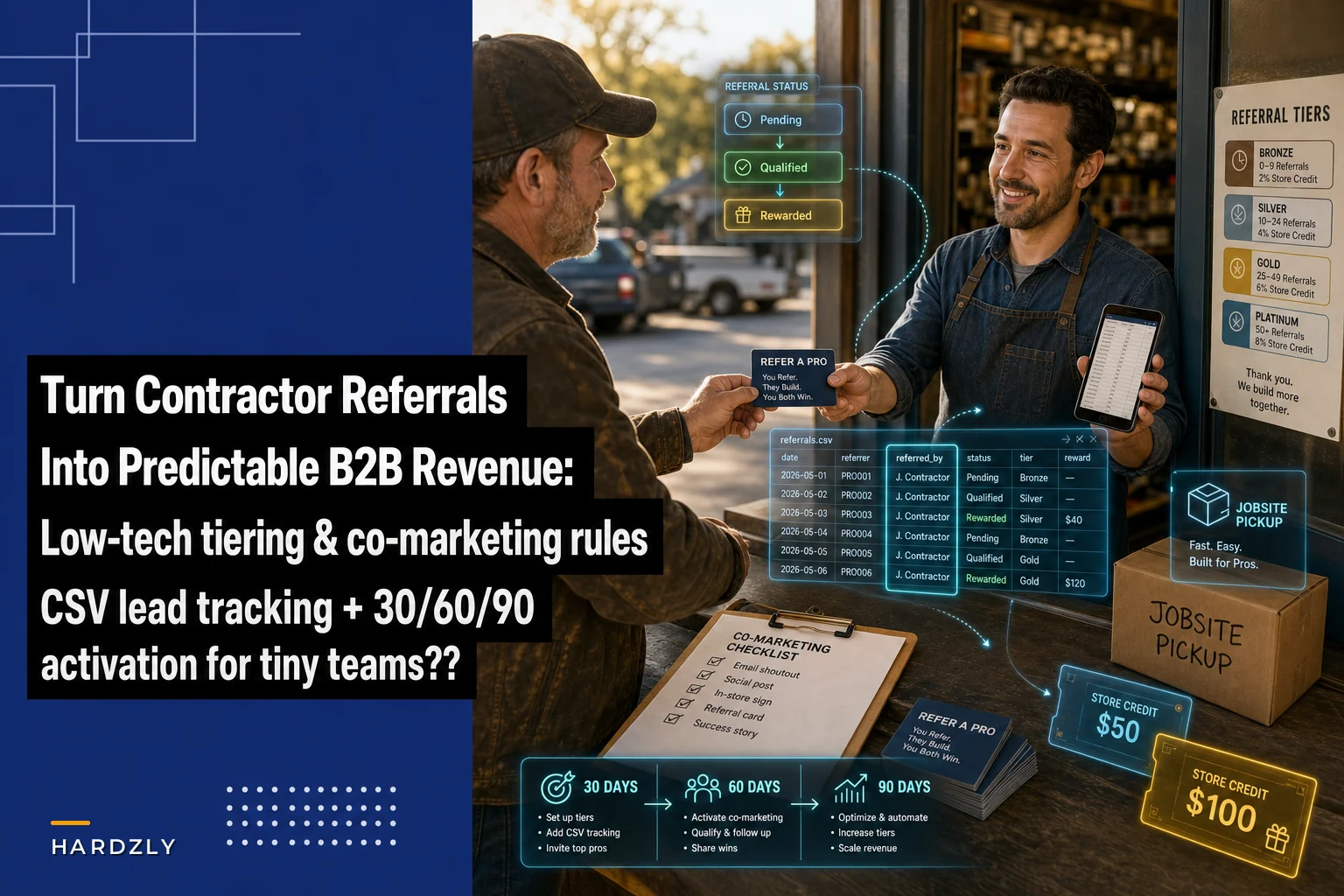

Most hardware store contractor accounts show up by accident. A framer walks in, buys enough over three months that you start recognizing his truck, and eventually somebody sets him up with a house account. There's no system behind it. He referred two other guys over the years, but you couldn't tell me their names, whether they still shop with you, or which of your existing pros actually send you the most business.
That's the gap this piece is about. Not landing contractor accounts — you already know how to do that. The problem is turning the referrals your good contractors would give you into something predictable, trackable, and worth their while. And doing it without buying a CRM you'll never fully configure.
This is a contractor referral playbook for a hardware store built for a two-to-five person team. Low-tech on purpose. One spreadsheet, a handful of rules, and a 90-day rollout you can actually finish.
Why contractor referrals stay accidental
The reason most stores never build a real referral engine isn't laziness. It's that referrals sit in an awkward spot between sales and relationships, and nobody owns them.
Your best electrician — the one doing $40k–$60k a year with you — probably knows five other tradesmen. He'd happily send them your way. Contractors talk constantly about where to buy, who honors returns, who stocks the right conduit. But he's never going to think to refer unless there's something in front of him at the counter prompting it. And when he does mention you to another guy, that guy walks in, opens an account, and there's zero connection back to the original referrer.
So the loop never closes. You get the new account, but the person who sent it never hears "thanks," never gets anything for it, and never does it again on purpose.
Worth noting: contractors refer based on reliability, not price. The stores getting the most word-of-mouth aren't the cheapest. They're the ones where the will-call order is always ready and the counter guy knows what a P-trap is. Which means your referral program isn't a discount scheme — it's a formalization of trust you've already built.
The tier structure: keep it to three levels
Overcomplicating tiers is the fastest way to kill this before it starts. You don't need six levels with points and redemption catalogs. Three tiers, based on trailing spend and referral activity, is enough for any single-location store.
Stop losing sales due to inventory gaps.
Hardzly helps you manage stock levels, orders, and supplier interactions efficiently.
- Unified inventory and sales tracking
- Supplier and purchase order management
- Automated workflow and task scheduling
No credit card required
| Tier | Qualifies by | Core benefits | What you ask in return |
|---|---|---|---|
| Blue (entry) | Active account, any spend | Net-15 terms, contractor pricing on 3–4 core categories | Nothing — this is the baseline |
| Silver | ~$1,500+/month trailing 3 mo or 1 successful referral | Above + priority will-call, first pick on closeout pallets, jobsite delivery on orders over $300 | Willingness to be named as a reference |
| Gold | ~$4,000+/month trailing 3 mo or 3 successful referrals | Above + dedicated account contact, quarterly "restock day" early access, annual account review | Actively refers, agrees to a co-marketing mention |
Two things make this work. First, referrals are a qualifying path, not just spend. A smaller contractor who sends you three solid accounts should get Gold treatment even if his own volume is modest — his referral value can easily outweigh his invoice total. Second, the benefits are operational, not just financial. Priority will-call and jobsite delivery cost you almost nothing but matter enormously to a guy losing daylight waiting at your counter.
If you already run tiered contractor accounts, this layers cleanly on top of the credit and invoicing structure in the contractor account playbook on tiered benefits and credit-check flows. The referral tiers here should mirror the account tiers you already use so nobody gets confused about which level they're on.
What counts as a "successful referral"
-
Opens an account (not just makes a one-time walk-in purchase)
-
Spends at least ~$500 in their first 60 days
-
Was named by the referrer at the time of signup, not claimed after the fact
That last point matters. Without a "named at signup" rule, you'll get contractors claiming credit for accounts that were already coming to you anyway. Ask every new account opener: "Did anyone here refer you?" and write the name down on the spot.
The referral rewards: match the reward to the trade
Cash-back sounds clean but creates two problems — it feels like a bounty, and it invites gaming. What works better is rewards tied to how contractors actually operate.
A few that hold up in practice:
-
Account credit applied to their next statement (~$50–$150 per successful referral, scaled by tier). Simple, shows up where they'll notice it, keeps them shopping.
-
Tier acceleration — three referrals bumps them to the next tier regardless of spend. Often more motivating than credit for a contractor who really wants delivery and priority pickup.
-
A useful physical thing — a good branded tape measure, a jobsite cooler, decent gloves. Contractors are weirdly loyal to gear that actually works. Skip the cheap junk; it signals you don't respect their time.
Avoid tiered cash percentages or anything that requires math to understand. If a contractor can't explain the reward to another contractor in one sentence, it won't spread.
Co-marketing rules: where most stores overreach
Hardware stores get into trouble here. They decide to "co-market" with their contractors and immediately start posting the contractor's business on the store Facebook, printing joint flyers, and cross-promoting in ways that feel forced and create liability nobody thought through.
Rules that keep this clean:
-
Only Gold-tier contractors get referred to customers. When a DIY customer asks "do you know anyone who installs these?", you should only be naming pros you'd stake your reputation on. Tier gates this automatically.
-
Referrals go both ways, but you never guarantee work. Point a homeowner toward a contractor; never promise that contractor's price, timeline, or quality. Say "here are two guys who buy from us and do good work" and stop there.
-
No exclusive arrangements. The second you promise one plumber all your homeowner referrals, you've made an enemy of every other plumber who shops with you. Rotate among Gold-tier pros in each trade.
-
Get a one-line written OK before you use anyone's name or logo anywhere. A text message counts.
Sample co-marketing templates
> Need it installed? These local pros buy their materials here and do quality work. We can't guarantee their pricing or schedule, but we're glad to point you to people we trust. > [Contractor name] — [trade] — [phone] > [Contractor name] — [trade] — [phone]
> Hey [name] — quick one. We're setting up a referral perk for our contractor accounts. If you send another tradesman our way and they open an account, we'll put a $[X] credit on your statement once they've spent $500. No paperwork on your end — just have them mention your name when they sign up. Appreciate you.
Tracking it all in one CSV
You don't need software for this. A single spreadsheet, updated at the counter, handles a store's worth of referral activity for years. The mistake people make is tracking too many fields, so the sheet becomes work and stops getting updated.
accountname, trade, tier, referredby, referraldate, firstpurchasedate, first60dayspend, referralstatus, rewardissued, rewarddate, notes
What each column does in practice:
-
referred_by — the name given at signup. Blank if it was a walk-in.
-
referral_status — one of
pending,qualified,expired. Pending until they hit $500 in 60 days, then qualified or expired. -
reward_issued — yes/no, so nobody double-pays a referrer.
-
notes — the human stuff. "Prefers text over email." "Slow payer, watch statement." This column is where the relationship actually lives.
A companion tab tracks referrers:
contractorname, tier, totalreferrals, qualifiedreferrals, totalrewardcredit, lastreferral_date
Sort that second tab by qualified referrals once a month and you instantly know who your real advocates are. Usually it's two or three names doing most of the work — those are the people who deserve the Gold review, the early restock access, and a genuine thank-you conversation.
One workflow rule makes this whole thing survive: the referral gets logged the moment a new account is opened, at the counter, by whoever's setting it up. Not batched at end of week. Not "I'll add it later." If it's not part of the account-opening motion, it won't happen consistently.
Here's a simple visual to show the CSV-based referral logging and reward flow.
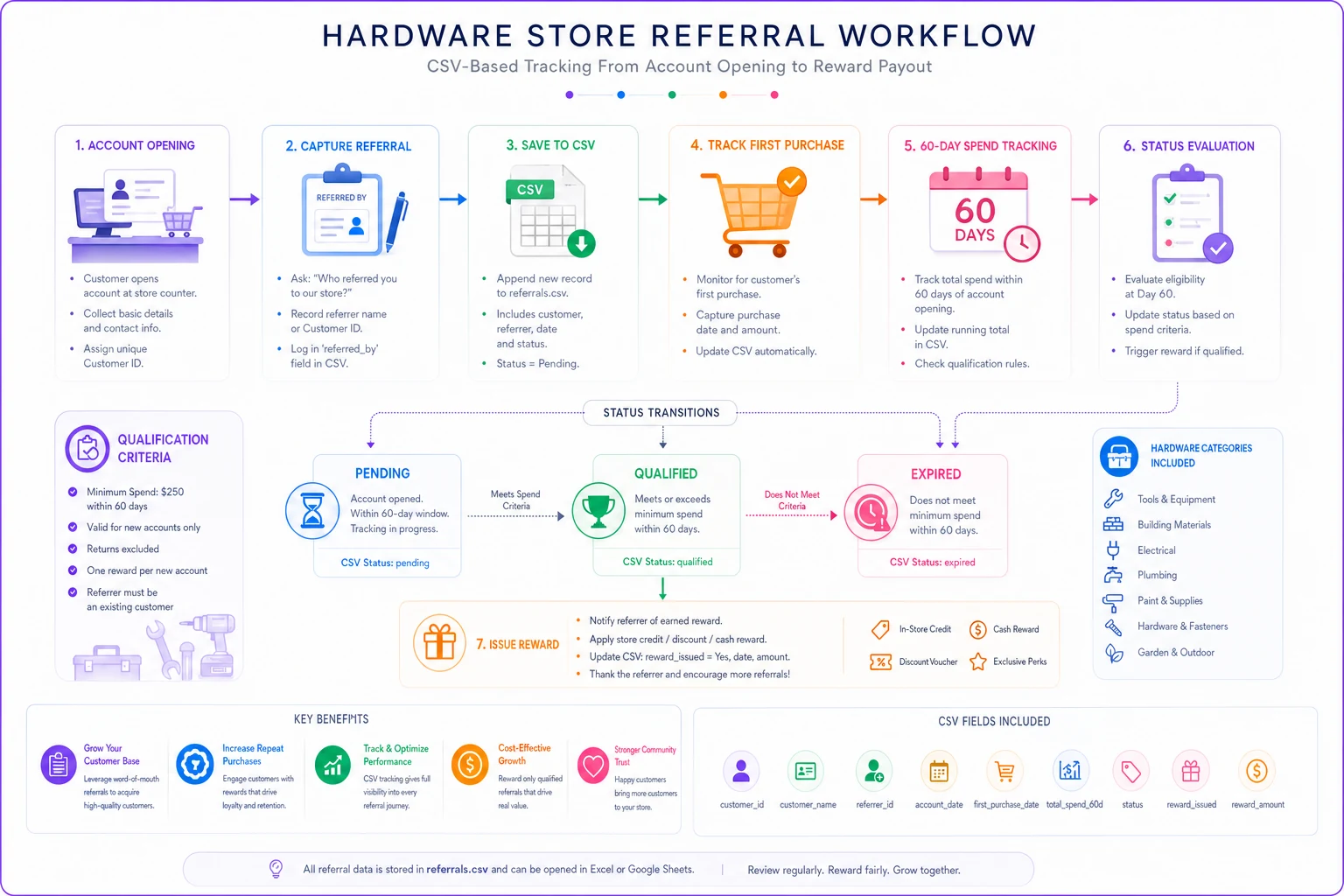
This visual summarizes the logging and reward flow so the team can follow it consistently.
The 30/60/90 activation plan
Rolling this out all at once is how it dies. Here's the phased version that a small team can actually complete without dropping the ball on daily operations.
Days 1–30: Build the foundation quietly
-
Define your three tiers and the exact benefits for each (use the table above as a starting point, adjust to your margins).
-
Set up the CSV with both tabs and back-fill your existing top 15–20 accounts by trailing spend.
-
Assign tiers to current accounts. Tell your Gold-tier pros first — in person — that they're getting new perks. No big launch, just a conversation.
-
Train whoever opens accounts to ask "who referred you?" every single time and log it.
Don't announce a "program" yet. Set the machinery before you turn it on.
Days 31–60: Activate your existing advocates
-
Send Template B to your top 10–15 contractors. Individually, not as a mass email. A referral ask feels personal or it feels like spam.
-
Print the counter cards (Template A) with your two or three vetted Gold pros per trade.
-
Start issuing rewards the moment the first referral qualifies — and make sure the referrer hears about it. "Hey, that credit's from Mike sending Dave our way." Visible rewards drive the next referral.
Days 61–90: Tighten and review
-
Run your first monthly referrer report off the second CSV tab. Identify who's active, who went quiet.
-
Adjust rewards if something isn't landing — if credit isn't motivating, try tier acceleration instead.
-
Do a short review with each Gold contractor
what they need, what they're seeing on jobsites, what you could stock better. This conversation generates more referrals than any incentive.
By day 90 you should have a working loop: accounts open with referrers logged, rewards issue off a clear rule, and you can name your top advocates from a sorted spreadsheet.
A realistic scenario
Take a single-location store doing around $2M a year with maybe 30 active contractor accounts. Before any of this, referrals were happening — probably three or four new accounts a year traced vaguely to word-of-mouth — but nobody tracked them and nobody got rewarded.
After running the 90-day plan, the picture usually shifts. Once the "who referred you?" question becomes automatic, stores often discover that three or four contractors were quietly responsible for most of their best accounts. Two of them get bumped to Gold and start referring on purpose once there's a reason to. Over the following six months, qualified referrals go from a vague handful to something like eight to ten trackable new accounts, several landing in the $1,000+/month range.
The reward cost stays manageable — a few hundred dollars in statement credits against several thousand a month in new recurring contractor revenue. The bigger change is that the store finally knows where its B2B growth comes from, which is the thing you can't get from a stack of anonymous house accounts.
When this makes sense — and when it doesn't
This works well if you already have a stable base of contractor accounts, decent will-call and delivery capability, and at least one person who owns account setup. The referral engine amplifies an operation that's already reliable.
Skip it for now if your fundamentals are shaky. If will-call orders aren't consistently ready or account billing is a mess, referrals will backfire — you'll be paying contractors to send people who then have a bad experience. Fix the account structure and invoicing basics first, then bolt referrals on top.
Don't bother with the co-marketing side if you can't confidently name two or three pros per trade you'd send your own family to. A weak homeowner referral is worse than none — it puts your credibility on someone else's job.
The part that actually matters
Everything above is mechanics — tiers, CSV columns, templates. The reason contractor referrals turn into predictable revenue has less to do with the spreadsheet and more to do with closing the loop out loud. Contractors keep referring when they can see it's working: the credit shows up, someone says thanks, the guy they sent got treated right.
Most stores already have the trust. What they're missing is the small, boring discipline of writing down who sent whom, and making sure the person who sent business actually hears about it. Do that consistently for 90 days and you've built something no big-box can copy — a network of tradesmen who'd rather send their friends to you than anywhere else.
Do that consistently for 90 days and you've built something no big-box can copy — a network of tradesmen who'd rather send their friends to you than anywhere else.
Ready to elevate your hardware store management?
Join 500+ hardware stores using Hardzly to boost operational efficiency, reduce stockouts, and grow revenue.