

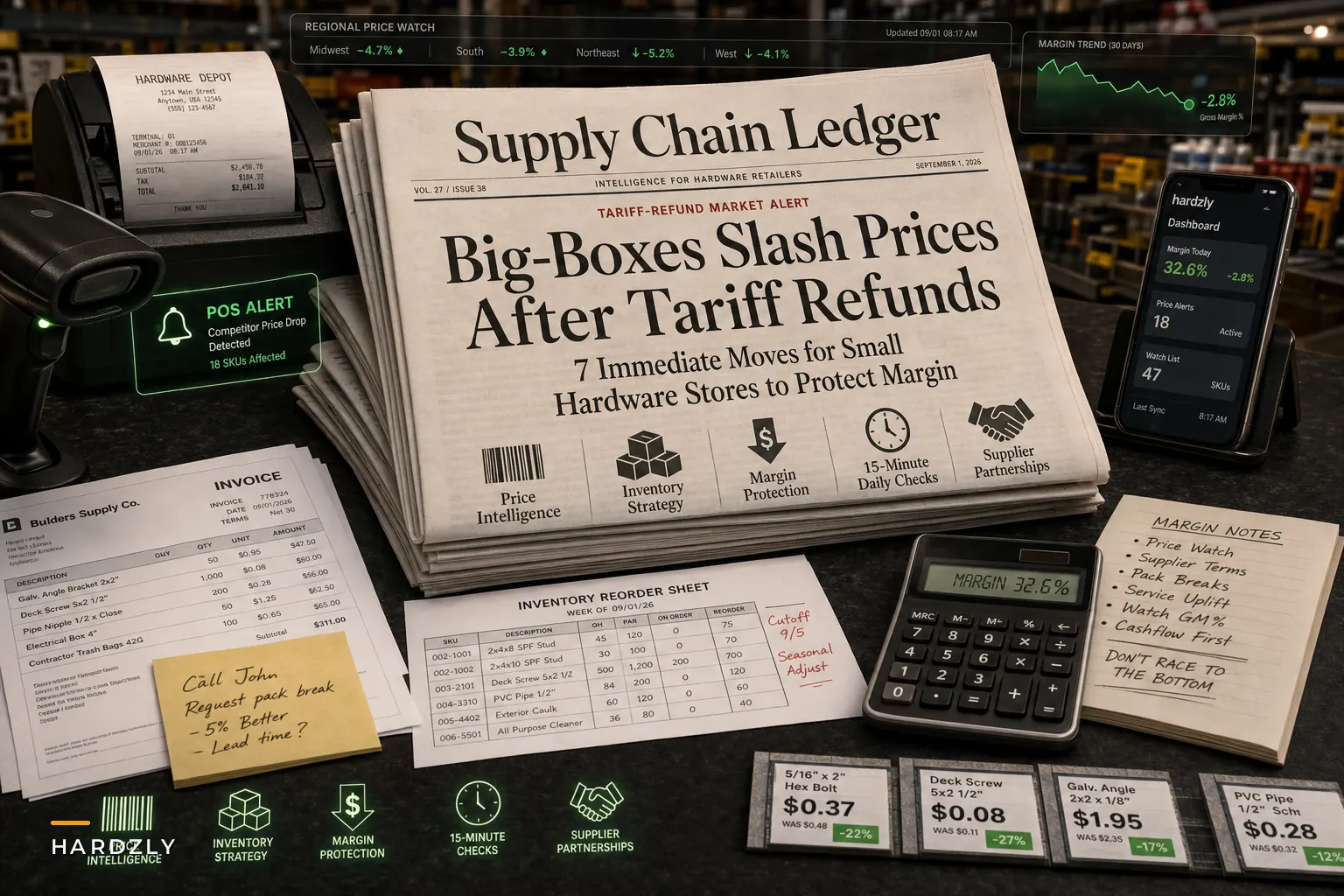

The big two just showed their hand. Home Depot's Q2 numbers dropped on August 18, Lowe's followed the next day, and buried inside both reports was the same signal: meaningful tariff-refund windfalls flowing back in, with both chains using those dollars to soften cost of goods and hold or trim shelf prices. Both were also pretty blunt about a cautious DIY shopper and a "frozen" housing market — which is exactly why they're chasing pro customers harder than usual right now.
The CNBC coverage of Home Depot's quarter framed it around housing conditions, and the Lowe's writeup noted the same pricing flexibility paired with a muted outlook. Read together, the takeaway for an independent isn't that complicated: your two biggest competitors just got a temporary cost cushion you almost certainly won't see, and they're going to spend part of it buying traffic on commodity SKUs right as Labor Day and early-fall projects kick in.
That's the situation. What actually matters is what you do about it in the next five business days — without blowing up your margins trying to match a price you can't sustain.
First, understand what they're actually doing (so you don't overreact)
A tariff refund is a one-time-ish cash event. It doesn't lower a retailer's structural cost forever. So when a big-box uses that money to fund lower prices, they're not spreading it thin across 40,000 SKUs — that would be invisible to shoppers. They fund a handful of loud, comparison-shopped items: a specific bag of concrete mix, a name-brand drill kit, a common box of deck screws, a gallon of a well-known paint line.
The mistake independents make is treating a headline price cut like a store-wide war and slashing across the board. You end up giving away margin on hundreds of items nobody was comparing anyway, to defend against a promotion aimed at maybe a dozen.
What's really happening is a traffic play on known-value items — products customers can roughly price in their head. Your job this week is figuring out which of your SKUs are exposed to that, and leaving everything else alone.
The 7 moves, in the order they actually matter
1. Build a "watch list" of your price-visible SKUs (30–45 minutes)
Stop losing sales due to inventory gaps.
Hardzly helps you manage stock levels, orders, and supplier interactions efficiently.
- Unified inventory and sales tracking
- Supplier and purchase order management
- Automated workflow and task scheduling
No credit card required
Not every product gets comparison-shopped. Customers don't know what a specialty hinge or an off-brand caulk should cost. But they absolutely have a rough number in their head for a common bag of quikrete, a case of AA batteries, or a name-brand cordless kit.
-
Nationally branded and stocked by both big-boxes
-
Bought on price, not advice
-
High enough volume that a lost sale actually stings
You're probably looking at somewhere between 40 and 120 SKUs, not thousands. That's your defense perimeter. Everything outside it, protect margin; inside it, make deliberate calls.
A quick pattern worth noting: for most single-location stores, the price-visible list is heavily weighted toward paint, common fasteners in bulk, batteries, tarps, adhesives, and a couple of hero power tools. If yours looks wildly different, double-check you're not including advice-driven items that just feel competitive.
2. Set POS price-drop alerts on that list — don't eyeball it
The danger with big-box tariff-funded pricing is that it moves quietly. A shelf price ticks down and you don't notice for three weeks because nobody told you. By then you've already lost the fall-project shopper who bought their whole cart elsewhere because your concrete looked expensive.
If your point-of-sale or inventory platform supports rules, set a simple flag: any watch-list SKU whose competitor price — or your own margin on it — crosses a threshold gets surfaced automatically. This is exactly the kind of repetitive monitoring that eats an owner's week when done by hand, and basically runs itself once it's configured. The point isn't sophistication — it's that you stop discovering price gaps at the register and start seeing them the day they open.
3. Decide your response tier for each watch-list item BEFORE the pressure hits
This is the single highest-leverage thing on the list, and most stores skip it. When a competitor drops price, you don't want to be inventing a response on the spot with a customer standing at the counter. Pre-decide.
For every watch-list SKU, assign one of three responses:
| Response tier | When to use it | What you actually do |
|---|---|---|
| Match | High-volume hero items where losing the sale loses the whole basket | Meet the price, accept thin margin, treat it as a traffic cost |
| Bracket | Items where you can offer a "good-better-best" so the compared price isn't your only option | Stock a cheaper alt below and a premium above; let the middle absorb comparison |
| Hold + justify | Items where service, availability, or bundling carries real value | Keep your price, train staff on the 10-second reason why |
The trap is defaulting everything to "match." You can't out-cash a company sitting on a refund windfall, and you don't need to. Most of your list should land in bracket or hold, with match reserved for a small number of genuine anchor items.
If you've never formalized your markup logic by category, this is a good moment to do it — the tier decisions get a lot cleaner when they sit on top of a real structure. Our margin-first pricing framework for hardware stores walks through category-tier markup bands and pairs directly with this exercise.
Start by assigning tiers to your top 40–60 price-visible SKUs so you have decisions ready for the most-exposed lines.
Quick visual of the workflow:
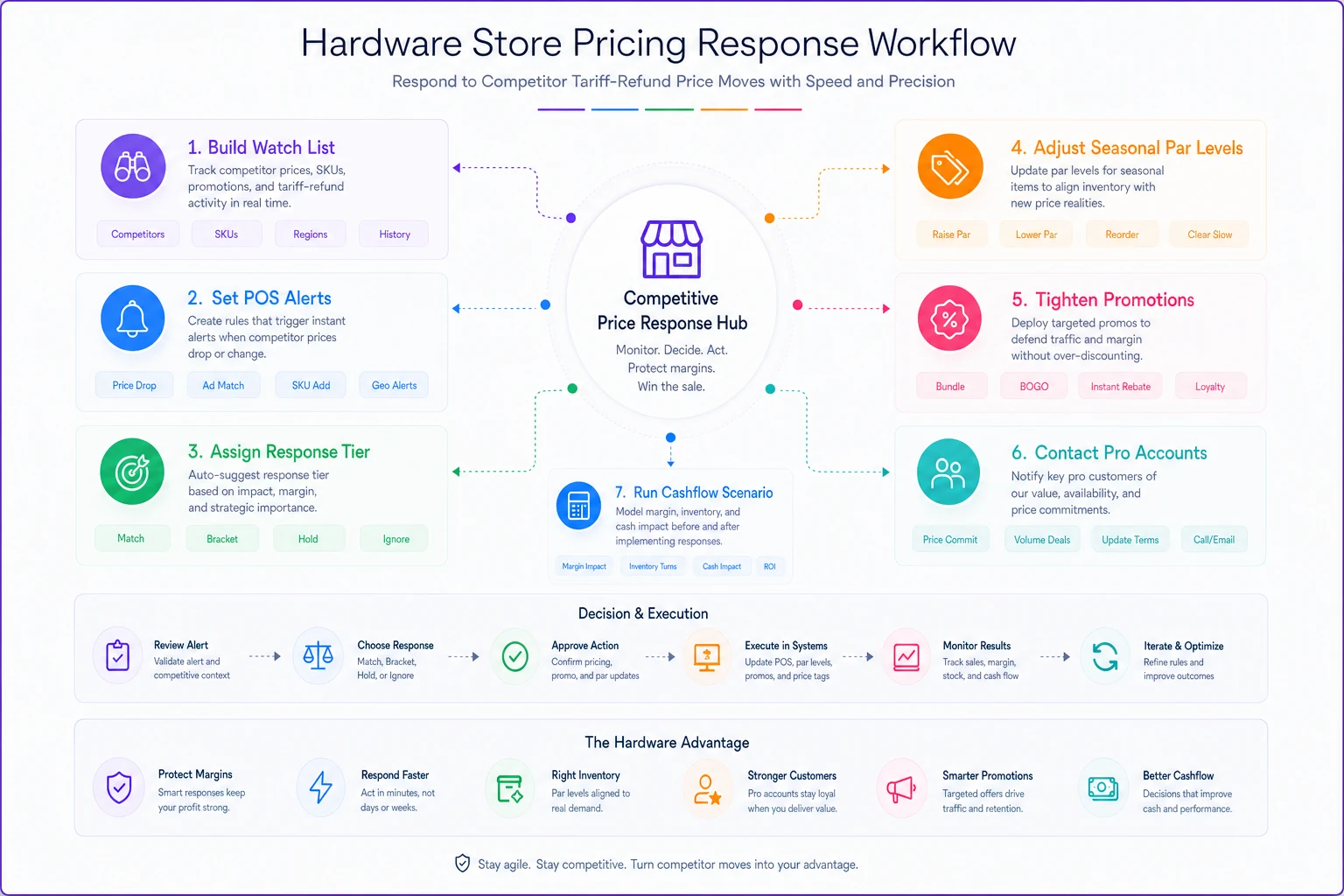
Use this to walk your team through the steps and show where decisions get made.
4. Re-check par levels on the seasonal SKUs you're about to commit cash to
Here's a cashflow trap that shows up every fall without fail: you load up on seasonal inventory at normal reorder quantities, then a big-box promo pulls a chunk of that demand elsewhere, and you're sitting on stock you paid full freight for while your competitor discounts theirs.
Before you fire off fall reorders, look at your seasonal par levels on anything that overlaps the big-box promo categories. If a SKU is both seasonal and on your price-visible watch list, trim the reorder and go more frequent instead of one big commit. You're trading a bit of ordering effort for not being stuck with deadstock you can only move by matching a price that kills your margin anyway.
A rough example: a store that normally brings in a full pallet of ice-melt in one September buy might split that into two smaller pulls three weeks apart. Slightly more receiving work, but if the season starts soft or a competitor undercuts, you're not holding the whole pallet at risk.
5. Tighten promo ROI — kill the lazy discounts
When margin pressure is coming from outside, the worst thing you can do is also run sloppy internal promotions on top of it. A lot of small stores run a fall circular out of habit, discounting items that were selling fine at full price.
Do a quick pass on any planned promotion:
-
Is this item actually price-visible, or am I discounting something nobody was comparing?
-
What's the margin after the discount, and what lift do I actually need to break even on the giveaway?
-
Would a bundle move more units at better total margin than a straight price cut?
Bundling deserves a specific mention. Big-boxes are clumsy with true bundles because their systems favor single-SKU pricing. A "starter deck kit" — screws, bit, sealant, a pair of gloves — priced as a package protects your per-item margin while giving the shopper something they can't easily line up against a single big-box price tag. That's a lane where you can actually win without racing to the bottom.
6. Point your attention at pro and repeat customers, since the big-boxes already are
Both chains basically told the market they're leaning into pro spending because the DIY shopper is cautious. That's a signal, not just a threat. Pro and contractor buyers care about availability, will-call speed, account terms, and someone who actually knows the counter — not saving forty cents on a box of screws.
This week, do two concrete things:
-
Make sure your contractor accounts know you're stable, stocked, and easy to buy from heading into fall. A single call or text to your top 15–20 accounts does more than any price cut.
-
Check whether your will-call pickup and account-billing flow is smooth enough that a busy pro doesn't get stuck waiting. Friction loses pro business faster than price does.
The independents that hold their ground during big-box price pushes almost always do it by owning the relationship-and-service side that a refund windfall can't buy.
7. Run a short cashflow scenario for a soft fall
Last one, and it's a defensive move. Model a version of your fall where the big-boxes' pricing pulls roughly 5–10% of traffic off your commodity lines. Not a catastrophe — just a realistic dent. What does that do to your cash position after you've paid for seasonal inventory?
If the answer makes you uncomfortable, that's a reason to lean harder on moves 4 and 5 — buy seasonal stock in smaller waves, cut the lazy promos — rather than a reason to panic. A store that knows its downside walks into the season making calm decisions. A store that hasn't done the math ends up over-discounting in October out of fear, which is usually worse than whatever the competitor did.
A real scenario: the deck-and-fastener squeeze
Picture a single-location store doing somewhere around $2.4M–$2.8M a year, decent fastener and lumber-adjacent business, one owner and a small counter crew.
Late August, a nearby big-box drops the price on a common exterior deck screw box and a well-known cordless kit — clearly funded by that refund cushion, not a permanent cost change. Over about two weeks, the store notices its deck-screw movement softening. No alarm bells, just quieter.
Instead of blanket-matching, the owner runs the list. Deck screws land in match — true anchor item, protects the whole project basket. The cordless kit goes to hold + justify: they can't win on that price, but they bundle it with a discounted second battery and a "we set it up and it's ready today" pitch, which the big-box can't easily counter. The specialty fasteners and coated hardware around it? Left completely alone at full margin, because nobody was comparing those anyway.
Net effect over the season: they gave up margin on exactly one line, held it on everything else, and the project-basket customers who came in for cheap screws still bought their brackets, sealant, and hangers at normal margin. The lost margin on the matched SKU was small and chosen, not bled out across the store.
That's the whole game — deliberate concession on a few items, protected margin everywhere else, and service value where price can't compete.
When matching prices is the wrong call
Worth being direct about this. Matching a tariff-funded big-box price is the wrong move when:
-
The item is advice-driven — if customers ask you which one to buy, you have pricing power and shouldn't hand it away
-
The SKU is low-volume — you're taking a margin hit to defend sales that barely existed to begin with
-
You'd have to match store-wide to feel consistent — that's how a promotion aimed at a dozen items quietly wrecks your whole margin structure
-
The competitor's cut is clearly temporary — riding out a short promo is often cheaper than permanently retraining your customers to expect the lower price
The refund windfall is, by nature, not permanent. Structural costs haven't changed for the big-boxes. Some of this pricing pressure will ease once the one-time cash is spent, which means the smartest response is targeted and reversible — not a scorched-earth repricing you'll struggle to walk back when they do.
The move to make today
Don't try to run all seven at once. Start with the watch list and the response tiers — moves 1 and 3. That's maybe an hour of work, and it converts a vague "the big-boxes are undercutting me" anxiety into a specific, bounded list of items with pre-made decisions attached. Everything else on this list gets easier once that perimeter exists.
The stores that struggle during these pricing pushes aren't usually the ones with higher costs. They're the ones reacting item-by-item, at the register, in a panic. The refund windfall gave your competitors a short-term lever. Your counter-lever is being deliberate, keeping your margin where it belongs, and owning the service and relationship side that no amount of one-time cash can replicate.
The stores that struggle during these pricing pushes aren't usually the ones with higher costs. They're the ones reacting item-by-item, at the register, in a panic. The refund windfall gave your competitors a short-term lever. Your counter-lever is being deliberate, keeping your margin where it belongs, and owning the service and relationship side that no amount of one-time cash can replicate.
Ready to elevate your hardware store management?
Join 500+ hardware stores using Hardzly to boost operational efficiency, reduce stockouts, and grow revenue.