



Most independent hardware stores don't have a pricing strategy. They have a pricing reflex. Cost comes in at $4.20, someone doubles it, rounds to $8.99, and moves on. That works fine until you look at your P&L six months later and realize your blended margin drifted three points and you have no idea which categories bled you.
The problem isn't that keystone markup is wrong. Sometimes it's exactly right. The problem is applying the same instinct to a gallon of premium paint, a box of deck screws, and a weekend rental on a tile saw — three categories with completely different cost structures, competitive pressure, and turn rates. Each one wants a different margin logic, and when you treat them the same, you either leave money on paint or price yourself out of fasteners.
A margin-first framework flips the order of operations. Instead of asking "what's the markup on this SKU," you ask "what category tier does this belong to, and what margin band protects the store's overall number." Individual pricing falls out of the band almost automatically. This is what separates a store that hits 42% blended margin on purpose from one that lands at 38% by accident.
Why per-SKU pricing quietly falls apart
When a store is small, per-SKU pricing feels manageable. The owner knows the numbers. They know paint should carry more than lumber, they know they can't touch commodity fastener pricing because the box store down the road sets the ceiling, and they adjust intuitively.
The trouble is intuition doesn't scale and it doesn't transfer. The moment you're not the only person setting prices — a manager receives a shipment, a new hire tags product, a vendor sends a cost increase — the logic in your head is invisible to everyone else. So the store ends up with:
-
Paint priced inconsistently across sheens because two different people tagged it
-
Fasteners at keystone when the market only supports 35–40% because nobody knew the ceiling
-
Rentals priced on gut feel with no accounting for actual asset recovery
-
Supplier cost increases that never make it into retail prices, so margin erodes silently
Margin doesn't collapse in one big event. It leaks. A vendor bumps cost 6% in March, the retail price never moves, and by December that category is running four points light. Multiply that across 40 categories and the leak is your entire net profit.
The fix is to stop managing thousands of prices and start managing a dozen or so markup bands.
The core idea: category tiers with margin bands, not fixed markups
A markup band is a target margin range assigned to a category tier, plus rules for where a given SKU lands inside that range. You're not setting one number — you're setting guardrails.
Stop losing sales due to inventory gaps.
Hardzly helps you manage stock levels, orders, and supplier interactions efficiently.
- Unified inventory and sales tracking
- Supplier and purchase order management
- Automated workflow and task scheduling
No credit card required
Here's the tier logic most hardware stores can build around:
| Tier | Category examples | Target margin band | What sets the price |
|---|---|---|---|
| Commodity / price-visible | Common fasteners, PVC fittings, standard lumber, batteries | 28–38% | Market ceiling (box stores, online) |
| Standard core | Hand tools, hardware, electrical, plumbing parts | 40–48% | Keystone-ish, some room to move |
| Specialty / advice-driven | Paint & sundries, specialty fasteners, niche hardware | 45–55% | Value & service, not comparison |
| Convenience / impulse | Small parts bins, adhesives, tape, seasonal impulse | 50–60% | Low price sensitivity |
| Rental / service | Tool rental, equipment, sharpening, key cutting | Recovery-period model | Asset payback + utilization |
The bands overlap on purpose. A SKU's exact position depends on three things: how price-visible it is, how much service goes into the sale, and how fast it turns. High-visibility, low-service, fast-turn items sit at the bottom of their band. Low-visibility, advice-heavy, slow-turn items sit at the top.
The insight most owners miss: your commodity tier isn't where you make money — it's where you keep credibility. You price it thin on purpose so customers trust the rest of your store. The specialty and convenience tiers are where the margin actually lives. If you're keystoning commodities and thinning specialty, you've got it exactly backwards.
Worked example 1: Paint
Paint is the category owners most often underprice relative to its true value, because they anchor on the gallon cost and forget the whole basket.
Say your cost on a gallon of quality interior latex is around $22. Keystone gets you to $43.99, roughly 50% margin. Fine. But paint is an advice-driven, low-comparison sale — most customers can't easily price-check your specific line, and they're leaning on you for color matching, sheen advice, and coverage math. That's specialty tier. There's room to sit at the top of the band.
More importantly, paint drags a sundries basket behind it that almost nobody prices with intention:
-
Roller covers, cost ~$2.10, sold at $6.99 → ~70% margin
-
Blue tape, cost ~$3.40, sold at $8.49 → ~60%
-
Drop cloth, cost ~$4.00, sold at $10.99 → ~64%
-
Tray + liner, cost ~$1.80, sold at $5.49 → ~67%
A typical paint project sale looks like this: one to three gallons plus $30–$45 of sundries. If you keystone the paint but leave sundries under-marked — a common tag-and-forget mistake — you're capping your best-margin sub-basket in the store.
A margin-first move on paint isn't "raise the gallon price." Hold paint at the top of the specialty band, and make sure every sundry is riding its convenience-tier band of 55–65%. On a busy paint counter doing 40–60 project baskets a week, tightening sundry margins alone can be worth a few thousand dollars a quarter without a single customer noticing.
Worked example 2: Fasteners
Fasteners are the opposite trap. Owners overprice the commodity and underprice the specialty, because they treat the whole aisle as one thing.
Common deck screws, drywall screws, standard hex bolts — these are price-visible. Contractors buy them by the pound and they know what a 5-pound bucket costs everywhere. Try to keystone that and a contractor account walks. This is pure commodity tier: 28–38%, priced against the market ceiling.
But the same aisle holds specialty fasteners — stainless in odd sizes, structural connectors, concrete anchors, tamper-proof hardware — that almost nobody comparison-shops because they need this one and they need it now. That's specialty or convenience tier. A stainless carriage bolt costing $0.90 can comfortably sell at $2.79–$3.29. Nobody's price-checking a single anchor bolt.
The failure pattern: a store keystones the whole fastener wall with one rule, prices commodity screws too high, loses the contractor's loyalty and their whole basket, and prices specialty anchors too low, giving away margin on the one item with no real competition.
Because fasteners live and die on stocking discipline, your pricing bands only work if your par levels are right — running out of a commodity screw during a project sends that customer to the box store for good. The mechanics of getting those par levels right are worth a separate read: par-level formulas for nails, screws and adhesives. Pricing and stocking are the same conversation here.
-
Commodity fasteners → bottom of the commodity band, market-checked quarterly.
-
Specialty fasteners → mid-to-top of the specialty band, priced on urgency and scarcity.
One aisle, two completely different pricing philosophies. That's the whole point of tiers.
Worked example 3: Rentals
Rentals don't fit a markup model at all, and forcing them into one is where most stores quietly lose money on equipment.
You don't mark up a rental — you recover an asset over a payback period, then earn on it. The right question is: how many rental days does it take to recover the purchase cost, and what utilization can I realistically expect?
Take a tile saw that costs $650. Set a daily rate of $45 and a weekend rate of $110. You need roughly 15 rental days to recover the asset before maintenance and consumables. If that saw rents 4–6 times a month on weekends, you recover the cost in three to four months and everything after is margin — minus blade wear, cleaning, and the occasional repair.
The pricing bands that matter for rentals aren't margin percentages, they're:
-
Recovery target how fast do you want the asset paid off? (Aggressive: 2–3 months. Conservative: 6.)
-
Utilization tier high-demand equipment can price at a premium; slow movers need volume pricing or deposits to justify the shelf space.
-
Damage/loss buffer built into the deposit and the rate, not tacked on as an afterthought.
The mistake here is pricing rentals to look competitive against a big-box rental counter without ever calculating your own payback. A store might rent a $900 generator for $35/day because "that feels right," never notice it only goes out twice a month, and quietly bleed money on maintenance for two years. No rental rate should get set until the recovery period is on paper.
Promotional exceptions: the rules that protect the band
Every store runs promos. The danger is that promos become permanent margin leaks — a "sale" price that never gets un-set, or a discount so deep it drags the category average below its band for the quarter.
Promotions should be exceptions with rules, not a free-for-all. A few guardrails worth writing down:
-
Never promote below the floor of the tier below. A specialty item can promote down into standard-core margin territory, but not into commodity margins. That keeps a "sale" from destroying category math.
-
Time-box every promo with a hard end date and a responsible person. The most common leak is a promo price that outlives the promotion because nobody reset it.
-
Cap the share of a category on promo at any one time. If more than roughly 20% of a category's SKUs are discounted simultaneously, you're not promoting, you're just running a lower price.
-
Use commodity items as the promotional face, not specialty. Discount the price-visible stuff people check. Protect the advice-driven stuff they don't.
-
Fund deep discounts with vendor money. If a supplier isn't co-funding a doorbuster, you're subsidizing it out of your own margin — sometimes fine, but it should be a deliberate choice.
The pattern that quietly wrecks blended margin: a manager runs a "10% off all paint" weekend to move volume, but paint is already your top-band specialty category. You just handed away your richest margin on the one thing customers weren't comparison-shopping. Promote roller covers instead, or a commodity fastener bucket — items where the discount drives traffic without giving away your best points.
Seasonal promos carry the same risk with an added twist: they're often trying to clear inventory before it becomes deadstock, which changes the math entirely. When the goal is clearance rather than traffic, different rules apply — the timing and depth logic for that is worth its own look in the seasonal deadstock playbook.
A cadence to keep the bands honest
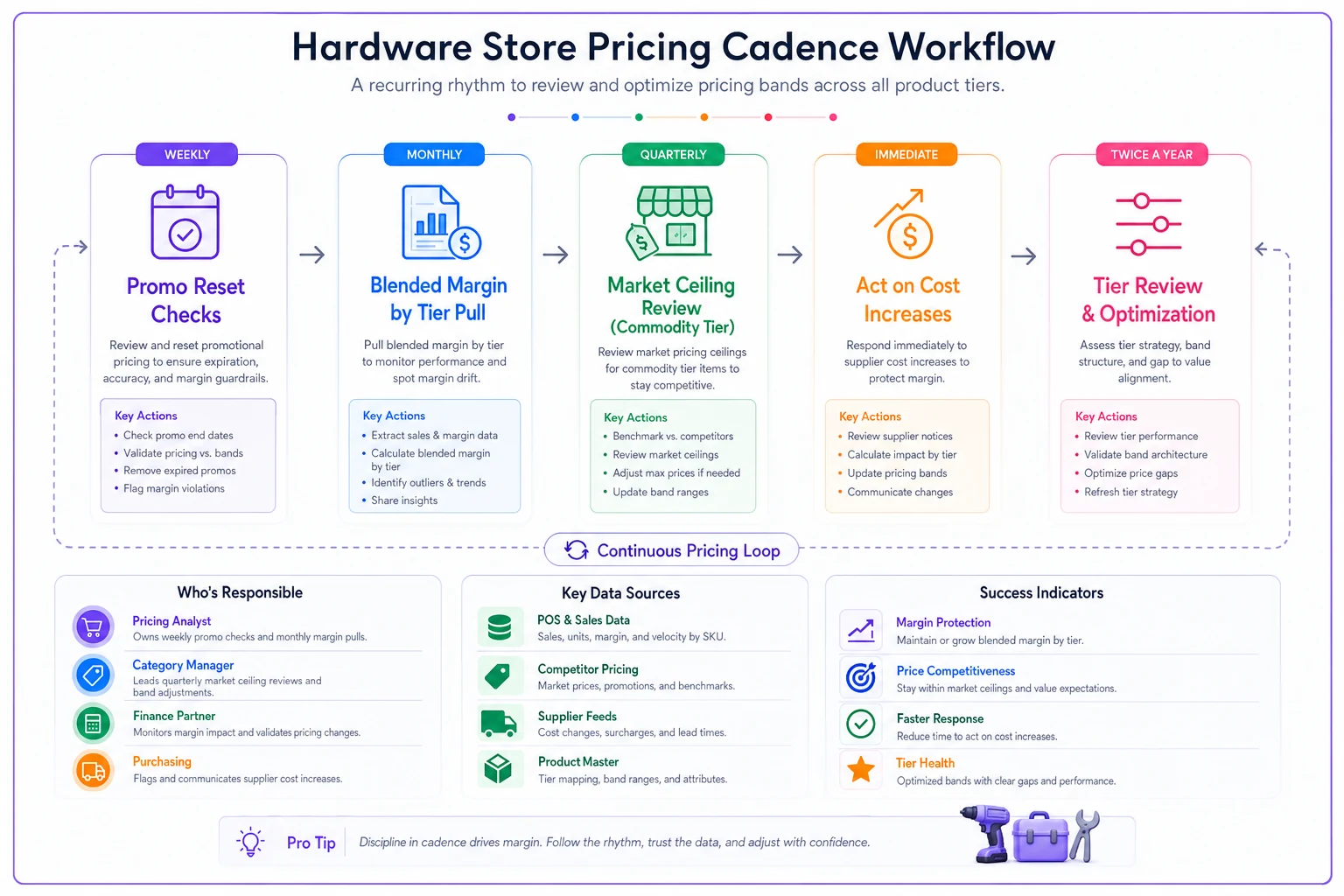
Bands only protect margin if you revisit them. Costs move, competitors move, categories shift tiers over time. A workable review rhythm:
Assign one person to own promo end-date resets so weekly checks actually happen.
-
Weekly Check for un-reset promo prices. Anything past its end date gets restored to band. Five minutes.
-
Monthly Pull blended margin by category tier. Any tier drifting more than ~2 points below target gets flagged.
-
Quarterly Re-check the commodity tier against the market ceiling. This is the tier most exposed to box-store and online pricing, and it moves the most.
-
On every cost increase Decide within the week whether it passes through to retail. If cost jumps enough to push a SKU out of its band, either reprice or re-tier it.
-
Twice a year Review whether any SKUs have changed tiers. A specialty item that becomes widely available online has quietly become commodity, and its band should drop to match reality.
The monthly margin-by-tier pull is the keystone habit. Most stores track blended margin as one number and never break it out by tier — so a leak in one category hides behind strength in another. Tiered reporting is what makes leaks visible while they're still small.
This workflow diagram shows the review rhythm and the checkpoints to keep bands honest.
The monthly margin-by-tier pull is the keystone habit. Most stores track blended margin as one number and never break it out by tier — so a leak in one category hides behind strength in another. Tiered reporting is what makes leaks visible while they're still small.
Where a system helps — without turning this into a spreadsheet nightmare
You can run this on a spreadsheet, and plenty of stores do. But the coordination problem is real: bands live in your head or a doc, prices live in the POS, cost updates come from vendors, and promo end dates live on a calendar nobody checks. When those four things don't talk to each other, the framework decays.
Operational software with some automation earns its keep here — not by doing your pricing for you, but by connecting the pieces. A platform that ties your product master to your POS can flag when a SKU falls outside its band, surface which categories drifted below target this month, and remind you when a promo price is due to expire. The judgment stays with you. The tedious cross-checking — the stuff that fails silently when a store gets busy — gets handled in the background so a cost increase doesn't sit unpriced for three months.
The goal isn't to automate away pricing decisions. It's to make sure the decisions you already made actually stick.
When this framework makes sense — and when it doesn't
It makes sense when you carry more than a few hundred SKUs across genuinely different category types, when more than one person sets or updates prices, or when your blended margin has been drifting and you can't pinpoint why. Multi-category stores with paint, fasteners, and rentals under one roof are the clearest fit — those three alone need three different pricing philosophies.
It's overkill when you're a highly specialized shop with one dominant category and one person controlling all pricing. If you sell essentially one thing and you set every price yourself, tier bands add process you don't need yet.
Start with your two biggest categories by revenue, get their bands right, watch them for a quarter, then expand. Stores that try to re-tier the entire floor in a weekend abandon the whole thing by month two.
A short real scenario
A single-location hardware store — solid traffic, decent contractor base, paint counter, small rental fleet — was running a blended margin around 38% and couldn't figure out why it felt low for their mix. When they broke margin out by tier, the picture was obvious: fasteners were keystoned across the board, paint sundries were under-tagged somewhere in the low 40s, and two rental machines had never had a payback calculation done on them.
They didn't overhaul everything. They split the fastener aisle into commodity and specialty bands, brought sundries up into their proper convenience band, and repriced the two rental units to a real recovery target. Nothing dramatic to any single customer. Over the next two quarters, blended margin moved into the low 40s — roughly a three-to-four point lift — mostly from margin they'd been leaving on the table in specialty and sundries, not from raising commodity prices where customers actually notice.
That's the whole thesis. Margin-first pricing isn't about charging more. It's about charging correctly by category, protecting the tiers where customers aren't comparing, and staying disciplined where they are. Do that consistently, keep the bands honest with a simple cadence, and the blended number takes care of itself.
That's the whole thesis. Margin-first pricing isn't about charging more. It's about charging correctly by category, protecting the tiers where customers aren't comparing, and staying disciplined where they are. Do that consistently, keep the bands honest with a simple cadence, and the blended number takes care of itself.
Ready to elevate your hardware store management?
Join 500+ hardware stores using Hardzly to boost operational efficiency, reduce stockouts, and grow revenue.