

Most hardware store owners don't have a data problem. They have a whose-version-is-right problem.
Why your numbers never quite match — and what it costs you when nobody owns the answer
Your POS says you have 14 of a specific deck screw. The shelf has 6. Your supplier portal lists it under a different part number entirely, and your website says "in stock" even though the last three are damaged and sitting behind the returns counter. Every one of those systems is technically "correct" from its own point of view. Nobody has decided which one wins when they disagree.
That's what an operational reporting backbone in retail actually is — not a fancy dashboard, but a set of agreed rules about which system is the source of truth for each type of information, who checks it, and how often. For a tiny team, this matters more, not less, because you don't have a data analyst quietly cleaning things up in the background. The owner is the backbone. And if that's not set up deliberately, the whole thing runs on memory and luck.
This article is about building that backbone in a way a non-technical owner and a two- or three-person crew can actually maintain — roles, sync checkpoints, simple reconciliation rules, and escalation templates for when something's off.
The real reason the numbers drift
It's tempting to blame the POS software or the supplier's clunky portal. In practice though, the drift comes from a governance gap, not a technology gap.
Stop losing sales due to inventory gaps.
Hardzly helps you manage stock levels, orders, and supplier interactions efficiently.
- Unified inventory and sales tracking
- Supplier and purchase order management
- Automated workflow and task scheduling
No credit card required
-
POS knows what sold and, in theory, what's on hand.
-
Product master (the internal list of what you carry, with descriptions, categories, cost, price) is the "official record" of what a SKU is.
-
Supplier listings tell you what you can order, at what pack size, under their part numbers.
-
Your online "in stock" listing tells the public something — often the most out-of-date thing of all.
When these disagree, someone on the floor makes a judgment call in the moment. "Eh, just adjust it." That call is invisible. It doesn't get logged. A hundred invisible calls a month is how your inventory value quietly becomes fiction.
The insight most owners miss: reconciliation isn't a monthly cleanup event. It's a routing problem. When two numbers disagree, you need a pre-decided rule for which one you trust — before the disagreement happens, not after.
What breaks as you grow past one person doing everything
When it's just the owner ringing sales, receiving trucks, and updating prices, the backbone lives in one head. Messy but coherent. One brain, one version.
| Stage | Team size | What usually breaks first |
|---|---|---|
| Owner-only | 1 | Nothing obvious — but no record of why adjustments happened |
| First hire | 2–3 | Silent inventory adjustments; receiving mismatches; price changes nobody remembers |
| Real crew | 4–6 | Supplier part numbers diverge from product master; online stock goes stale; end-of-day cash and sales don't tie out |
| Multi-role | 6+ | Nobody knows who owns a given number; every dispute becomes a meeting |
Notice the trend: the problem isn't more errors, exactly — it's that errors stop being traceable. When one person did everything, they could at least reconstruct what happened. Add people without adding ownership rules, and every mismatch becomes a mystery.
That's the whole point of a governance model. Keep the system traceable as you add hands.
The core idea: one owner per data type
You don't need one person doing all the checking. You need one person accountable for each type of data. That's the difference between a checklist that gets done and one that dies in week three.
-
Sales & cash truth → whoever closes the register owns that the daily close ties out.
-
On-hand inventory truth → whoever does receiving owns that what arrived matches what got entered.
-
Product master truth → one person owns adding new SKUs correctly, so descriptions, categories, and cost/price are consistent. If your product master is a mess, a lightweight MDM system for a single-location store is where you fix that before anything else — the backbone can't sit on a shaky master.
-
Supplier listing truth → one person owns the mapping between your SKUs and each supplier's part numbers. This is where a lot of quiet chaos lives, and the vendor-SKU mapping and consolidation approach is the groundwork for keeping it sane.
-
Public "in stock" truth → one person owns that the website or marketplace listing reflects reality on a cadence.
The rule to hold onto: one data type, one owner, always. Two owners means no owner.
Sync checkpoints: nightly and weekly
A backbone lives or dies on its checkpoints. Too many and people ignore them. Too few and drift accumulates for weeks before anyone notices. For a tiny team, two rhythms are enough.
The nightly close (10–15 minutes)
-
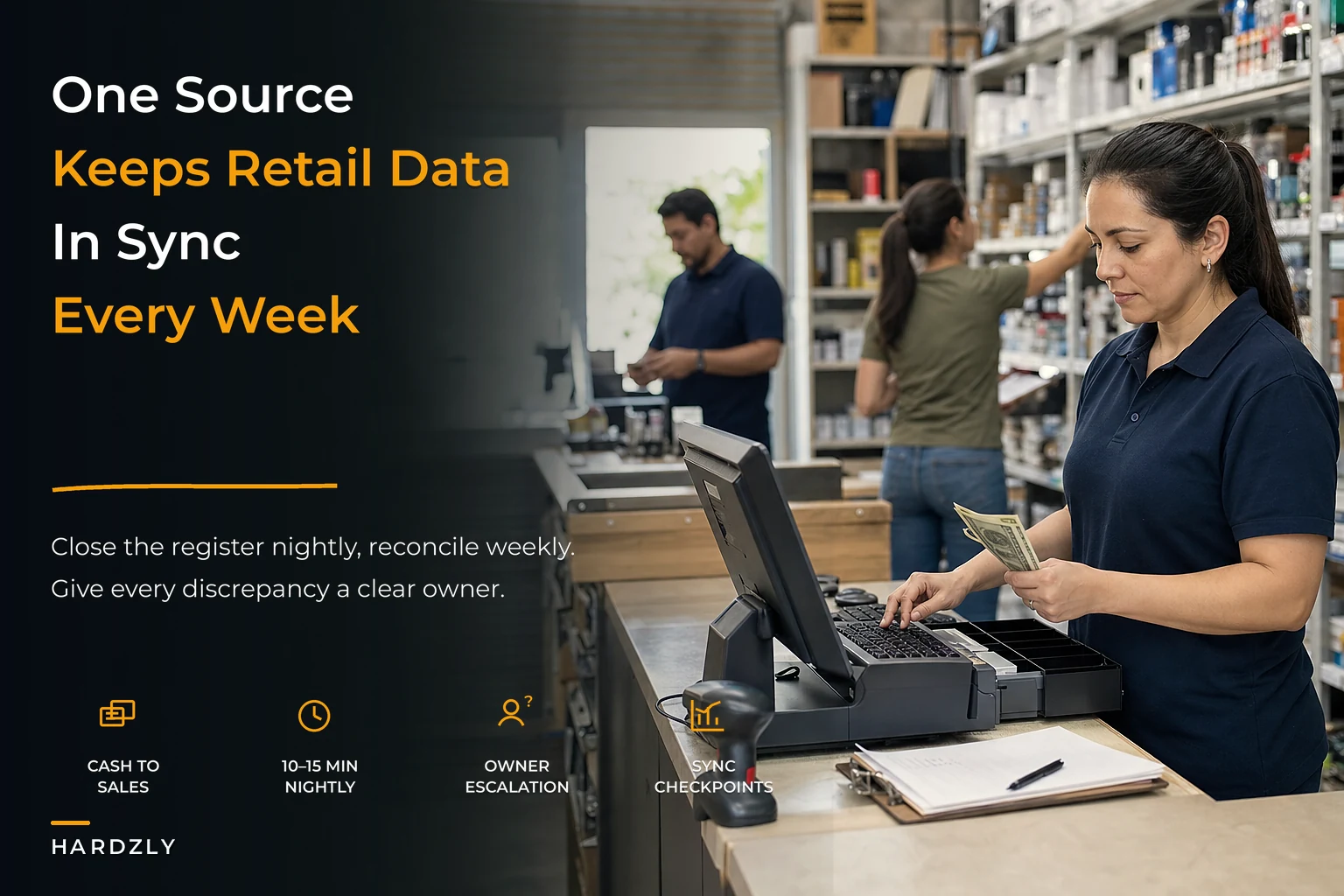
Cash to sales. Count the drawer, compare to what the POS says the day rang. Note any variance over a set threshold (say, $5) — don't chase pennies.
-
Receiving check. Did anything come in today that hasn't been entered? Enter it or flag it. Never leave a truck half-received overnight — that's the single biggest source of next-day phantom stock.
-
Adjustment log. Any inventory adjustment made today — damaged, returned, "found extra" — gets one line written down: SKU, quantity, reason, initials. That's it.
-
Flag anything weird. One sentence in the log. "Deck screws showing negative on hand." You're not solving it tonight; you're catching it.
The adjustment log is the piece almost everyone skips, and it's the most valuable. It converts silent judgment calls into a traceable record. When the weekly reconciliation finds a gap, the log tells you why instead of leaving you guessing.
The weekly reconciliation (30–45 minutes)
-
Review the week's adjustment log. Any patterns? One SKU showing up three times means something structural is wrong.
-
Spot-count 10–15 high-value or fast-moving SKUs against POS on-hand. Not the whole store — a rotating sample.
-
Reconcile any received orders against supplier invoices for pack-size and price mismatches.
-
Confirm the public "in stock" listing matches reality for your top sellers.
-
Clear or escalate every open flag from the nightly logs.
A quick visual of the nightly and weekly checkpoint flow:
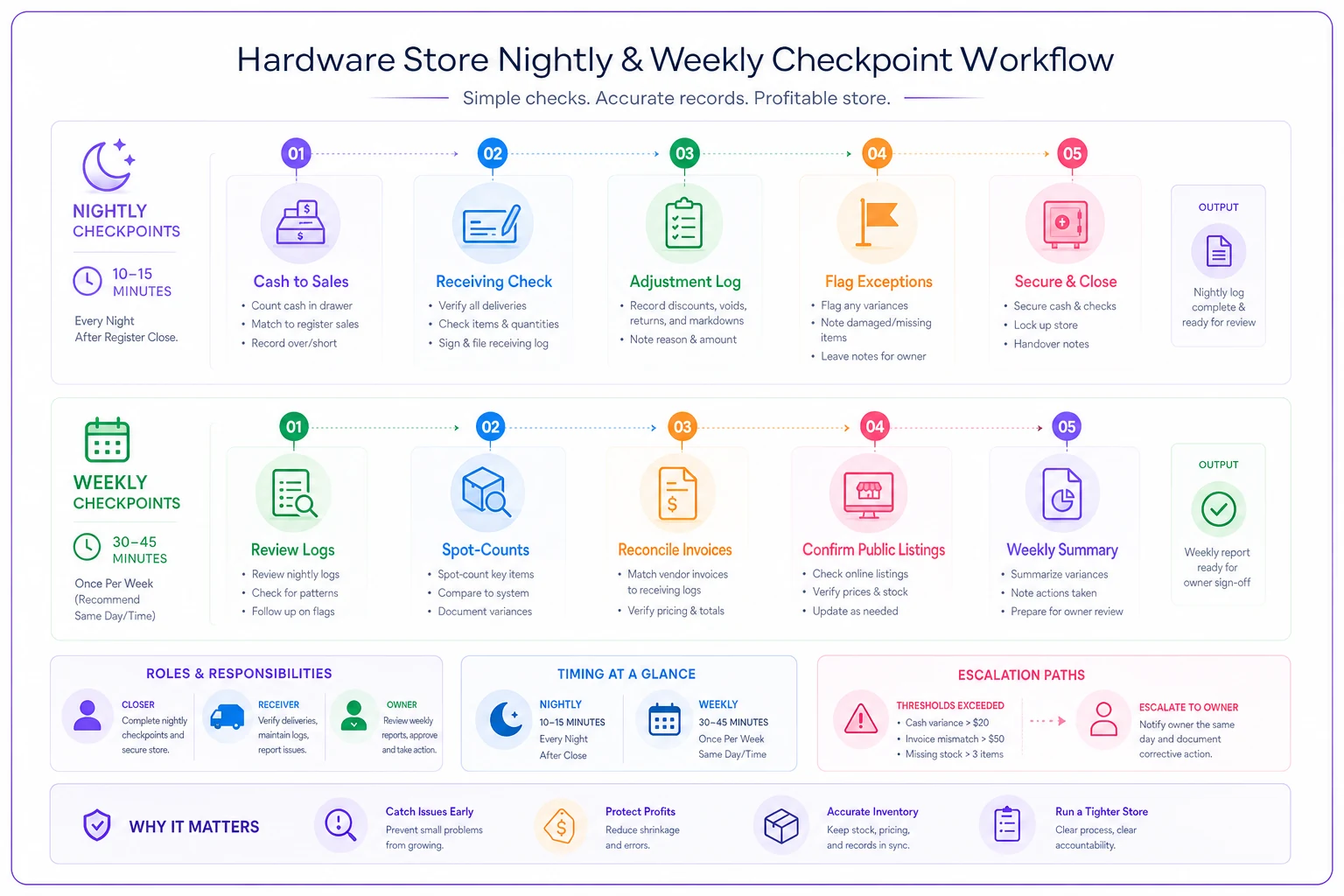
Keep the nightly close under 15 minutes to keep staff buy-in and consistency.
The weekly session isn't about counting everything. It's about catching drift early enough that fixing it takes minutes, not a weekend audit.
Simple reconciliation rules (the part that removes arguments)
Reconciliation only works if the "who wins" question is answered in advance. Otherwise every mismatch turns into a debate, and debates don't happen when the store's busy — so the mismatch just gets ignored.
| When these disagree | Default winner | Action |
|---|---|---|
| Shelf count vs POS on-hand | Physical count | Adjust POS, log the reason |
| Supplier part # vs your SKU | Your product master | Fix the mapping, not the master |
| POS price vs shelf tag | Product master price | Reprint tag, check for a missed price change |
| Invoice pack size vs what you entered | Physical receiving count | Correct entry, flag supplier if recurring |
| Website "in stock" vs actual | Actual on-hand | Update listing same day |
One nuance worth calling out: physical count wins for quantity, but the product master wins for identity — what the item is, its price, its category. Mixing those two up is a classic mistake. Someone "fixes" a price during a physical count and now the master is wrong for every future order.
Escalation templates for a non-technical team
Escalation sounds corporate for a three-person store, but all it means is: when a flag can't be cleared in the normal checkpoint, here's exactly what to write and who to tell. The templates matter because they remove the "I didn't want to bug you" hesitation that lets problems sit.
Keep them dead simple. A shared note, a group text, a whiteboard — the channel matters less than the format.
Inventory mismatch escalation:
> SKU: _ | System says: | Shelf shows: | Checked by: | Date: | Suspected cause: _
Supplier discrepancy escalation:
> Supplier: _ | Our SKU / their part #: | Ordered: | Received: | Invoiced: | Issue: (short/over/wrong item/price) _
Cash variance escalation:
> Date: _ | Expected: | Actual: | Variance: | Notes: _
The rule attached to each: anything above a set threshold goes to the owner within 24 hours, no exceptions. Set the thresholds so you're not drowning — cash variance over $20, inventory value discrepancy over $50, any supplier issue that affects reordering. Below the line, log it. Above the line, escalate.
A real scenario
A single-location hardware store, three people plus the owner, doing somewhere in the low-to-mid six figures a month. Their POS on-hand was trusted by nobody. Reorders were guesswork because the numbers were "usually wrong by a bit," and every so often they'd double-order something or run bare on a fast mover.
They didn't buy new software first. They assigned owners, started the nightly adjustment log, and ran a Monday 30-minute reconciliation. The first two weeks were ugly — the log surfaced that one employee was routinely adjusting counts down without noting damaged goods, which explained a chunk of the phantom stock. Not theft, just an undocumented habit.
Within about two months, spot-count accuracy on their tracked SKUs went from roughly 70% matching to the high 90s. The more useful outcome wasn't the accuracy number — it was that reorder decisions stopped being a gut call. They cut the occasional panicked emergency order and quit tying up cash in accidental double-buys. Nothing dramatic month to month. Just fewer surprises, and an owner who could finally trust a report enough to act on it.
When this makes sense — and when it doesn't
When it's worth building: the moment more than one person can touch inventory, prices, or the register. That's the tipping point. Also whenever you're about to lean on your numbers for something real — seasonal ordering, a loan conversation, deciding what to cut.
When it's overkill: if you're genuinely a one-person shop and the store fits in your head, don't build heavy checkpoints for an audience of one. Keep the adjustment log habit, skip the ceremony. Build the rest when you hire.
Who should NOT do this yet: stores whose product master is fundamentally broken — duplicate SKUs, missing costs, three versions of the same item. Governance on top of bad master data just makes the mess run faster. Clean the master first, then build the backbone. There's no point reconciling to a source of truth that isn't true.
Where software quietly helps — and where it doesn't
None of this requires software. The habits and rules are the actual backbone. Plenty of stores run this on a shared spreadsheet and a whiteboard, and it works fine.
The manual version has a ceiling, though. Nightly logs written by hand are easy to skip on a busy night. Spot-counts don't flag themselves. Cross-checking supplier part numbers against your master by eye gets tedious fast once you're carrying thousands of SKUs. This is where an operational platform with some automation earns its keep — not by replacing your judgment, but by handling the boring watching: flagging when a SKU's on-hand goes negative, surfacing adjustment patterns you'd never catch scanning a paper log, nudging the weekly reconciliation instead of relying on someone to remember.
The order matters though. Set up the roles, checkpoints, and reconciliation rules first. Software applied to a system that already works makes it faster. Software applied to chaos just gives you faster chaos.
The takeaway
The backbone isn't a report or a tool. It's the decision, made ahead of time, about which system wins when they disagree — and who's accountable for checking.
Get that right with a tiny team and the numbers start meaning something. Skip it, and you'll keep making decisions on data you don't actually trust, which costs money in ways that never show up cleanly on any single line of the P&L.
Start with one owner per data type and the nightly adjustment log. Those two habits alone will surface most of what's currently invisible in your operation. Everything else is refinement.
The backbone isn't a report or a tool. It's the decision, made ahead of time, about which system wins when they disagree — and who's accountable for checking.
Start with one owner per data type and the nightly adjustment log. Those two habits alone will surface most of what's currently invisible in your operation. Everything else is refinement.
Ready to elevate your hardware store management?
Join 500+ hardware stores using Hardzly to boost operational efficiency, reduce stockouts, and grow revenue.