

Most commission plans at hardware stores get written on a napkin. Someone on the floor is selling a ton of power tools, the owner wants to reward that, and so a flat "2% of sales" shows up in the next paycheck. It feels fair. Six months later the owner is staring at a P&L wondering why total sales are up but gross margin dollars are flat — or worse, down.
That gap is almost always the commission plan quietly working against the store. A counter commission plan for a small store isn't really about motivating people to sell more. It's about making sure that when they sell more, you make more too. Those are not the same thing, and the difference lives in the details most plans skip: what counts, what the margin floor is, what happens on returns, and how you check it every month without hiring a bookkeeper.
This is a walkthrough of how these plans break, what the fixes actually look like with real numbers, sample clawback language you can steal, and a one-page monthly report you can run yourself.
The core problem: commission on revenue ignores margin
The failure mode is pretty simple. You pay 2% of sales. A floor associate has two ways to hit a number:
-
Sell a $400 cordless combo kit that you make $70 on.
-
Sell $400 worth of fasteners, paint, and adhesives that you make $150 on.
Both pay the associate $8. But one of those sales is more than twice as valuable to you. When commission ignores margin, your team naturally drifts toward whatever is easiest to sell at volume — and in hardware, the easiest high-ticket items to move are usually the lowest-margin branded tools where the customer already knows the price from the big box down the road.
So you end up paying incentives that gently steer the floor toward your thinnest categories. The plan is doing exactly what you told it to. You just told it the wrong thing.
If your category markups aren't already mapped out, that's the prerequisite step — there's a full breakdown in the margin-first pricing framework for hardware stores, and you really can't build a sane commission plan on top of pricing you haven't organized into tiers yet.
Four template structures, and what each one actually does to behavior
There's no single correct plan. There are trade-offs, and which one fits depends on how much you trust your margin data and how complex you're willing to get. Keep it low-complexity — a plan nobody understands is a plan nobody trusts.
Stop losing sales due to inventory gaps.
Hardzly helps you manage stock levels, orders, and supplier interactions efficiently.
- Unified inventory and sales tracking
- Supplier and purchase order management
- Automated workflow and task scheduling
No credit card required
| Plan type | How it pays | Protects margin? | Best for |
|---|---|---|---|
| Flat % of revenue | e.g. 2% of ticket | No | Almost never — avoid for mixed assortments |
| Flat $ per qualifying sale | e.g. $5 per tool rental booked | Partial | Services and add-ons with predictable margin |
| % of gross margin dollars | e.g. 8% of (price − cost) | Yes | Stores with clean cost data in POS |
| Tiered % by category band | 1% low-margin, 3% high-margin | Yes | Stores without reliable item-level cost |
The two that actually defend your margin are the bottom two. Paying a percentage of gross margin dollars is the cleanest option — the associate literally can't earn more by selling you underwater. But it only works if your POS has accurate landed costs on items, which a surprising number of small stores don't.
If your cost data is messy, the tiered-by-category approach is the practical substitute. You group categories into bands and assign a commission rate to each. You don't need perfect item costs — you just need to know that fasteners-by-the-pound and custom paint mixes make you more than branded power tools, and you set the rates accordingly.
Worked example: flat vs. margin-based on the same month
Run one associate, one month, same sales. Say she rang up the following:
-
$6,000 in power tools at ~18% margin → $1,080 margin dollars
-
$3,000 in fasteners/paint/adhesives at ~42% margin → $1,260 margin dollars
-
$1,000 in rental bookings at ~70% margin → $700 margin dollars
Total sales: $10,000. Total margin dollars: roughly $3,040.
Under flat 2% of revenue: she earns $200. Power tools — the lowest-margin category — drove the biggest chunk of that payout even though they contributed the least margin per dollar.
Under 6% of gross margin dollars: she earns about $182. Slightly less total, but now every dollar she chases is a dollar you actually keep. If next month she shifts $1,000 from power tools into fasteners, her payout rises and so does your margin. The incentive and your P&L finally point the same direction.
That alignment is the whole point. Under the flat plan, her best month and your best month can be completely different months. Under the margin plan, they're the same month.
Service vs. product splits (don't pay them the same way)
Services and rentals behave nothing like product sales, and lumping them into one commission rate is a common mistake. A tool rental or a sharpening job carries high margin but also real labor and turnaround obligations. You want to reward booking and completing those, not just ringing them up.
-
Product sales commission on margin dollars or by category band.
-
Services & rentals flat dollar per completed job, released only after the job is actually finished and returned clean.
Paying a flat amount per completed service keeps it simple and ties the reward to completion, not just intake. If you're running a sharpening bench or something similar, the completion-based payout fits neatly with the SLA structure in the tool sharpening service SOP — you pay out when the job clears the turnaround window, not when it's dropped off.
The trap here is paying on booked rentals before the tool comes back. Pay on booking, and you've just incentivized your team to push rentals out the door without caring whether they return — which is a different and more expensive problem.
The minimum-margin constraint: your single most important line
Every plan above should sit on top of one hard rule: no commission is earned on any sale below the minimum margin floor. This single constraint prevents the worst behavior — floor staff discounting to close a sale and still collecting commission on the shrunken ticket.
In practice, this usually happens at the counter when a customer pushes for a price match. The associate wants the sale (and the commission), so they knock 15% off a tool that was already at 18% margin. Now the store makes almost nothing, and under a naive plan the associate still gets paid. The minimum-margin floor says: if the final margin on this line drops below, say, 12%, the commission on that line is zero.
How to set it:
-
Pull your category-tier markups (you need these first).
-
Set a floor a few points below your target margin per category — not at target, or every legitimate sale fails.
-
Make it a per-line check, not per-ticket, so one deep discount can't ride on a healthy ticket's coattails.
-
Write it into the plan in one sentence so there's no ambiguity.
A plain-language version: "Commission is earned only on sale lines closing at or above the category minimum margin. Lines below the floor earn no commission regardless of sale price or total ticket size."
Clawbacks: sample language you can actually use
Returns and chargebacks are where commission plans leak money if you're not paying attention. An associate rings a $900 sale in month one, earns commission, and the customer returns it in month two. If you've already paid out, you're now down the margin and the commission.
> Returns & clawback policy. Commission is advanced on completed sales. If a product is returned, exchanged for a lower-margin item, or the sale is otherwise reversed within 60 days, the commission originally paid on that sale will be deducted from the next commission payout. If returns in a pay period exceed commission earned in that period, the balance carries to the following period. Normal warranty exchanges for an identical item do not trigger a clawback.
A few things that matter in that wording:
-
60-day window. Long enough to catch the real returns, short enough that staff aren't haunted by sales from last quarter.
-
Deduct from next payout, not a direct bill. Nobody should ever get a paycheck that's smaller because of a clawback for a return that wasn't their fault. Netting against future commission keeps it fair.
-
Warranty exchange exemption. If you clawback on warranty swaps, your team stops helping customers with warranty issues. Don't create that problem for yourself.
If returns in a pay period exceed commission earned in that period, the balance carries to the following period.
A real scenario
A single-location store with four floor staff ran flat 2.5% of revenue for years. Monthly commission was running somewhere between $1,800 and $2,100 across the team, and the owner couldn't shake the feeling it wasn't driving the right sales. Total revenue was fine; margin dollars were stuck.
They switched to a two-part plan: 6% of gross margin dollars on product, $6 flat per completed rental, a 12% per-line minimum-margin floor, and the 60-day clawback above. The first month was bumpy — two associates earned a bit less because they'd been living on power-tool volume. By month three, though, the mix had shifted. Attach rates on fasteners, adhesives, and paint climbed noticeably because those were now the better-paying sales for staff. Commission cost landed in a similar range — around $1,900 — but the margin dollars behind those sales were up a few points. Same payroll, better mix. That's the whole game.
The one-page monthly report to verify alignment
The plan means nothing if you don't check it. You don't need software to start — a single sheet, run once a month, tells you whether your incentives and your margin are actually pulling the same direction. Here's what goes on it, per associate:
-
Total sales (revenue rung)
-
Total gross margin dollars generated
-
Commission paid
-
Commission as % of margin dollars (this is your key number — it should stay stable)
-
Lines below margin floor (count — should be low and ideally shrinking)
-
Clawback amount this period
-
Service/rental completions paid
The one metric to watch above everything else: commission paid ÷ margin dollars generated. If that ratio drifts up over time, you're paying more to earn each margin dollar — a sign the plan is being gamed or the floor is set too low. If it's stable or dropping while margin dollars rise, the plan is working.
Quick sanity check each month: if any associate's revenue rank is much higher than their margin dollar rank, someone's volume is coming from your thin categories. Worth a conversation before it becomes a habit.
Here's a simple workflow to run the report each month:
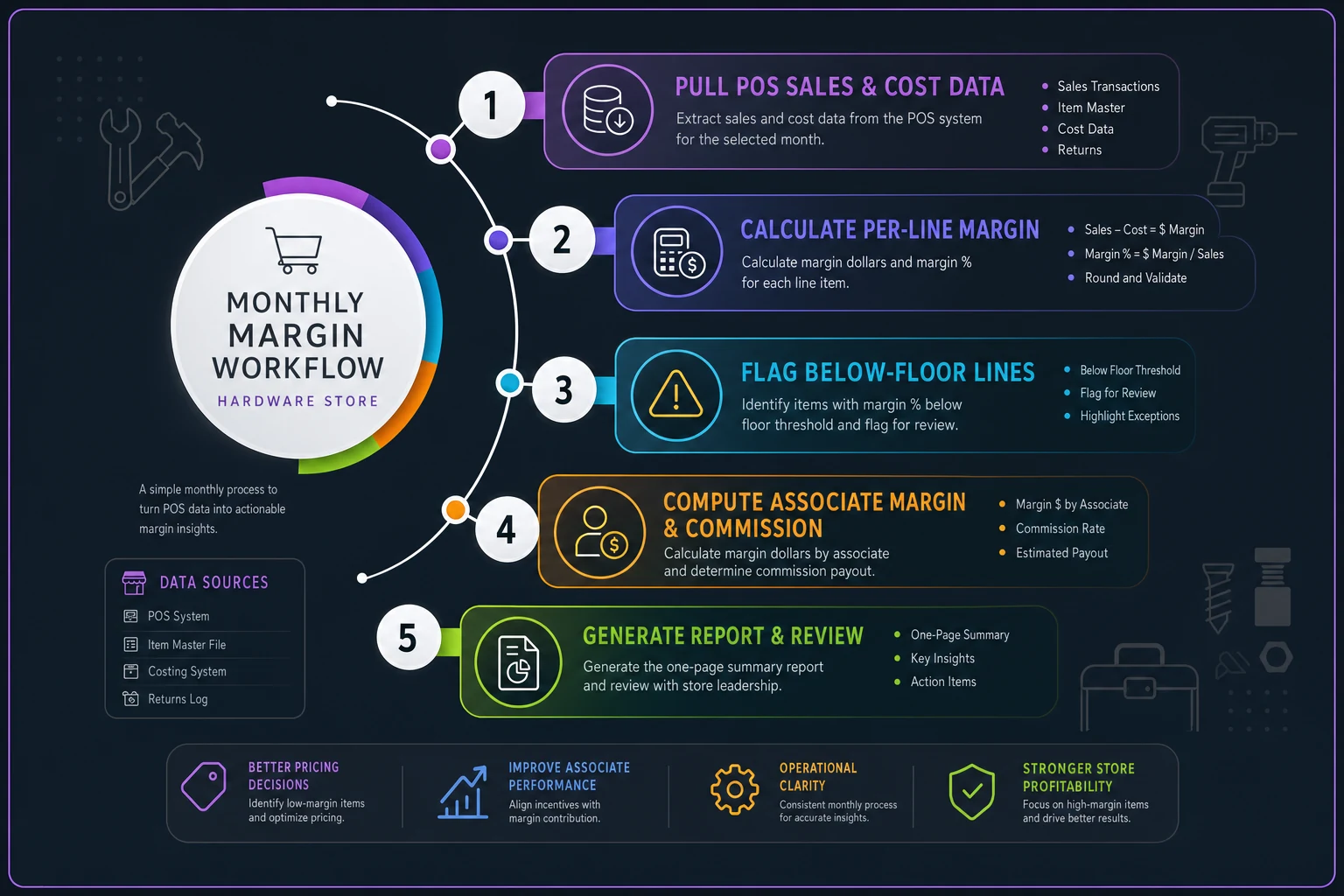
Do it monthly and you'll spot issues early.
When this makes sense — and when it doesn't
Margin-based commission makes sense when you have reasonably clean cost data in your POS, a mixed assortment with real margin spread between categories, and a floor team that actually influences what customers buy.
The tiered-by-category version makes sense when your cost data is unreliable but you still know which categories make you money. It's the honest workaround.
Skip commission entirely when your team is tiny and everyone already sells the full mix, or when your product margins are so compressed that any commission just erodes thin profit. In those cases a flat quarterly bonus tied to overall store margin targets is cleaner and avoids all the gaming problems above.
Who should not run a flat-% revenue plan at all: any store with meaningful margin variation across categories — which is basically every hardware store. The flat plan is the one structure that reliably pays your people to hurt you.
Keeping it running without the monthly headache
The hard part isn't designing the plan — it's pulling the numbers every month to actually verify it. That's where most owners quietly give up and the plan drifts back into "pay whatever the POS report shows."
Run the one-page report by hand for two months before automating to catch data issues.
If your margin dollars, returns, and category data already live in one place, generating that one-page alignment report becomes a few-minute job instead of an evening with spreadsheets. Operational platforms that connect your POS, cost data, and payroll can run that commission-to-margin ratio automatically and flag below-floor lines before payout, so the clawbacks and minimum-margin check happen without manual reconciliation. But the plan has to come first — get the structure right on paper, prove it works for a couple months by hand, then worry about automating the report.
The goal is simple: you want the month that's best for your staff's paycheck to be the exact same month that's best for your margin. Build the plan so those two can't diverge, write the clawback so returns don't leak, set the floor so discounts don't get rewarded, and check the ratio every month. Do that, and commission stops being a cost you tolerate and becomes a lever you actually control.
Ready to elevate your hardware store management?
Join 500+ hardware stores using Hardzly to boost operational efficiency, reduce stockouts, and grow revenue.