

Most hardware stores that offer sharpening treat it as a courtesy. Somebody drops off a lawnmower blade, it sits behind the counter for two weeks, gets ground on the bench grinder between other tasks, and eventually the customer picks it up for eight bucks. Nobody tracked the labor. Nobody knows if it made money. Half the time it was done by whoever happened to be around.
That's the core problem. Sharpening and small repairs can be one of the highest-margin services a hardware store offers — raw material cost is basically zero, the equipment's already paid off, and the customer is standing in your store with tools they rely on for actual work. Run it as a favor and it becomes a time sink that eats your best employee's afternoon and generates goodwill instead of margin.
This post is about turning that bench into a real operational line: a proper intake process, pricing bands you don't have to recalculate every time someone walks in, turnaround commitments you can actually keep, and a simple way to know whether each job made money. The goal isn't to build a sharpening empire. It's to stop quietly losing money on something you're already doing.
Where the money leaks: the "loose bench" problem
The typical sharpening setup fails in a few predictable places.
Intake is verbal. Customer says "can you sharpen these?" and hands over a bag of chisels. No ticket, no name, no agreed price, no promised date. The item lands in a pile, and when the customer calls three days later, whoever picks up the phone has no idea what's in the shop or when it'll be done.
There's no pricing structure. Every job gets quoted on the fly, which means the same lawnmower blade might be $6 one week and $12 the next depending on who's at the register. Owners tend to underquote because they're guessing low to avoid friction at the counter.
The labor is invisible — and this is the quiet killer. A hand plane iron that needs re-flattening and honing can take 25 minutes. A kitchen knife on a wheel takes three. If you charge the same flat "$5 sharpening" for both, you're losing badly on the plane iron and you don't even know it because nobody's tracking time against price.
And then there's the consumables problem. Grinding wheels, honing compound, replacement belts, cut-off discs — these wear out. Stores run out mid-job. Same logic as any other stock item; you want a small par level so you're never scrambling mid-bench. If you've read our par-level formulas for nails, screws and adhesives, the same thinking applies directly to abrasive consumables.
Build the intake ticket first
Everything downstream depends on getting intake right. The ticket is your agreement with the customer and your instruction to whoever's on the bench.
Stop losing sales due to inventory gaps.
Hardzly helps you manage stock levels, orders, and supplier interactions efficiently.
- Unified inventory and sales tracking
- Supplier and purchase order management
- Automated workflow and task scheduling
No credit card required
-
Customer name + phone (for the ready-for-pickup text later)
-
Item description and quantity — "3 chisels, 1 hand plane iron, ½" set"
-
Condition notes — chipped edge, rust, bent, previously sharpened elsewhere
-
Service requested — sharpen only, sharpen + minor repair, evaluate first
-
Price band or "quote after inspection" flag
-
Promised-ready date (your SLA — more on this below)
-
A claim number or tag that goes on the item and the customer's copy
The single most important field people skip: condition notes. If a customer brings in a chisel with a chip they didn't mention, and you grind it out and hand it back shorter than they expected, that's a disagreement waiting to happen. Note the chip at intake, point it out, and you've protected yourself. A quick line — "edge chipped ~2mm, will need extra grinding, edge will be slightly shorter" — turns a potential complaint into a heads-up the customer already agreed to.
Tag the physical item the moment it comes in.
Tag the physical item the moment it comes in. A cheap tag gun and pre-numbered tags cost almost nothing and eliminate the "which bag was this?" problem entirely. Serializing what's in your possession is the same discipline that keeps rental tools from walking off — covered in detail in the rental tool workflow post — and it maps cleanly onto the sharpening bench.
Pricing bands so nobody has to guess
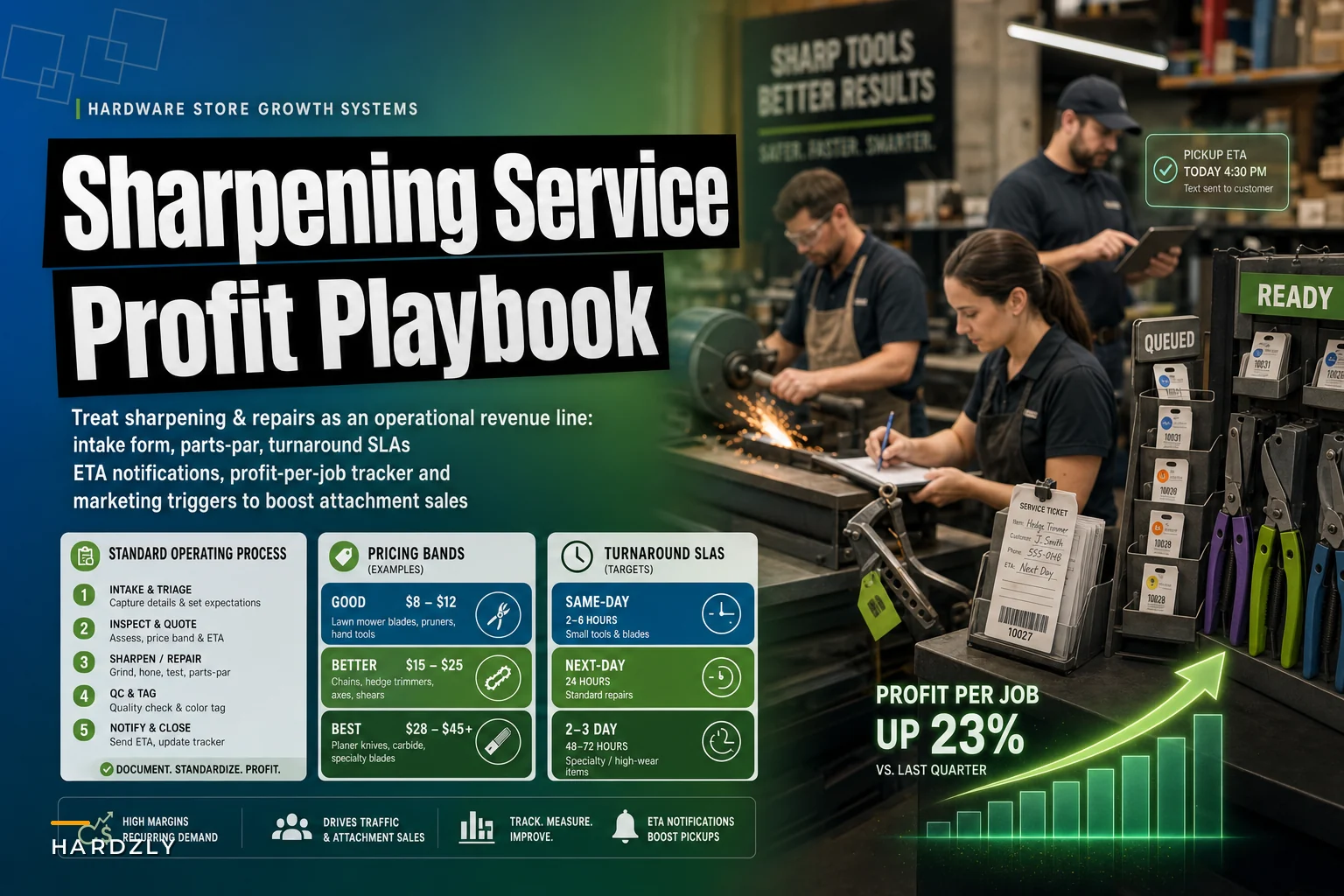
Stop quoting job by job. Build three or four bands based on time and complexity, print them on a laminated card at the counter, and let anyone at the register quote confidently.
| Band | Typical items | Bench time | Price range |
|---|---|---|---|
| Quick edge | Kitchen knives, scissors, basic pocket knives | 3–6 min | $4–$8 each |
| Standard tool | Chisels, plane irons, single-blade shears, drill bits | 8–15 min | $9–$16 each |
| Heavy / powered | Mower blades, hedge trimmer blades, axes, hatchets | 12–20 min | $14–$22 each |
| Repair + sharpen | Chipped edges, re-handling, bent blades, saw sharpening | 20–40 min+ | Quote after inspection |
Two rules make bands actually work:
-
Set a minimum ticket. If someone brings one kitchen knife, a $4 job barely covers the time to write the ticket and process payment. A $10–$12 minimum per visit fixes this. Most customers bring more than one thing anyway.
-
Anything in the "repair" band gets inspected before you commit. Never quote a re-handle or a chip removal blind. Inspect it, then call or text the customer with a number before you touch it.
One thing worth noting: stores that post their pricing openly tend to get more drop-offs, not fewer. Customers who avoided asking because they didn't know the cost start coming in once they can see it's $8, not some unknown number.
Turnaround SLAs you can actually keep
The fastest way to kill repeat business is a promised date you miss. The second fastest is having no promised date at all, so the customer keeps calling to check in.
-
Standard ready in 3 business days. This is your default and covers most volume.
-
Next-day ready by end of next business day, for a small rush premium ($3–$5, or roughly +25%).
-
Same-day / while-you-wait only for quick-band items and only when the bench is actually free.
The key is being honest about capacity. If your one sharpening-capable employee works Tuesday through Saturday and can realistically finish 15–20 items a day alongside other duties, then intake needs to reflect that. Once you've got 40 items queued up, the "3-day" promise you're making on new intake is already wrong. Track the queue count and push the promised date out when the backlog builds.
Here's a simple workflow to keep SLAs honest.
-
Item comes in, gets tagged, ticket written with a promised date based on current queue depth.
-
Ticket goes into a dated queue — physical clipboard, whiteboard, shared sheet — sorted by promised date, not arrival order.
-
Bench works oldest-promised-first, marks each ticket done and moves the item to a labeled "ready" shelf.
-
Customer gets a notification when the item hits the ready shelf.
-
Item stays on the ready shelf with a pickup deadline; after 30 days it goes to an unclaimed process.
That third step — working by promised date, not by whatever job looks interesting — is where most benches fall apart. The fun restoration job gets done first while the stack of mower blades sits. Sort by date and the SLA holds.
A visual workflow helps staff understand the intake-to-ready process quickly.
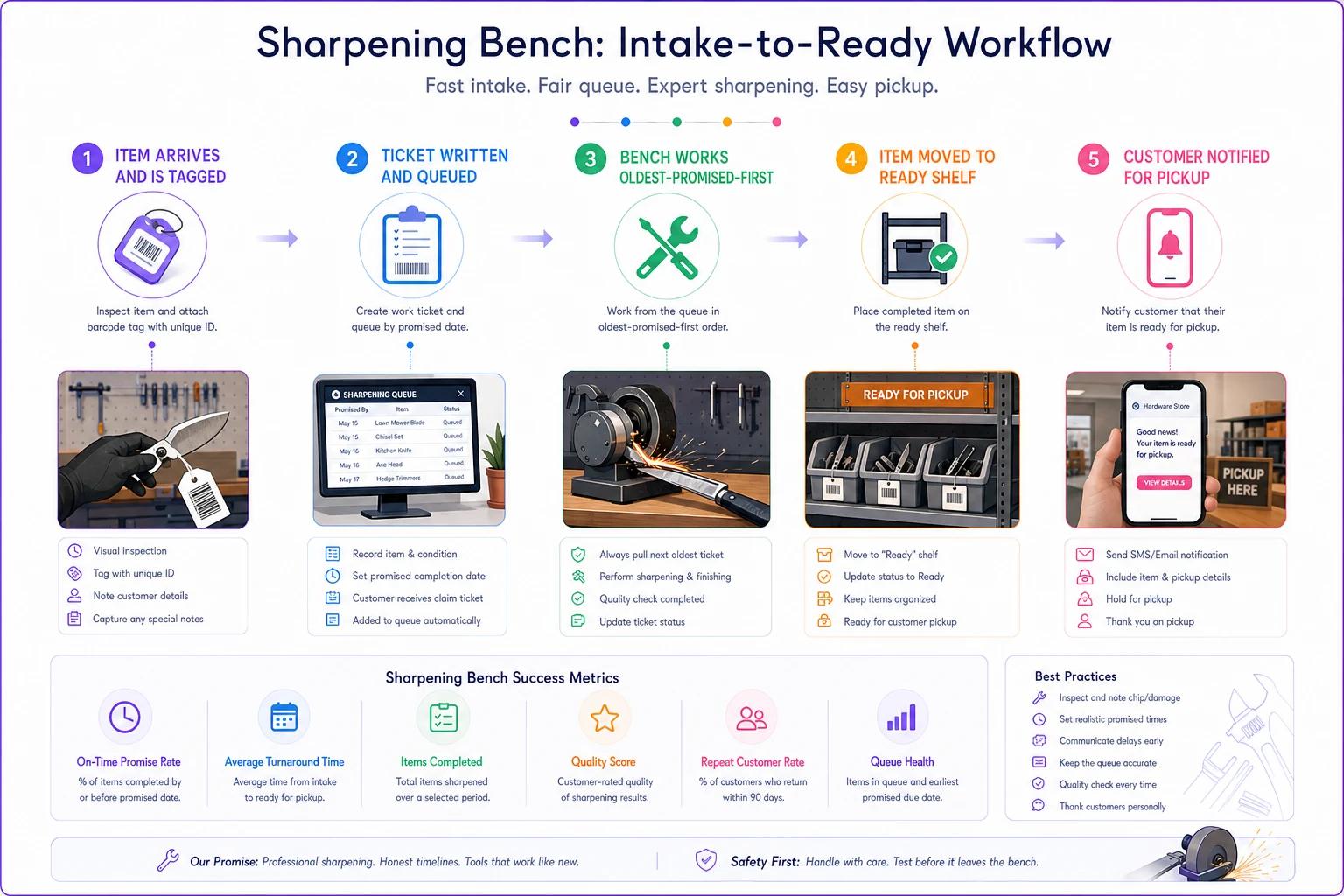
Keep the visual near the bench or intake counter so anyone taking tickets can set realistic promised dates.
ETA notifications: the cheap win most stores skip
The phone-tag problem is real. Customer drops off, you finish two days early, item sits on the ready shelf for a week because nobody reached out, and the customer finally shows up annoyed nobody told them. Meanwhile that shelf space is tied up and you're storing their stuff for free.
A simple "your item is ready" text at pickup-ready is one of the highest-return habits you can build into this process. It clears your shelf faster, makes the operation look organized, and is the natural moment to prompt an attachment sale.
You don't need anything fancy. A manual text from the store phone works fine. If your store already runs an operational or point-of-sale platform that can fire an automated "ready for pickup" message off a status change, use it — the same notification logic that handles backorder alerts handles sharpening pickups just fine. The point is the customer finds out the moment it's done, without someone having to remember to call.
The profit-per-job tracker
You can't manage margin you don't measure. This doesn't need to be complicated — a five-column log tells you most of what you need.
-
Ticket #
-
Price charged
-
Bench minutes (rough is fine — 5, 10, 20)
-
Consumables note (only for jobs that burned a belt or disc)
-
Net (price minus a labor rate for the minutes)
Pick a loaded labor rate. If your sharpener costs around $22/hour all-in, that's roughly $0.37/minute. A 10-minute standard chisel at $12 costs about $3.70 in labor and pennies in abrasive — nets close to $8. A 30-minute chip-repair job you only charged $16 for costs around $11 in labor — barely $5 net, and that's before the cut-off disc you burned through.
Run this log for a month and patterns show up quickly. Quick-band knife jobs and standard tool jobs usually carry the whole operation, while under-priced repair jobs quietly lose money. Once you can see it, you either re-price the repairs or stop taking the ones that don't pay.
You don't need to track every job forever. Run it seriously for 30–60 days, learn where your bands are off, fix the pricing, then spot-check occasionally from there.
Marketing triggers: turn a sharpened blade into a sale
Someone who brings in tools to be sharpened is telling you exactly what they own and use. That's a live marketing signal sitting right in your intake ticket, and most stores ignore it completely.
-
At pickup, attach the consumable. Mower blade sharpened? "You're due for a new air filter and oil for the season — want me to grab those?" Chainsaw chain sharpened? Bar oil and a spare chain are two aisles over. The attachment rate on these is high because the need is obvious and the customer is already spending.
-
Sharpening as a reason to come back. A knife sharpened well brings someone back every few months. Each visit is a chance to sell something else.
-
Seasonal reminders off intake data. If you captured that a customer brought mower blades in April, a quick nudge next March brings them back. A simple contact list sorted by service month is enough.
-
Bundle offers. "Sharpen 3, the 4th is free" nudges people to bring the whole drawer instead of one knife, which pushes them past your minimum ticket and increases per-visit revenue.
The pattern across stores that do this well: the sharpening itself runs roughly break-even to modestly profitable, but attachment sales at pickup are where the real money shows up. The blade sharpening is the hook; the filter, oil, chain, and grease are the catch.
A real scenario
A single-location hardware store had been "offering sharpening" for years with no real system behind it. Items piled behind the counter, one guy handled them whenever he had a gap, prices were guessed, and nobody could tell you if it made money. Volume was around 25–30 items a week, mostly mower blades and knives.
They set up a basic SOP over a slow week: a tag gun at intake, a laminated pricing-band card, a dated whiteboard queue, and a rule that every pickup gets an attachment offer. They set a $10 minimum and started texting customers when items were ready.
Over the next couple of months, a few things shifted. Ready-shelf clutter dropped because customers picked up within a day or two of the text instead of waiting a week. Average ticket climbed from around $8 to closer to $14 once the minimum and multi-item bundles kicked in. Attachment offers at pickup started adding roughly $200–$400 a month in filters, oil, and chains that used to walk out the door unsold. Nothing dramatic on any single day — but the bench went from a break-even courtesy to a small, reliable profit line, and the phone-tag calls basically stopped.
When this makes sense — and when it doesn't
When it's worth building: You already get sharpening requests regularly, you have at least one employee with the skill and a few spare hours a week, and you sell adjacent consumables. The attachment-sale math is what makes the whole thing worthwhile.
When to keep it small: If requests are rare and seasonal, don't overbuild the system. A simple intake ticket and a pricing card are enough. You don't need queue tracking for six mower blades a month.
When to skip it entirely: If you have no one who can actually sharpen properly, don't fake it. A badly sharpened chisel or a mower blade ground at the wrong angle comes back as a complaint and a refund. Bad sharpening damages trust faster than not offering it at all. In that case, partner with a local mobile sharpener and take a referral cut — or just don't advertise it.
The bottom of it
Sharpening and small repairs sit quietly in most hardware stores as a favor nobody measures. Give it an intake ticket, a set of pricing bands, honest turnaround dates, a ready-for-pickup nudge, and a simple margin log — and it stops being a time sink.
The bench work itself might only clear modest profit, but it pulls the right customers back through your door on a regular basis, and the consumables you sell at pickup are where it actually adds up. You're already doing the work. The only real change is running it like a service line instead of a favor.
Sharpening and small repairs sit quietly in most hardware stores as a favor nobody measures. Give it an intake ticket, a set of pricing bands, honest turnaround dates, a ready-for-pickup nudge, and a simple margin log — and it stops being a time sink.
The bench work itself might only clear modest profit, but it pulls the right customers back through your door on a regular basis, and the consumables you sell at pickup are where it actually adds up. You're already doing the work. The only real change is running it like a service line instead of a favor.
Ready to elevate your hardware store management?
Join 500+ hardware stores using Hardzly to boost operational efficiency, reduce stockouts, and grow revenue.