

That DeWalt 20V drill combo sitting in your backroom? The one your supplier discontinued three months ago? It's worth $289 today. In six weeks, maybe $180 if you bundle it right. Wait another month and you'll be begging your rep to take it back at cost minus restocking fees.
Every hardware store deals with discontinued SKUs. The difference between stores that lose money and stores that break even comes down to timing and having clear decision rules — not vague "markdown when it feels old" policies, but actual cutoff dates tied to specific actions.
The 30-60-90 day reality check
Most hardware stores discover discontinued items by accident — during inventory counts, when reordering fails, or worse, when a customer asks why you're still charging full price for last year's model. By then, you've already blown past your best disposition windows.
-
Days 0-30
Items still sell at 85-95% of original price
-
Days 31-60
Value drops to 60-75% depending on category
-
Days 61-90
Lucky to get 40-50% through bundles or clearance
-
Days 90+
Dead money unless the vendor takes returns
Paint and adhesives hold value longer than power tools. Seasonal items crater fastest. Fasteners and basic hand tools can sometimes ride out the full cycle without major losses. But waiting to see what happens is how you end up with $8,000 in discontinued inventory occupying valuable shelf space.
The smart play is having predetermined paths for every discontinued SKU category before the supplier even sends that discontinuation notice.
Category-specific decision trees with real cutoffs
Power Tools & Equipment
Stop losing sales due to inventory gaps.
Hardzly helps you manage stock levels, orders, and supplier interactions efficiently.
- Unified inventory and sales tracking
- Supplier and purchase order management
- Automated workflow and task scheduling
No credit card required
-
Day 1-15
Full price with "limited stock" messaging
-
Day 16-30
Bundle with consumables (bits, blades, batteries)
-
Day 31-45
20% markdown or negotiate vendor buyback
-
Day 46-60
Parts harvest evaluation for service department
-
Day 61+
Final clearance at 40% off or vendor return
A discontinued Makita circular saw at $189 cost might bundle with a 3-pack of blades for $229 total in week three. That same saw stripped for parts — motor, bearings, housing — could generate around $95 in service revenue if you repair tools. But only if you make that call by day 45.
Paint & Finishes
-
Day 1-30
Hold at full price
-
Day 31-60
Create contractor bulk deals (buy 5 gallons, get 15% off)
-
Day 61-75
Markdown 25% for retail
-
Day 76-90
Final push at 40% off
-
Day 91+
Donate to local nonprofits for the tax writeoff
Paint's interesting because contractors will buy discontinued colors if the discount hits their threshold — usually around 20-25% for quality brands. Retail customers need deeper cuts or they won't touch it.
Fasteners & Hardware
-
Day 1-60
No action needed usually
-
Day 61-90
Repackage into contractor bags if applicable
-
Day 91-120
Bundle with related items
-
Day 121+
Break bulk and mix into grab bins
That box of 500 specialty lag bolts nobody wants? Break it into 25-count bags at $8.99 each. You'll move them a lot faster than trying to push the full case at any discount.
Seasonal Items (Off-Season Discovery)
Immediate: Calculate storage cost vs. markdown loss If storage exceeds 15% of value → clearance now If under 15% → hold for next season start
Finding discontinued snow shovels in April means different math than discovering them in October. Eight months of storage at $2 per square foot can easily cost more than taking a 50% loss today.
Bundle strategies that actually move dead stock
Standard markdowns just train customers to wait for lower prices. Bundles create new value propositions that move inventory without destroying margins on everything else.
| Bundle | Contents | Individual total | Bundle price | Margin/Notes |
|---|---|---|---|---|
| The Starter Pack Bundle | Discontinued drill + bit set + carrying case + safety glasses | Individual total: $340 | Bundle price: $279 | Margin preserved: 18% vs. 5% on a straight markdown |
| The Pro Surplus Bundle | 3 discontinued paint brushes + roller frame + tray liner 5-pack | Individual total: $67 | Bundle price: $45 | Moves dead brushes while holding 22% margin |
| The Workshop Upgrade Bundle | Discontinued shop vac + extension hose + filter 2-pack + accessories | Individual total: $189 | Bundle price: $149 | Creates $40 in perceived value while clearing shelf space |
Bundles work when the discontinued item becomes the "bonus," not the focus. Lead with the active SKU, position the discontinued item as added value. The moment a customer feels like you're trying to unload something on them, the deal dies.
Lead with the active SKU; position the discontinued item as added value.
Bundles work when the discontinued item becomes the "bonus," not the focus. Lead with the active SKU, position the discontinued item as added value. The moment a customer feels like you're trying to unload something on them, the deal dies.
Refurb pathways most stores miss
Some discontinued power tools generate more profit as parts inventory than selling whole. A $300 discontinued table saw with a bad motor might seem like a write-off, but the fence system, miter gauge, and blade guard could be worth $180 in parts revenue spread over six months.
Items worth considering for parts harvest:
-
Power tools with swappable components
-
Outdoor power equipment (especially small engine parts)
-
Pneumatic tools with standard fittings
-
Higher-end hand tools with replaceable parts
Items never worth parting out:
-
Anything under $75 original retail
-
Paint equipment (too messy, low demand)
-
Basic hand tools
-
Electrical items (liability issues)
The math only works if you already do tool repair or have established parts customers. Starting a parts operation just to handle discontinued items won't pay off.
Vendor negotiation scripts that work
Getting vendors to take back discontinued inventory requires specific language and timing. Generic "please take this back" emails get ignored.
Initial Discovery Email (Send within 72 hours)
"Hi [Rep Name], Just discovered SKU [number] was discontinued during our cycle count. Currently holding [quantity] units at $[cost] each. Can you check available options:"
-
Return authorization at standard terms
-
Buyback at [cost minus 15%]
-
Exchange credit toward active SKUs
-
Markdown support/co-op funding
Need a decision by [date — 14 days out] to plan floor space for spring deliveries. Current aging: [days since last sale] YTD sales: [units] averaging [units/month]
Follow-up Call Script (Day 7)
"Following up on the [quantity] units of discontinued [product]. Space is getting tight with new deliveries coming. What can we work out by Friday? Even partial credit would help. I've got [competing brand] offering to fill that space with their new line."
Final Push Email (Day 12)
"Need to clear this inventory by [date]. Final offer: Take back [quantity] units at [cost minus 20%] with credit toward next order. Otherwise marking down 40% this weekend and won't have space for your spring promotional displays. Let me know by end of day."
The vendor relationship matters more than any single SKU, but they also know you can't sit on dead inventory forever. Reasonable deadlines with specific consequences get responses.
Building your discontinued SKU workflow
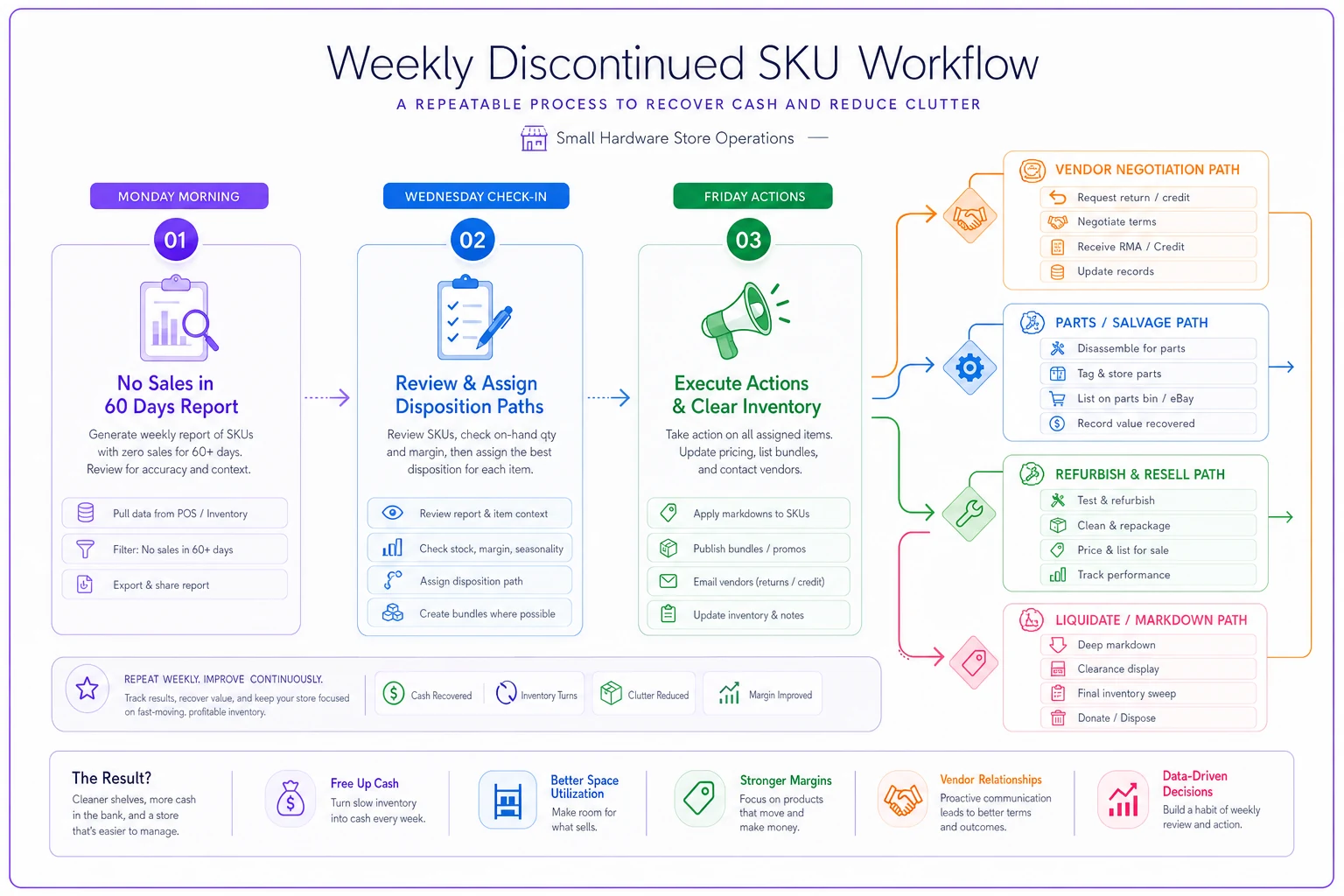
The real problem isn't discovering dead inventory — it's acting fast enough when you do. A basic weekly routine catches issues before they cost serious money:
-
Monday Morning (15 minutes) - Run "no sales in 60 days" report - Flag any items showing as discontinued in system - Check vendor bulletins for discontinuation notices
-
Wednesday Check-in (10 minutes) - Review flagged items from Monday - Assign disposition path based on category and age - Create bundles for anything in 31-45 day window
-
Friday Actions (20 minutes) - Execute markdowns for items hitting time triggers - Send vendor negotiation emails - Update store signage for clearance items
Visual workflow for the weekly routine:
Small stores running manual systems can track this in a basic spreadsheet with columns for: SKU, quantity, days discontinued, disposition path, action date, and outcome. The discipline matters more than the tools.
An operational platform with basic automation makes this significantly easier — automatic flags when items hit aging thresholds, suggested bundle combinations based on inventory levels, templated vendor emails triggered by discontinuation notices. Catching a discontinued SKU at day 30 versus day 90 can be the difference between recovering cost and eating a writeoff.
Common discontinued SKU mistakes to avoid
Mistake 1: The "Wait and See" Approach Hoping discontinued items will somehow sell at full price after 90 days. They won't. Every week past day 30 costs you disposition options and margin.
Mistake 2: Emotional Attachment to Cost "But we paid $80 for this." Doesn't matter. That money's already spent. The only question is whether you recover $40 today or $20 in three months.
Mistake 3: Contaminating Active Inventory Mixing discontinued items with current stock confuses staff and customers. Segregate discontinued SKUs physically and in your system immediately upon discovery.
Mistake 4: Ignoring Vendor Relationships Burning bridges over one discontinued SKU return isn't worth it. But neither is eating every discontinued item without pushback. Find the balance.
Mistake 5: Clearance Section Chaos A messy clearance section screams "desperate" and actually slows sales. Organized clearance with clear pricing moves faster than jumbled markdown bins.
Making discontinued SKUs work for you
Smart hardware stores plan for roughly 3-5% discontinued inventory annually. It's not failure — it's normal retail. The stores that lose money are the ones caught off guard every time.
Your seasonal deadstock routines already give you the framework for time-based disposition. The same discipline applies to manufacturer discontinuations, just with tighter windows and more vendor back-and-forth.
Monthly "closeout" promotions work better than random markdowns scattered throughout the year. Customers learn to check for deals, you move inventory on a predictable schedule, and margins stay somewhat protected. A customer buying a discontinued drill at 30% off might grab full-price bits and batteries while they're in the store.
Track your discontinued SKU recovery rates by category. If you're consistently recovering less than 60% of cost on power tools but 75% on paint, adjust your ordering patterns and initial markup accordingly. That data also helps in vendor negotiations — showing documented pattern losses tends to get better buyback terms than just complaining.
Perfect timing still means some loss. But structured disposition with clear timelines produces predictable, manageable losses instead of surprise writeoffs that wreck your quarter. Most hardware stores can cut discontinued inventory losses by 40-50% just by acting within the first 45 days instead of waiting until day 90.
That DeWalt drill combo in your backroom — check when it was discontinued. More than 30 days? Stop reading and go mark it down or call your rep. Every day costs real money.
You'll always have some discontinued items running a hardware store. The question is whether you manage them or they manage you. With clear timelines, predetermined pathways, and basic vendor scripts, discontinued SKUs become a minor operational task instead of a major inventory headache. Your SKU cleanup processes will catch these earlier, your disposition playbook tells you what to do, and your recovered capital goes toward inventory that actually sells.
Ready to elevate your hardware store management?
Join 500+ hardware stores using Hardzly to boost operational efficiency, reduce stockouts, and grow revenue.