



Running cash flow at a single-location hardware store feels like juggling chainsaws sometimes. Supplier invoices come in at random times, petty cash disappears into who-knows-what, and somehow your inventory value on paper never quite matches what's actually turning into cash at the register.
The disconnect between what you buy and when you get paid creates this constant cash squeeze. Most hardware store owners struggle because they're tracking purchases in one system, sales in another, and cash somewhere on a spreadsheet that gets updated... occasionally.
Here's what typically breaks: you order $8,000 worth of fasteners and electrical supplies expecting them to turn in 30 days based on last year. But market conditions shifted, contractor accounts are slow-paying, and now you're sitting on inventory while scrambling to pay suppliers. Meanwhile, your petty cash drawer that started the month at $500 needs refilling twice before month-end, and nobody can explain where it went.
Why traditional accounting doesn't work for hardware retail operations
Standard accounting treats your hardware store like any other business — inventory goes in, cash comes out, everything balances monthly. But hardware retail operates differently. You're dealing with thousands of SKUs across dozens of suppliers, each with different payment terms, return policies, and minimum orders.
Take supplier invoices. Grainger might give you net-30 terms while your local lumber yard wants payment on delivery. Home Depot Pro desk runs on a different cycle than your specialty tool suppliers. Each has their own invoice format — some include freight separately, others bundle it. Matching these against your receiving documents becomes a part-time job.
The real killer is timing mismatches. You receive goods on the 28th, the invoice shows up on the 3rd, and your bookkeeper processes it on the 10th. By then, half the inventory is sold but the cash from those sales is tied up in contractor accounts with 45-day terms. Your books show profit while your bank account shows problems.
What makes this harder at single locations is you don't have a dedicated AP person. It's usually the owner or manager squeezing invoice reconciliation in between customer questions and ordering runs. Mistakes compound — duplicate payments, missed early-pay discounts, or worse, letting supplier relationships sour because invoices got buried under the counter.
The hidden cost of poor purchase-to-pay coordination
Every hardware store owner knows the surface costs — late fees, lost discounts, angry suppliers. But the real damage shows up in your buying patterns. When you can't trust your cash position, you start making fear-based inventory decisions.
Stop losing sales due to inventory gaps.
Hardzly helps you manage stock levels, orders, and supplier interactions efficiently.
- Unified inventory and sales tracking
- Supplier and purchase order management
- Automated workflow and task scheduling
No credit card required
Stores pass on seasonal opportunities because they can't quickly calculate available cash after pending payables. One owner missed a solid deal on snow blowers — 40% off for early-bird ordering — because he couldn't figure out if paying three other suppliers would leave enough headroom. Those blowers would have netted him around $12,000 in margin. Instead, he paid full price two months later and made roughly half that.
Poor AP/AR coordination also damages supplier relationships in ways that aren't immediately obvious. Hardware wholesale runs on relationships and trust. When you repeatedly pay late or dispute invoices because your records don't match, suppliers stop offering deals. They require deposits. They ship to other stores first when inventory is tight. Your cost basis creeps up 3-5% just from losing preferential treatment, which adds up fast.
Then there's the working capital trap. Without clear visibility from purchase to payment to collection, stores either hoard cash and miss opportunities, or overextend and create crises. Neither approach grows the business. You need the middle ground where cash flows predictably enough to take calculated risks on new categories or bulk buys.
Building your inventory-to-cash system for a single store
The solution isn't complicated software or hiring a CFO. It's creating a simple, repeatable system that connects your buying decisions to cash reality. Here's the framework that works for stores doing roughly $1-3 million annually with small teams.
-
Current bank balance
-
Minus pending payables next 7 days
-
Minus weekly payroll
-
Minus reserved petty cash
-
Equals available for purchasing
Two minutes. Prevents most cash crunches. No complex forecasting required.
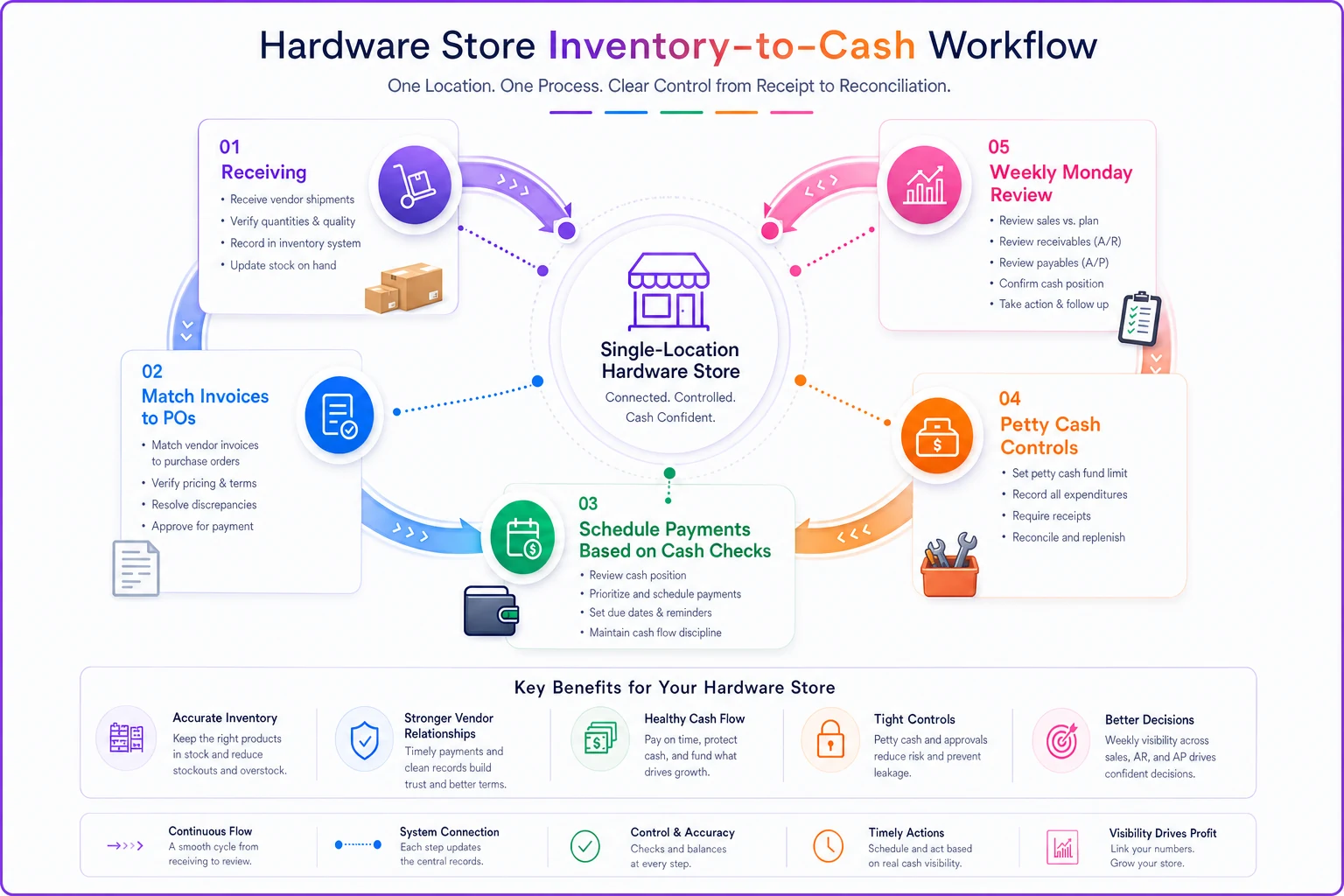
A compact workflow to visualize how each step connects.
-
Every delivery gets matched to the PO same day
-
Discrepancies over $50 get flagged immediately
-
Invoice arrives → matched within 48 hours
-
Payment scheduled based on terms optimization
For petty cash, which bleeds most stores dry, set hard rules:
-
$300 weekly limit
-
Receipts required for anything over $20
-
Weekly reconciliation every Monday morning
-
Specific categories only — customer goodwill, emergency supplies, local purchases
Make the purchase authorization check part of your ordering checklist so it's not skipped.
The real game-changer is connecting these to your sales cycle. Every Monday, review:
-
What sold last week (category level)
-
What's pending payment from customers
-
What inventory needs reordering
-
What suppliers need paying this week
This creates a rhythm where cash, inventory, and purchasing align instead of constantly working against each other.
A 30-day implementation timeline that won't disrupt operations
Week 1: Baseline and setup
Map out all supplier payment terms in one document. Note who offers early-pay discounts, who charges late fees, and who's flexible. Flag your top 10 suppliers by volume — these get priority treatment.
Create your petty cash log. A simple notebook works fine. Date, amount, purpose, who. Train everyone who touches the register. This week is just about starting the habit.
Week 2: Receiving and matching
Start matching every delivery to its PO immediately. Don't let paperwork pile up. If something doesn't match, call the supplier that day. Small discrepancies under $25? Note them but don't waste time fighting it. Focus on the big mismatches that actually impact cash.
Start tracking invoice arrival dates too. You're looking for patterns — which suppliers invoice quickly, which lag. This helps predict cash needs better over time.
Week 3: Payment optimization
Implement the available cash check before ordering. Set a calendar for supplier payments based on terms. If Grainger gives 2% for payment within 10 days, mark day 9. If your lumber yard has no early discount, they get paid on day 29.
Start categorizing petty cash expenses by type. You'll quickly see where money disappears — usually customer appeasement and emergency supply runs that should have been planned purchases.
Week 4: Full cycle connection
Run your first complete Monday review linking sales to purchasing to payments. Compare what product categories sold versus what you're actively buying. Check customer payment timing against supplier payment needs.
This is where patterns emerge. Maybe electrical supplies turn in 15 days but you're paying suppliers in 30 — that's free float you can use. Or seasonal items move slowly but suppliers want quick payment — that's a cash drain worth reconsidering.
Real numbers from actual implementation
A hardware store in suburban Ohio ran this exact system last year. Before: floating $45,000-65,000 in payables at any given time, missing roughly $400 monthly in early-pay discounts, burning through $600-800 in petty cash with no clear tracking. The owner was spending 10-12 hours monthly on crisis cash management.
After 60 days: payables stabilized around $48,000, they captured $350 monthly in discounts, and petty cash dropped to around $400 with full documentation. Owner now spends about 3 hours weekly on proactive cash management instead of fighting fires. That freed-up time went into building better POS forecasting, which further sharpened buying decisions.
Cash position improved too. Instead of scrambling to cover surprise expenses, they maintained a $15,000 buffer — enough to take advantage of bulk buys and seasonal prebooking that competitors passed on. First-year impact: roughly $24,000 in additional margin from opportunistic purchasing alone.
Common failure points and how to prevent them
The biggest failure happens when stores try to implement this during busy season. Start in January or August when things are slower. You need a couple of calm weeks to build habits before stress-testing them.
Second failure: overcomplicating it. Stores create 15-step approval processes that nobody actually follows. Keep it simple. Three checkpoints maximum for regular purchases. Only big, unusual buys need more scrutiny.
Third issue is the owner trying to handle everything personally. Train your senior staff on the basics — they should be able to receive shipments, match invoices, and flag problems. You handle supplier relationships and payment timing, but delegate the daily matching.
Data entry errors kill these systems too. One transposed number makes your cash position wrong, which cascades into bad decisions. Double-check any entry over $1,000. Have someone else verify bank reconciliations monthly.
Building your monthly inventory-to-cash cadence
The monthly rhythm ties everything together. Here's the cadence that works:
| Week (Days) | Tasks |
|---|---|
| Week 1 (Days 1-7) | - Close previous month's books - Pay suppliers with early-discount terms - Review slow-moving inventory against payables - Adjust ordering for seasonal shifts |
| Week 2 (Days 8-14) | - Process contractor invoices - Chase overdue customer payments - Review petty cash burn rate - Project cash position for month-end |
| Week 3 (Days 15-21) | - Place major reorders based on sales velocity - Schedule remaining supplier payments - Audit receiving discrepancies from past two weeks - Update seasonal forecasting models |
| Week 4 (Days 22-30) | - Final push on collections - Optimize payment timing for cash position - Prepare next month's purchasing budget - Quick inventory count on problem categories |
This rhythm means you're never more than a week from catching issues. Problems stay small. Cash stays predictable.
The AP/AR coordination checklist for daily operations
Print this and post it at your desk:
Daily (15 minutes):
-
Match yesterday's deliveries to POs
-
Check bank balance against payment calendar
-
Note any customer payment promises
-
Verify petty cash receipts
Weekly (1 hour):
-
Run available cash calculation
-
Schedule supplier payments
-
Review aging customer accounts
-
Reconcile petty cash to log
-
Flag inventory/cash mismatches
Monthly (3 hours):
-
Full supplier invoice reconciliation
-
Customer payment pattern analysis
-
Inventory turn calculation by category
-
Adjust payment terms negotiations
-
Update cash reserve targets
Quick inventory count on problem categories
When operational software makes sense for this workflow
Manual tracking holds up fine to around $2 million in revenue. Beyond that, the transaction volume makes spreadsheets and paper logs unsustainable — you're spending too much time on data entry instead of making decisions.
The right operational software connects your POS sales data to payables to cash forecasting without the manual work. When fasteners sell quickly, the system can flag that supplier for priority treatment. When seasonal items sit, it surfaces the conversation about stretching payment terms before it becomes a problem.
AI automation helps most when it comes to pattern recognition — things humans consistently miss because there's too much data to track manually. Maybe contractor payments always lag in the third week of the month, so cash projections need to account for that. Or you're consistently over-ordering from certain suppliers and the system starts flagging it before you've noticed yourself.
The real operational value comes from centralizing information. Instead of checking three different systems and a notebook to understand your cash position, everything lives in one place — supplier performance, customer payment history, inventory velocity, cash flow projections. For single-location hardware stores, this kind of setup typically cuts time spent on financial tasks by 60% or more, which is meaningful when it's usually the owner doing all of it.
Stop reacting, start controlling your cash cycle
The difference between profitable hardware stores and struggling ones usually isn't sales volume — it's cash management. Every store sells hammers and light bulbs. The ones that grow are the ones that convert those sales into predictable cash that funds better buying decisions.
This playbook isn't about perfection. Some invoices will still surprise you. Customers will still pay late. Petty cash will still occasionally vanish in ways that defy explanation. But with these controls in place, those become minor annoyances instead of cash flow emergencies. Start with supplier reconciliation triggers. Add petty cash controls. Build your purchase-to-pay checkpoints. Connect everything with that monthly cadence. Within 90 days, you'll have a clearer picture of your cash position than most hardware store owners ever get. The stores that survive the next decade won't be the ones with the biggest selection or sharpest prices. They'll be the ones that master the boring fundamentals — turning inventory investments into cash efficiently, predictably, and with enough visibility to make smart moves when opportunities show up.
Ready to elevate your hardware store management?
Join 500+ hardware stores using Hardzly to boost operational efficiency, reduce stockouts, and grow revenue.