

Most hardware stores don't have a growth problem. They have a lifecycle problem.
Walk into any independent store on a random Tuesday and you'll see plenty of transactions happening. The register rings. People buy stuff. But if you ask the owner a simple question — "How many of the contractors who bought from you in January are still buying from you in September?" — you usually get a shrug, or worse, a confident guess that turns out to be wrong.
That gap is the whole thing. Revenue isn't lost at the register. It leaks quietly between the first purchase and the second, then between the tenth and the eleventh, and nobody notices because there's no system watching the relationship over time.
This is a playbook for building that system without buying software you don't need or hiring someone to run a CRM. It's structured around four moving parts that most stores already touch but never connect: contractor activation, demo days, review nudges, and low-tech loyalty. And it's built so you can test everything in measurable 30/60/90-day chunks instead of guessing.
The core problem: you're treating one-time buyers and lifetime customers the same way
Here's the pattern. A store spends real energy getting people in the door — a sign out front, a sale, a good location — and then does almost nothing intentional after the first sale. Every customer, whether it's a homeowner buying a single toilet flapper or a framing contractor spending $2k a month, gets the exact same experience: nothing.
That's fine for the flapper guy. It's a disaster for the contractor.
Because the real money in local hardware isn't in foot traffic. It's in repeat frequency from a small group of high-value accounts. A store doing, say, $1.4M a year usually finds that 40–60 contractor and small-business accounts drive a disproportionate slice of gross profit — often a third or more. And those accounts are exactly the ones most likely to drift to a competitor or a big-box pro desk if you never give them a reason to stay loyal.
The mistake isn't failing to market. It's failing to treat the relationship as the asset. Foot traffic is a flow. A loyal contractor base is a compounding balance.
Why this breaks across almost every independent store
The reason it breaks is boring but important: nobody owns the customer after checkout.
Stop losing sales due to inventory gaps.
Hardzly helps you manage stock levels, orders, and supplier interactions efficiently.
- Unified inventory and sales tracking
- Supplier and purchase order management
- Automated workflow and task scheduling
No credit card required
Think about how the workflow actually runs. Receiving owns inbound stock. The counter owns the transaction. Whoever does the books owns invoices and payables. But the customer lifecycle — the arc from first visit to loyal repeat buyer — has no owner. It falls through the cracks between departments that all technically touch the customer but none of which are responsible for keeping them.
At a tiny store this is invisible because the owner is standing right there and remembers everyone. You know Dave the electrician's name, you know his kid plays baseball, you know he prefers a specific brand of wire nut. That personal memory is your lifecycle system.
Then you grow. You add a second counter person. You hire someone for weekends. Suddenly Dave walks in on a Saturday, the new kid doesn't know him from a stranger, doesn't know he gets contractor pricing, makes him wait, quotes him retail — and Dave quietly starts splitting his orders with the supply house across town. You never find out. There's no alert for "loyal account is buying 30% less than last quarter." The relationship just erodes.
This is the scaling trap: the thing that made you great when you were small (personal memory) doesn't survive contact with more staff and more customers. You need to convert that memory into a repeatable process before it gets diluted.
The four levers, and how they actually connect
People treat these as four separate marketing ideas. They're not. They're stages of one lifecycle, and they feed each other. Skip one and the others get weaker.
| Lever | Lifecycle stage | What it does | Where it leaks if ignored |
|---|---|---|---|
| Contractor activation | Acquisition → first repeat | Turns a walk-in pro into a tracked account | Pros buy once, never come back as "yours" |
| Demo days | Reactivation + acquisition | Brings dormant accounts back and pulls new ones in | New product sits on shelf; lapsed pros forget you |
| Review nudges | Trust + local visibility | Feeds the top of the funnel with social proof | New buyers can't find you; reputation stays invisible |
| Low-tech loyalty | Retention + frequency | Increases how often existing accounts return | Best customers drift with no switching cost |
The connection matters. A demo day brings a lapsed contractor back in the door. That's your chance to activate them into a tracked account. Once they're an account, your loyalty mechanic increases their frequency. Once they're buying happily and often, they're the easiest person in the world to ask for a review — which pulls in the next batch of pros. It's a loop, not a list.
Run only demo days and you get a fun event with no follow-through. Run only loyalty and you're just discounting people who were going to buy anyway. The system works because the stages hand off to each other.
Lever 1: Contractor activation — the part everyone skips
Activation just means: the moment a pro buys from you the second time, or opens an account, you capture them so you can track and serve them deliberately going forward.
Most stores never do this. A contractor buys $600 of PVC and drywall screws, pays cash, walks out — and to your system he's identical to a tourist buying batteries. No name, no trade, no way to ever reach him again.
-
Trigger Any transaction over a threshold (say $250), or any customer who mentions they're doing a job for a client, gets the counter question: "You want me to set you up on our contractor list? Faster checkout, and I'll flag you when the stuff you buy goes on sale."
-
Capture Name, trade, phone, and the one or two categories they buy most. That's it. A single index card, a shared spreadsheet, or a note in your POS customer field.
-
Assign tier New account, active account, or key account based on rough monthly spend. You're not being precise — you're bucketing.
-
Set the follow-up Every activated account gets one deliberate touch within 14 days. A text: "Thanks for coming in — restocked the ¾ EMT you were after."
Keep the capture form to one index card or a single spreadsheet row to minimize friction.
That's the whole mechanic. What changes is that a pro who used to be anonymous is now someone you can serve on purpose. If you want the full structure behind tiering, credit and invoice cadence, we've broken that down separately in the contractor account playbook, and the referral engine that feeds activation is covered in turning local contractor referrals into predictable B2B revenue.
The insight most owners miss: activation is the only lever that makes the other three measurable. Once pros are tracked accounts, you can actually see whether a demo day brought them back, whether the loyalty mechanic increased their frequency, whether the review ask worked. Without activation, everything else is a vibe.
Lever 2: Demo days that actually move accounts
The typical demo day is a vendor rep standing next to a table of donuts while three people wander over out of politeness. Money spent, nothing learned, nothing changed.
A demo day that works is designed around your account list, not around the vendor. The vendor's product is the excuse. The real goal is reactivating dormant accounts and giving active ones a reason to show up mid-week.
-
Before Pull your list of accounts that haven't bought in 60+ days. Personally invite them — a text, not a flyer. "Hey Mike, we've got the DeWalt rep here Thursday morning doing a demo on the new impact line, coffee and breakfast, come by." A personal invite to a lapsed account converts far better than a public event.
-
During Have someone whose only job is to note who showed. Not to sell — to observe and reconnect. "Haven't seen you in a while, how's the Henderson job going?"
-
After Every attendee gets a follow-up within 48 hours tied to what they looked at. The demo isn't the conversion. The follow-up is.
A realistic pattern: a store invites 25 lapsed accounts to a fastener demo, gets 9 to show, and reactivates 5 or 6 into buying again over the following month. That's not a huge event. But 5 reactivated accounts each worth a few hundred a month is real, recurring gross profit from a Thursday morning and a box of pastries.
When demo days are a bad idea
If you haven't done activation yet, skip demo days. You'll have no list to invite and no way to measure whether it worked — you'll just be feeding donuts to whoever wanders in. Demo days are a reactivation tool. If you have nothing to reactivate, you're not ready for this lever yet.
Lever 3: Review nudges without begging
Reviews are the cheapest local-visibility lever that exists, and the one stores are weirdly shy about. The problem is almost never that customers won't leave reviews — it's that nobody asks at the right moment.
The right moment is right after a good experience you can see happening. A contractor thanks you for tracking down an odd part. A homeowner's face lights up when you actually knew which fitting they needed. That's the window. Ask then, not in a generic email blast three weeks later.
-
A small printed card at the counter with a QR code straight to your Google review page. No app, no login gymnastics.
-
A trained one-liner your staff uses when the moment's right
"If we saved you a trip today, a quick Google review really helps a small shop like us."
-
A monthly glance at how many new reviews came in. That's your only metric.
Something worth noticing: stores that get from around 15 reviews to 60+ often see a real bump in "found us on Google" walk-ins, because you cross the threshold where you look established instead of sketchy. It's not linear. There's a credibility floor, and getting over it changes how much free traffic Google sends you.
One mistake to avoid: don't incentivize reviews with discounts. It violates Google's rules, it attracts junk, and it trains customers to expect payment. Ask because you did good work. That's enough.
Lever 4: Low-tech loyalty that creates switching cost
Loyalty programs get overcomplicated fast. Points, tiers, apps, plastic cards — most of it is friction that a busy contractor will never bother with.
The goal of loyalty for a hardware store isn't gamification. It's switching cost. You want a loyal contractor to feel a small, real reason to come to you instead of the place across town, and to feel like they'd lose something by leaving.
-
Spend-based standing perks. Once an account crosses a monthly threshold, they get automatic contractor pricing, no-questions returns, and first dibs when tight-supply items land. No card. It's just tied to their account.
-
The "we held it for you" habit. When you know Dave burns through a specific fastener, you keep a couple boxes back for him. That single behavior creates more loyalty than any points system, because it's personal and it saves him a stockout.
-
A simple punch-style perk for smaller repeat buyers. For the homeowner who's clearly doing a long project — a physical card, tenth bag of concrete free, whatever fits your margin. Cheap, tangible, works.
Loyalty isn't a discount, it's a relationship the customer would have to rebuild elsewhere. Contractor pricing plus "you know my job and my preferences" is enormously sticky. The supply house across town might beat you by 3% on wire, but they don't hold your EMT and ask about the Henderson job. That's the moat.
Running it as 30/60/90 experiments
The reason most of this never gets implemented is that owners try to do all four levers at once, get overwhelmed, and quit. Don't. Run it as sequential experiments so each one produces a result you can actually read.
Days 1–30: Activation only. Set the counter trigger. Start capturing accounts. Do nothing fancy. Your only goal is to end the month with a real, growing list of tracked accounts. Baseline metric: how many accounts did you activate, and roughly what's their combined monthly spend?
Days 31–60: Loyalty + reviews. Now that you have accounts, turn on the loyalty perks and the review ask. These are low-effort and compound. Metric: are activated accounts returning more often, and did new-review count go up?
Days 61–90: Demo day + reactivation. Run one demo day targeted at your lapsed accounts. Follow up hard. Metric: of the lapsed accounts you invited, how many bought again within 30 days?
Here's a quick visual of the 30/60/90 workflow.
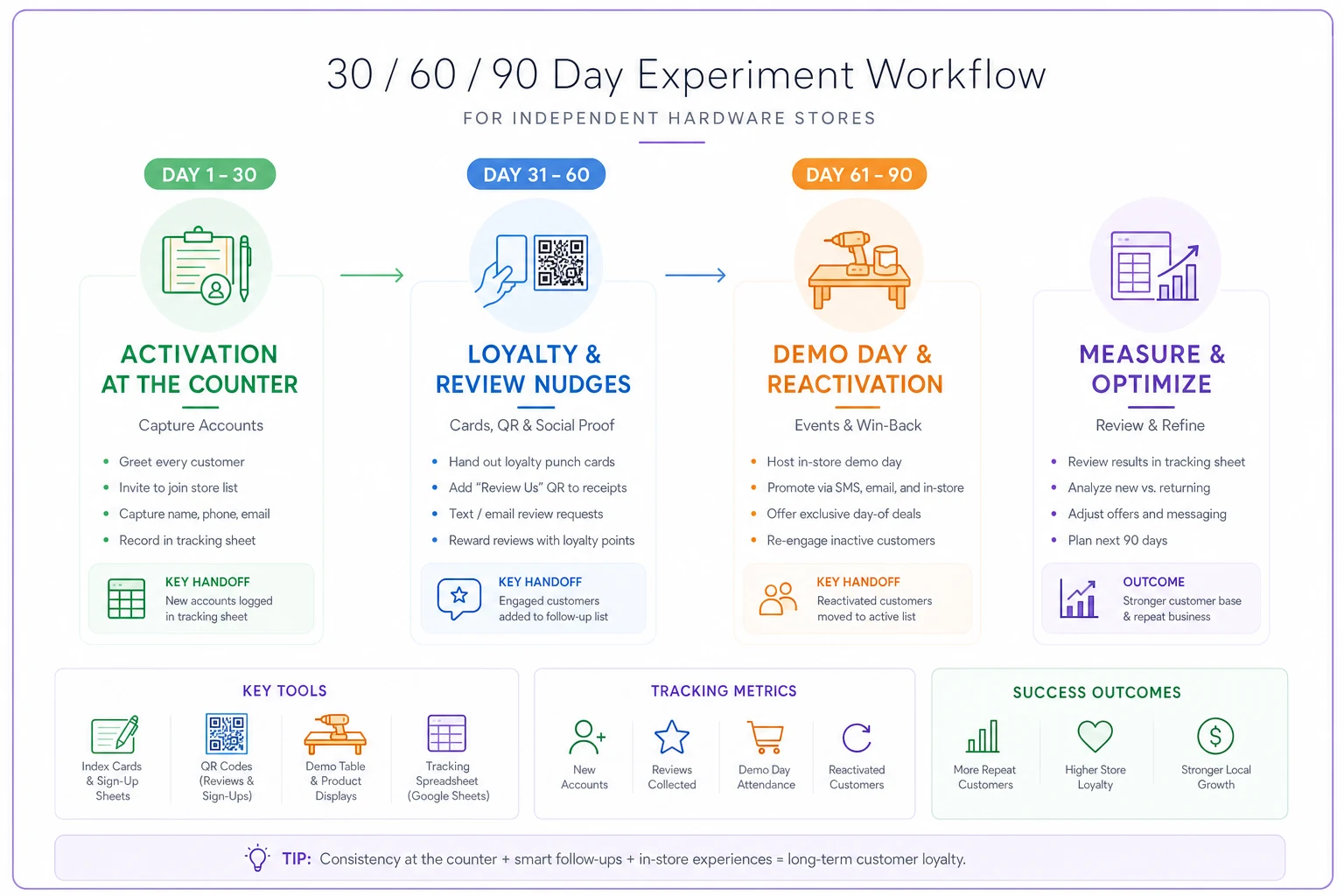
At each checkpoint you're running a genuine ROI check, and none of it needs a CRM — a spreadsheet with account name, tier, last-purchase date, and rough monthly spend covers everything.
The one ROI check that matters
> (Extra gross profit from reactivated + more-frequent accounts) − (cost of demo day, cards, staff time)
A worked example. Say over 90 days you reactivate 5 lapsed accounts averaging $350/month gross margin, and your loyalty mechanic nudges 8 existing accounts to buy roughly one extra time a month at ~$120 margin each. That's about $1,750 + $960 ≈ $2,700 in additional monthly gross profit. Your costs were a demo day (maybe $300 all-in), some printed cards, and a few hours of staff time. The payback is obvious within the first month, and the accounts keep compounding after.
The whole calculation depends on activation. If you never tracked accounts, you couldn't tell reactivated buyers from random walk-ins, and this entire ROI check would be a guess. That's why activation is step one and everything else follows.
Where a real system starts to strain — and what fixes it
The spreadsheet approach works beautifully up to a point. That point usually arrives around the time you cross roughly 60–80 active accounts, or add a second location, or hire enough counter staff that no single person holds the whole customer picture in their head anymore.
The symptoms are consistent: last-purchase dates go stale because nobody updates them, follow-ups get missed because they live in someone's memory instead of a queue, and two staff members give the same contractor two different prices because the tier info isn't visible at the register. The manual system doesn't fail dramatically — it just quietly stops being accurate, and an inaccurate customer list is almost worse than none because you trust it.
This is where a lightweight operational platform earns its keep — not a bloated CRM built for a sales team of twenty, but something that keeps account tiers, last-purchase signals, and follow-up reminders in one place your whole counter can see. The value isn't the software itself; it's that the lifecycle finally has an owner, even when the owner isn't standing behind the register. Everything in this playbook can start on paper. It just needs somewhere reliable to live once your memory stops being able to hold it all.
The real scenario
A single-location store in a mid-size town, doing somewhere around $1.6M a year, had the classic setup: strong walk-in traffic, no idea who their repeat pros were. The owner could name maybe a dozen regulars but had no list and no system.
They ran the 30/60/90 sequence almost exactly as laid out. Month one, they activated 44 contractor and small-business accounts just by asking at the counter — a number that genuinely surprised the owner, who'd assumed they had "a few good customers." Month two, loyalty perks and a QR review card went in; reviews climbed from the high teens into the forties over about six weeks. Month three, a targeted demo day invited 22 lapsed accounts, pulled 8 in, and reactivated 5.
By the end of 90 days, the tracked accounts were driving a noticeably larger and more predictable share of monthly gross profit, and — this was the part the owner cared about most — a Saturday hire could pull up an account, see the tier, and give a contractor the right price without the owner in the building. The revenue lift was real, roughly a few thousand a month in added gross profit. But the durable win was that the customer relationships stopped living only in one person's head.
Bringing it together
Local growth for a hardware store isn't a mystery, and it isn't about outspending the big box down the road. It's about refusing to treat your best customers like strangers. The four levers — activation, demo days, review nudges, loyalty — only work as a connected lifecycle, where each stage hands the customer to the next.
Start with activation, because it makes everything else measurable. Add loyalty and reviews, because they compound with almost no effort. Use demo days to reclaim the accounts drifting away. Check the ROI at 90 days with one honest calculation. And when the manual version starts creaking under its own weight, give the lifecycle a real home so it survives your growth instead of getting diluted by it.
The stores that win locally aren't the ones with the most traffic. They're the ones who remember their customers on purpose — and built a system so they never forget.
Local growth for a hardware store isn't a mystery, and it isn't about outspending the big box down the road. It's about refusing to treat your best customers like strangers. The four levers — activation, demo days, review nudges, loyalty — only work as a connected lifecycle, where each stage hands the customer to the next.
The stores that win locally aren't the ones with the most traffic. They're the ones who remember their customers on purpose — and built a system so they never forget.
Ready to elevate your hardware store management?
Join 500+ hardware stores using Hardzly to boost operational efficiency, reduce stockouts, and grow revenue.