

Most hardware counters already run small service work. Somebody comes in to get a mower blade sharpened, grabs a furnace filter, asks whether their pressure washer needs a winter check. Each of those is a one-off. The customer leaves, and whether they come back depends entirely on whether they remember you exist six months later.
That's the whole problem. You're doing the work, building the relationship, and then letting it reset to zero.
Subscriptions fix the reset. Not the heavy, app-based, credit-card-on-file kind that scares off a 62-year-old homeowner at your counter — the simple kind. A punch-card mentality with a billing date. The goal isn't to turn your store into a SaaS company. It's to take services you already offer and give customers a reason — and a reminder — to come back on a schedule.
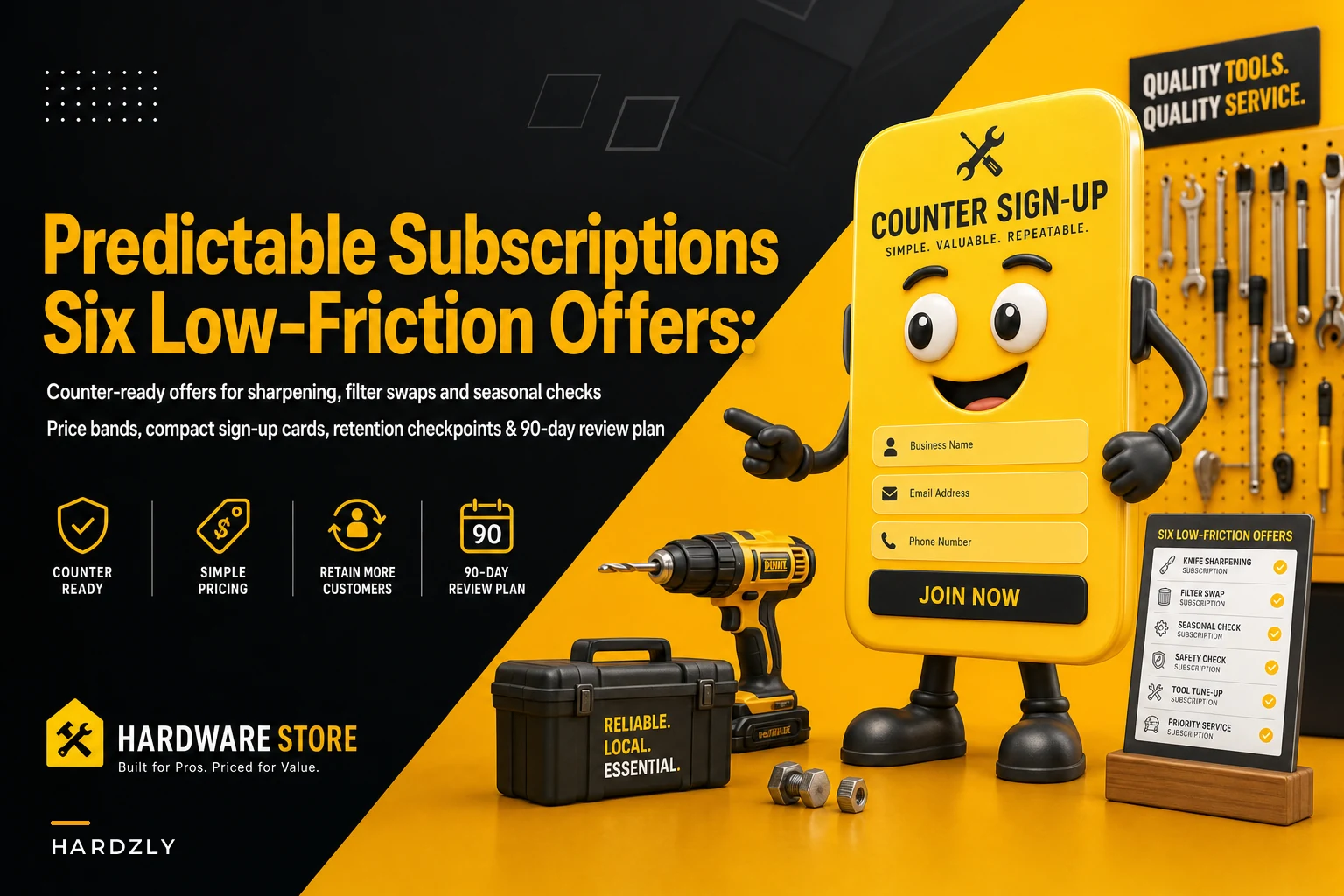
Below are six specific offers that work at a counter, the pricing logic behind them, how to sign people up without friction, and a 90-day plan to check whether any of it is actually making you money.
Why one-off services quietly cap your service revenue
The pattern across most independent stores running counter services: service revenue is lumpy because every sale starts cold. You have no forward visibility. March might bring 40 sharpenings, July might bring six, and you can't staff or stock against that because you don't know it's coming.
The second issue is margin erosion through forgetting. A customer who buys a furnace filter in October intends to swap it again in January. Most don't. Not because they went somewhere else — because nobody reminded them and life got busy. You lose the recurring purchase to inertia, not competition.
A subscription does two unglamorous things: it smooths your revenue curve, and it moves the "remember to come back" burden off the customer and onto a system. That's it. Everything else is just pricing and mechanics.
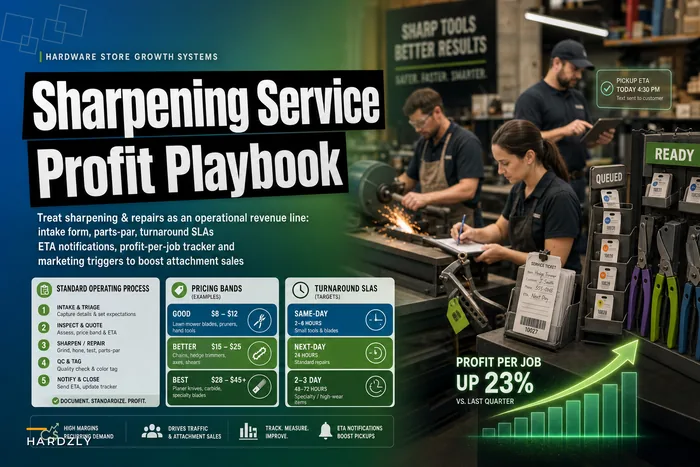
If you want the deeper SOP side of running a service bench profitably, that's covered in the piece on tool sharpening as a profitable service — this article assumes you can already do the work and focuses purely on making it recurring.
The six offers that actually convert at a counter
Not every service belongs in a subscription. The ones that work share three traits: they repeat on a natural cycle, the customer can't easily do them alone, and the per-visit price is low enough that nobody overthinks it.
Stop losing sales due to inventory gaps.
Hardzly helps you manage stock levels, orders, and supplier interactions efficiently.
- Unified inventory and sales tracking
- Supplier and purchase order management
- Automated workflow and task scheduling
No credit card required
1. Blade & Tool Sharpening Plan
The flagship. Lawnmower blades, pruners, chisels, planer blades, kitchen knives if you want the walk-in traffic. The natural cycle is seasonal — spring and fall for lawn equipment, year-round for trades.
Structure it as a prepaid bundle: a set number of sharpenings per year at a discount versus walk-in rate, plus priority turnaround. That priority turnaround does a lot of the selling on its own. A contractor will pay to skip the line.
2. Furnace & HVAC Filter Program
The easiest sell in the building. Customers hate remembering, and the filters are low-dollar, high-repeat. You hold the right sizes for them, text or call when it's swap time, and they pick up — or you deliver locally for commercial accounts.
The margin isn't really in the filter. It's in the attached trips. A customer coming in every 60–90 days buys other things while they're standing there.
3. Seasonal Equipment Check
Pre-season tune-up checks for mowers, snowblowers, pressure washers, generators. Two visits a year: one before the season, one to winterize. Small inspection fee bundled into the subscription, parts billed separately.
This one works because it catches problems before the customer actually needs the equipment — which means you're the hero instead of the emergency.
4. Key & Lock Maintenance (Property Managers)
Niche but sticky. Property managers with multiple units need rekeying, spare key stock, and lock lubrication on a rotating basis. A quarterly plan with a flat visit rate and a key-cutting credit locks in B2B revenue that renews almost automatically.
5. Propane Exchange Plan
If you run propane, a prepaid multi-exchange plan at a slight per-tank discount gets grillers and patio-heater owners coming back to you instead of the gas-station cage. Low effort, pure habit formation.
6. Battery & Small-Engine Service Club
Chainsaws, trimmers, leaf blowers, cordless tool batteries. A yearly plan covering diagnostics, a tune-up, and discounted consumables — oil, filters, line. Targets the serious homeowner and the small landscaping crew.
Pricing bands: where most stores get this wrong
The mistake is pricing a subscription as "walk-in price times number of visits, minus a discount." That math protects nobody. You give up margin and the customer doesn't perceive enough value to actually commit.
Price subscriptions on convenience and priority, not just volume. The discount should be modest — the reminder, priority turnaround, and reserved stock carry the rest of the value. A contractor doesn't subscribe to save $8. He subscribes to not wait three days in May.
Here's a realistic band structure to start from. Adjust to your market, but keep the spread tight.
| Offer | Walk-in price | Subscription price | Billing cycle | Rough gross margin target |
|---|---|---|---|---|
| Sharpening Plan (6 blades/yr) | ~$12/blade | ~$60/yr (≈$10/blade) + priority | Annual prepaid | 55–65% |
| Filter Program | ~$14/filter | ~$11/filter, auto-reminder | Per swap (60–90 days) | 35–45% |
| Seasonal Equipment Check | ~$45/visit | ~$70/yr (2 visits) | Annual prepaid | 50–60% |
| Key & Lock (PM plan) | ~$25/visit | ~$80/quarter flat | Quarterly | 45–55% |
| Propane Exchange (6-pack) | ~$22/tank | ~$120 (≈$20/tank) | Prepaid block | 20–30% |
| Small-Engine Club | ~$90/tune-up | ~$140/yr bundle | Annual prepaid | 40–50% |
Two things worth noting. Propane runs thin on margin — it's a traffic and loyalty play, not a profit center, so don't overweight it. And the filter program is billed per-swap rather than prepaid, because customers resist prepaying for something they think of as a $14 commodity. Match the billing model to how the customer already thinks about the purchase.
Removing the friction at sign-up
The whole thing dies if signing up takes longer than ringing up a normal sale. Nobody at a hardware counter wants to fill out a form while three people wait behind them.
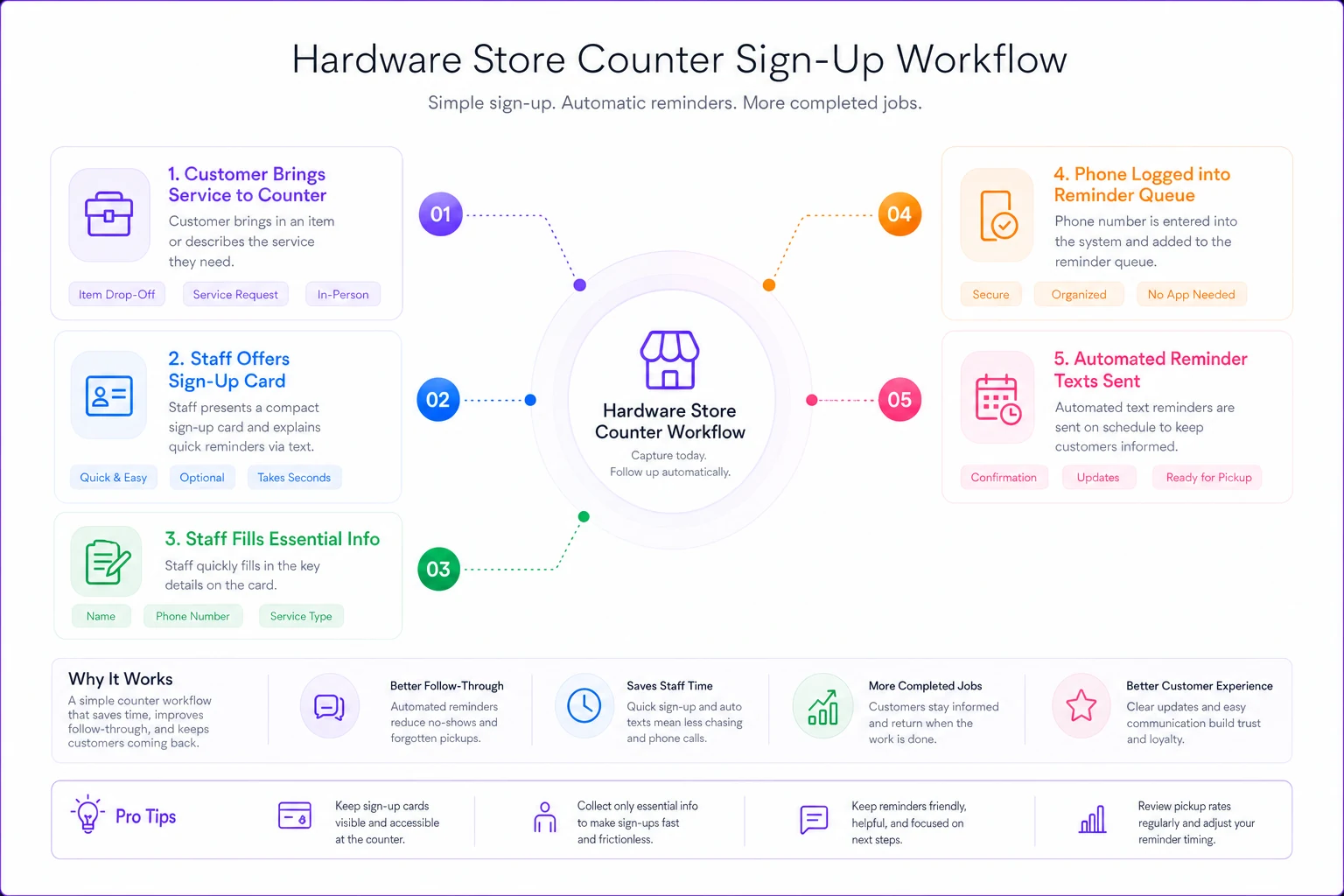
Keep a physical sign-up card at the register for each program. Capture only what you genuinely need:
-
Name and phone (phone is what actually matters — it's your reminder channel)
-
Which plan, which cycle
-
Equipment details if relevant (blade count, filter size, model number)
-
Preferred reminder method (text or call)
-
A line for staff initials and date
Phone is what actually matters — it's your reminder channel.
That's it. No email required, no address unless you deliver. The card should fit on a 4x6 so it doesn't feel like paperwork.
A clean counter workflow:
-
Customer brings in a one-off service — say, a single sharpening.
-
Staff quotes the walk-in price, then one sentence
"If you do this a few times a year, the plan drops it to ten a blade and you skip the line in spring."
-
If interested, fill the card — 30 seconds.
-
Charge the plan (prepaid) or note the per-swap billing.
-
Log the phone number and next reminder date into whatever you use to track it.
That last step is where stores leak. A card in a shoebox is not a reminder system. Somebody has to actually get texted when their filter is due, or the whole promise falls apart and you've just sold a discount with no retention benefit.
This is the one piece worth automating. A lightweight operational platform — the kind that ties your service log to a reminder queue — turns "we meant to call them" into a scheduled text that goes out on its own. It doesn't need to be fancy. It needs to fire the reminder on the right day and show you who's due this week.
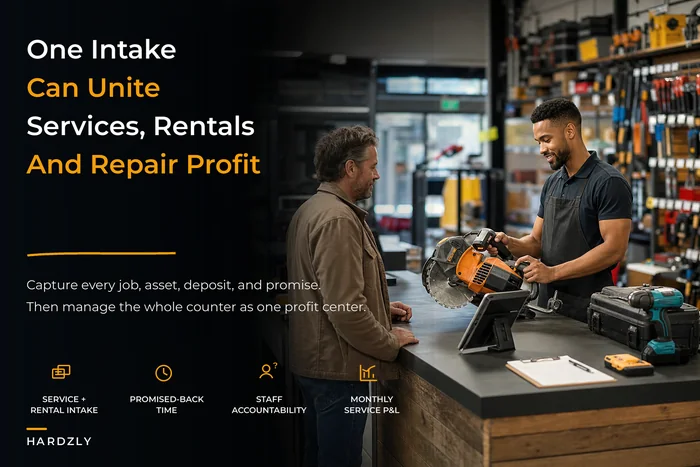
If you already run a combined service and rental operation, folding these plans into one tracked system is the natural move — which is roughly the thinking behind a consolidated service and rental profit system.
Retention checkpoints: catch the drop before it's a cancellation
Subscriptions don't churn loudly. They fade. A customer skips one swap, then two, then quietly never renews. If your only checkpoint is the annual renewal date, you find out you lost them a year too late.
-
The missed-visit flag. If a filter swap or seasonal check is 14 days overdue, that's a signal. One nudge text recovers a surprising share of these.
-
The halfway nudge. Around the midpoint of an annual plan, a quick "you've got 3 sharpenings left, spring's coming" message does two jobs — reminds them of value received and prompts usage.
-
The pre-renewal conversation. Two to three weeks before renewal, not the day of. A customer who's used the plan says yes easily; one who forgot they had it needs the reminder of what they actually got.
The pattern worth watching: customers who use the service at least twice in the first 90 days renew at a much higher rate than those who use it once or zero times. So your real retention work isn't at renewal — it's driving that second visit early.
A real scenario
A single-location store that did steady but unpredictable sharpening work — somewhere between 25 and 50 jobs a month depending on season — launched a Sharpening Plan and a Filter Program off counter cards. No app, no website checkout, just the card and a reminder list.
In the first quarter they signed roughly 70 plan customers across both programs. The filter program drove the surprise: those customers came in every couple of months, and the attached basket — stuff grabbed while picking up filters — regularly ran $20–$40 above the filter itself.
Service revenue didn't explode. But it got flat, in the good sense. The lumpy March-spike/July-dead pattern smoothed into something they could actually forecast, and the owner stopped guessing at spring staffing. The real lift showed up in attached sales and a return rate they could finally count on.
When this makes sense — and when it doesn't
This works well when you already run counter services with repeat demand, you have a staff member who'll consistently log sign-ups, and you serve a mix of homeowners and small trades who value convenience over squeezing every last dollar.
This is a bad idea when your service work is genuinely one-off — custom fabrication, rare repairs, things with no natural cycle to subscribe to. It's also a mistake if you can't commit to the reminder system. A subscription with no reminders is worse than no subscription, because you've promised ongoing value and silently failed to deliver it.
Who should skip it: stores where one person is already running the whole counter at capacity and genuinely cannot add the 30-second sign-up step. Fix the staffing bottleneck first, then layer this in.
The 90-day review
Run these offers for a full quarter, then look at four things. Don't judge it before 90 days — subscriptions need at least one full cycle to show their real retention behavior.
-
Sign-up rate. How many plan sign-ups per 100 service transactions? Under 10% and your counter pitch needs tightening, or the price band is off.
-
Second-visit rate. What share of new subscribers used the service twice in the first 90 days? This predicts renewal better than anything else.
-
Attached sales lift. Compare the average basket on a subscriber visit against a normal walk-in. This is often where the real money is — especially on filters and propane.
-
Margin after reminders. Net out the cost of the discount and any delivery or labor. Confirm each program is clearing the margin targets in the pricing table — or cut the ones that aren't.
Kill the losers without sentiment. If propane is bleeding margin and not driving enough attached traffic, drop it and double down on sharpening and filters. The point of the 90-day window is to find the two or three offers that fit your customers, not to run all six indefinitely.
The stores that make this work aren't the ones with the slickest systems. They're the ones that treat a service sale as the start of a relationship instead of the end of a transaction — and then actually remember to follow up. The cards and pricing bands above are just the structure. The follow-through is the whole game.
Ready to elevate your hardware store management?
Join 500+ hardware stores using Hardzly to boost operational efficiency, reduce stockouts, and grow revenue.