


Most hardware store owners aren't short on ideas. There's already a mental list a mile long: move the fasteners wall, run a contractor Tuesday promo, bundle caulk with the painter's tape, put a grab-and-go display by the register. The problem isn't ideas. It's that there's no system for deciding which ones to actually try, how to run them cleanly, and how to know—without arguing about it—whether they worked.
So what usually happens is you try something on a gut feeling, it kind of works or kind of doesn't, nobody tracks it, and three weeks later you've quietly gone back to the old layout. No learning, no record, just churn. Multiply that across a year and you've spent a lot of energy with almost nothing to show for it.
An experimentation framework for small retail fixes that. Not a lab, not a data science team—just a lightweight, repeatable loop that lets a 1–3 person team test an idea, measure it honestly, and keep the winners. The whole thing runs on a few spreadsheets and a monthly 45-minute meeting. The hard part isn't the tools. It's having rules you actually follow so good ideas don't die and bad ones don't linger.
Why most store "experiments" produce nothing
The pattern that shows up again and again in small stores: an idea gets tried because someone was enthusiastic about it, not because it was prioritized against other ideas. There's no baseline, so when sales tick up nobody can tell if it was the new endcap or just a rainy week that pushed foot traffic. And there's no decision point—no moment where someone says "this is a keeper" or "kill it." The test just dissolves.
The deeper issue is that testing in a tiny store competes directly with running the store. You and maybe two other people are already covering the register, receiving, cutting keys, and answering "where's the plumbing aisle" forty times a day. Any experiment that requires a lot of setup or tracking will lose to the daily grind every single time. So the framework has to be almost offensively simple, or it won't survive contact with a normal Tuesday.
-
No idea intake. Ideas live in your head or on sticky notes. The loudest or most recent idea wins, not the best one.
-
No baseline. You can't prove a lift if you never wrote down "normal."
-
Tests that run forever. Without an end date, an experiment becomes the new permanent state by default, winner or not.
-
No go/no-go rule. When results are fuzzy, owners keep things out of inertia or kill them out of frustration. Both are expensive.
-
Winners that never get institutionalized. Even when something works, it doesn't make it into the planogram, the par levels, or the staff routine. So it fades.
If you've built out a merchandising maturity model for your store, experimentation is the engine that actually moves you up the levels. Without a testing loop, your merchandising stays frozen at whatever you last guessed was right.
The four parts of the loop
The framework has exactly four moving pieces. Keep it to four. Every extra piece is one more thing that breaks when you get busy.
Stop losing sales due to inventory gaps.
Hardzly helps you manage stock levels, orders, and supplier interactions efficiently.
- Unified inventory and sales tracking
- Supplier and purchase order management
- Automated workflow and task scheduling
No credit card required
-
Idea intake + prioritization rubric — a single list where ideas go, scored so you know what to run next.
-
Pilot templates (14-day and 30-day) — pre-built plans for the three test types you'll run most: merchandising, promos, and attach.
-
Measurement sheet with go/no-go thresholds — the one sheet that decides the fate of every test, written before the test starts.
-
Monthly governance meeting — 45 minutes to review results, kill losers, institutionalize winners, and pick next month's tests.
That's the whole system. Each piece below has real structure you can copy.
Part 1: Idea intake and the prioritization rubric
The intake is just a tab in a spreadsheet. Every idea—yours, your counter staff's, a contractor's offhand suggestion—gets dropped in with one line of description. Don't filter at the door. The filtering happens through scoring.
| Factor | What it means | 1 (low) | 5 (high) |
|---|---|---|---|
| Impact | Potential margin or revenue if it works | Minor | Could move a whole category |
| Effort | Setup + daily tracking burden | Multi-day rebuild | 20 minutes to launch |
| Confidence | How sure you are it'll work | Total guess | Strong signal already |
| Reversibility | How easy to undo if it flops | Hard to unwind | Flip a display back in an hour |
Score impact, confidence, and reversibility normally. For effort, flip it—low effort should score high—so a simple sum works. Add the four numbers. Anything that lands at roughly 14+ is a strong candidate. Below 10, park it.
Reversibility matters more than people expect. In a small store, a cheap-to-undo test is worth running even on low confidence, because the downside is tiny. A full fastener-wall reorg that takes two days to reverse needs a much higher confidence score before it's worth the gamble. That single column stops you from betting the floor on a hunch.
One thing stores often notice after using this for a month or two: the rubric's real job isn't picking the single best idea. It's giving you permission to say "not this month" without the idea feeling rejected. It's parked, scored, and it'll come up again. That alone kills most of the politics around whose idea gets tried.
Part 2: The 14-day and 30-day pilot templates
Two durations cover almost everything. Use 14 days for fast-signal tests—promos, counter attach prompts, a single display swap. Use 30 days for anything where weekly traffic patterns matter or the sample is thin, like a slow category reorganization or a contractor-targeted bundle.
-
Hypothesis (one sentence)
"If we place X near Y, attach rate on Z rises."
-
What changes (the single variable)
change one thing. Two changes and you'll never know which worked.
-
Baseline window
the 2–4 weeks before, same metric.
-
Measure
the one number that decides it.
-
Guardrail
a metric that must not get worse (e.g., total category margin).
-
End date + decision owner
who calls go/no-go, and when.
Merchandising pilot (30-day)
Hypothesis: Moving the caulk/sealant set from the back plumbing aisle to an endcap near the paint section lifts weekly caulk units.
Variable: location only—same SKUs, same price, same facings.
Baseline: trailing 4 weeks of caulk units.
Measure: weekly caulk units sold.
Guardrail: plumbing-aisle total sales shouldn't drop more than a hair (you didn't want to cannibalize).
Decision: owner, day 30.
Promo pilot (14-day)
Hypothesis: A "buy 2 get 10% off" on a specific abrasive line clears slow stock without wrecking margin.
Variable: the promo itself.
Baseline: trailing 4 weeks of that line's units and gross margin dollars.
Measure: units moved and total gross margin dollars (not just units—easy to "win" on volume while losing money).
Guardrail: blended category margin stays above your floor.
Decision: day 14.
Attach pilot (14-day)
Hypothesis: A scripted counter prompt—"grab a blade for that?" when someone buys a utility knife—raises blade attach rate.
Variable: the verbal prompt, used consistently.
Baseline: blade-per-knife ratio from recent sales.
Measure: attach rate (blade packs sold ÷ knives sold).
Guardrail: none really—attach tests are near-zero downside, which is exactly why they're great starter experiments.
Attach tests are the single best place for a nervous first-timer to begin. No layout work, no price risk, no stock exposure. You're just testing whether a sentence at the counter changes behavior. If your team can't run a clean attach test, the bigger experiments aren't going to land either.
Part 3: The measurement sheet and go/no-go thresholds
This is the part that makes the whole thing honest, and it's the part most people skip. Write your go/no-go thresholds before the test starts. The moment you decide after seeing the data, you'll rationalize keeping your favorite ideas regardless of what actually happened.
-
GO (institutionalize) the measure beats baseline by a clear margin—roughly 15%+ for attach and promo tests, or a solid repeatable weekly lift for merchandising—and the guardrail held.
-
NO-GO (kill) flat, down, or the guardrail broke.
-
EXTEND (rare) result is promising but the sample's too thin to trust. Allowed once, for one more cycle, then you must decide. No infinite extensions.
That "extend only once" rule exists because the most common way these programs die isn't bad tests—it's zombie tests that never resolve. An experiment with no forced ending quietly becomes policy.
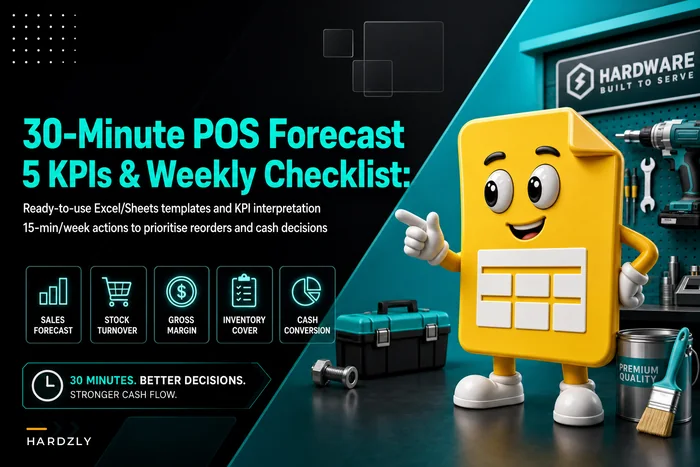
Pull your numbers the same way every time. If you've already got a 30-minute POS forecast dashboard running, you've basically already got your measurement feed—baseline units, margin dollars, category trends are right there. Experiments and your weekly KPI review should pull from the same source so you're never arguing about whose spreadsheet is right.
One thing worth stressing: track gross margin dollars, not just units, on anything price-related. A promo that moves 40% more units at a gutted margin can feel like a huge win on the floor and still lose money for the month. The measurement sheet catches that; your gut won't.
Part 4: The monthly governance meeting
Forty-five minutes, same day each month, even if it's just you and one other person. The agenda never changes:
-
Review active tests (15 min)
For each, read the measure, check the guardrail, call GO / NO-GO / EXTEND. Record it.
-
Institutionalize winners (10 min)
A winner isn't "done"—it's a change that now needs to live somewhere. Update the planogram, the par level, the counter script, whatever. If it doesn't get written into a routine, it's not a winner, it's a memory.
-
Retire losers cleanly (5 min)
Flip the display back, end the promo, note why it failed. Dead tests still teach.
-
Pick next month's tests (15 min)
Pull the top-scored ideas from intake. Cap it at two or three active tests at once. A three-person store running six simultaneous experiments measures nothing accurately.
The institutionalize step is where most of the value actually gets captured or lost. A promo that works and then just ends, because nobody built it into the calendar, is pure waste—you paid the discount, learned the lesson, and threw the lesson away. Winners have to graduate into standard operations: the planogram, the reorder par, the seasonal promo schedule. That's the difference between running experiments and actually improving the store.
This is also where experimentation connects to your broader category work. When you're deciding how to turn mixed assortments into margin-per-sqft winners, the monthly meeting is where test results feed those decisions—which categories earn more shelf, which get cut—with evidence instead of opinion.
Here's a simple visual of the monthly meeting workflow.
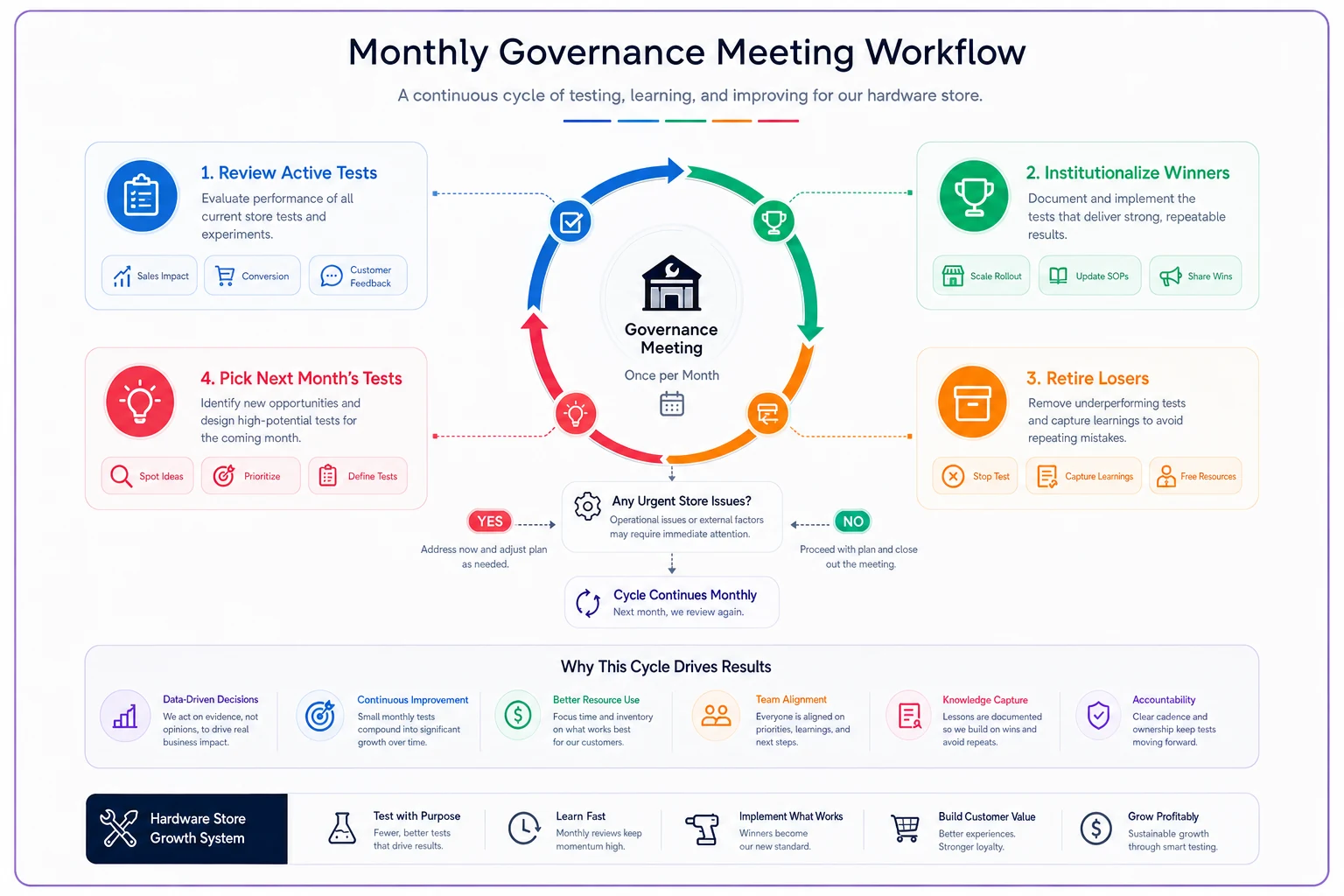
Use it as a reminder of the quick, repeatable flow.
A real scenario
A two-person hardware store—owner plus one full-timer, doing somewhere around $70k–$80k a month—kept rearranging the impulse area by the register on instinct. Candy, batteries, flashlights, a tape measure clip strip, rotating constantly. Never any clearer whether it helped.
They ran one clean 30-day merchandising pilot instead. Hypothesis: swap the low-moving candy spinner for a small "project finishers" zone—sandpaper packs, pencils, snap blades, a couple glue tubes—right at the counter. One variable: the fixture contents. Baseline: trailing four weeks of impulse-zone margin dollars, which were weak, maybe $400-ish a week and mostly low-margin candy.
By day 30, the project-finishers zone was running noticeably higher in margin dollars—roughly a 25–30% lift over the candy baseline—and the items were higher-margin to begin with, so the gross dollars moved more than the unit count suggested. The guardrail (total front-end transaction value) held fine. Clear GO. The win got written into the planogram, and the candy spinner moved to a smaller spot by the door where it still sold fine to kids tagging along.
The real outcome wasn't that one zone. It was that the owner stopped guessing. The next three ideas went through intake, got scored, and two of them ran as proper tests the following month. The store finally had a loop instead of a habit of rearranging things and hoping.
When this makes sense—and when it doesn't
This is worth doing when you've got recurring ideas you keep half-trying, when you can pull basic unit and margin numbers from your POS, and when you're tired of debating whether past changes actually worked. Even a solo operator can run one test at a time this way.
This is a bad idea when your fundamentals are on fire. If you're regularly out of stock on core SKUs, your product data is a mess, or you don't know your category margins, fix those first. Experimentation assumes a stable baseline. You can't measure a 15% lift against a number that swings 15% on its own because of stockouts.
Who should skip it for now: a brand-new store still finding its footing. Your first six months are the experiment. Get a clean baseline established before you start testing against it—otherwise every test is measuring the noise of a business still settling in.
Keeping it alive past month three
The failure mode for these programs isn't the setup—it's month three, when the store gets busy and the governance meeting gets "skipped just this once." That's how it dies. Protect two things: the recurring meeting slot, and the cap of two or three active tests. Both exist to keep the system small enough to survive a hard week.
If keeping the baselines, scores, and measurement sheets in sync across a few spreadsheets gets tedious, that's usually the sign to pull the numbers straight from a system that already holds your sales and category data, rather than retyping figures by hand. The less manual the measurement step is, the more likely you are to actually run the test to completion. But the spreadsheets work fine to start. Don't let tooling be the reason you delay.
The core idea is simple: a tiny team can't afford to run experiments the sloppy way, because every hour you spend testing is an hour you're not covering the floor. The payoff isn't any single winning endcap. It's that over a year, you accumulate a stack of proven changes—each one small, each one measured, each one now baked into how the store runs—instead of a year of rearranging shelves and never quite knowing if it mattered.
Ready to elevate your hardware store management?
Join 500+ hardware stores using Hardzly to boost operational efficiency, reduce stockouts, and grow revenue.