

Most hardware stores don't lose money because any single part of the business is broken. They lose it in the gaps between the parts — the counter sells a bundle at a discount the rental desk never sees, the contractor account racks up a credit balance nobody reconciles against actual project margin, and the service bench eats labor hours that get buried under "store overhead." Each channel looks fine on its own. The business as a whole quietly bleeds.
That's the trap of running three businesses under one roof without a shared financial spine. Retail counter sales, a rental fleet, contractor and B2B flows — if each one keeps its own scorecard, nobody's accountable for the combined P&L. The idea of a commercial operating system for your hardware store isn't about buying another dashboard. It's about forcing all three channels through one monthly consolidation routine so you can actually see where the margin goes.
Here's how this breaks, what it looks like when the channels are siloed, and how to build a consolidation cadence that catches the leaks before they compound.
Why three channels under one roof drift apart
Nobody tells you this when you add a rental program or lean into contractor accounts: each channel develops its own gravity. The counter runs on transaction speed and gut-feel markup. Rentals run on utilization and tracking down overdue tools. Contractor accounts run on relationships, terms, and the occasional handshake deal. Three different rhythms, three different mental models of what "good" looks like.
In real operations, the drift usually shows up like this. Your retail margin report looks healthy at 34–38% blended. Your rental revenue line looks great because gross rental dollars are climbing. Your contractor sales volume is the biggest number on the board. Everything's growing, on the surface. But when you actually assign costs correctly — the maintenance and depreciation eating your rental fleet, the extended terms and discounts quietly dragging contractor margin into single digits — the picture changes fast.
The pattern that shows up repeatedly: the channel that looks biggest on revenue is often the smallest on actual contribution. Contractor volume feels like the engine of the store, but after net-30 terms, loyalty pricing, and the counter staff time spent pulling will-call orders, the real margin can be thinner than your walk-in retail. Nobody catches it because contractor sales never sit next to a fully-costed P&L.
The silo problem in plain numbers
Take a single-location store doing roughly $2.1M a year across three channels. A typical split might look like this — and watch what happens when you move from "revenue" thinking to "contribution" thinking.
Stop losing sales due to inventory gaps.
Hardzly helps you manage stock levels, orders, and supplier interactions efficiently.
- Unified inventory and sales tracking
- Supplier and purchase order management
- Automated workflow and task scheduling
No credit card required
| Channel | Annual revenue | Reported gross margin | Hidden costs often missed | Realistic contribution |
|---|---|---|---|---|
| Counter retail | ~$1.3M | 35% | Shrink, markdowns, re-tagging | ~28–30% |
| Rentals | ~$450k | "feels like 70%+" | Maintenance, downtime, depreciation, lost tools | ~40–45% |
| Contractor / B2B | ~$350k | 22% | Extended terms, volume discounts, pick/pack labor | ~12–15% |
The rental line is the interesting one. Owners love quoting rental "margin" because the per-rental math looks fantastic — a tool that cost $600 rents for $45/day, so after a dozen rentals it's "pure profit," right? Except the fleet needs servicing, some units sit idle half the year, and a couple walk off and never come back. Once you load those costs in, you often land closer to 40% — still your best channel, but nowhere near the 70% people throw around. Serialized tracking and a real service workflow make this far more visible, which is exactly the groundwork covered in the consolidated service & rental profit system.
The contractor line is where it stings. That 22% gross looks acceptable until you realize net-30 (that drifts to net-45 in practice) and contractor-tier discounts are shaving real points, and the labor to assemble and hold orders isn't charged anywhere. A store doing $350k in contractor sales at a true 13% contribution is producing around $45k — less than you'd expect from a channel that feels like your most important customer relationship. Keeping those accounts profitable comes down to terms and credit discipline; the contractor account playbook covers exactly that.
What breaks as you scale
When you're small, you can hold all three channels in your head. You know the rental fleet by serial number, you know which contractors stretch their terms, you know roughly where retail margin sits. The store runs on owner memory.
The breakage starts when volume outgrows memory. Here's the sequence:
-
Cross-channel discounts go unaccounted. A contractor buys lumber and rents a concrete saw in the same visit. The counter staff throws in a discount to win the whole ticket. Retail eats the discount, rentals never know it happened, and the combined ticket margin is invisible.
-
Shared labor gets mis-assigned. The same two employees run the counter, prep rentals, and pull contractor orders. On the books, all their hours hit "retail payroll." Rentals and contractor flows look more profitable than they are because their labor cost is hiding in the retail bucket.
-
Inventory moves between channels with no costing trail. A sawblade sold off the retail shelf vs. one consumed servicing a rental vs. one included in a contractor bundle — same SKU, three different margin realities, one undifferentiated cost of goods.
-
Decisions get made channel-by-channel. You decide to expand the rental fleet because "rentals are our best margin," without seeing that the capital might return more if it went into contractor credit capacity or into slow-but-steady counter categories.
The core failure isn't any one of these on its own. It's that you're making capital and pricing decisions on channel-level numbers that were never reconciled against each other. Three pipes that never got connected to the same meter.
The monthly consolidation routine
The fix is boring and it works: one recurring monthly routine where all three channels roll into a single consolidated P&L, with explicit decision gates. Not a glance at three separate reports — one combined view, run the same way every month so trends actually mean something.
The monthly consolidation workflow looks like this.
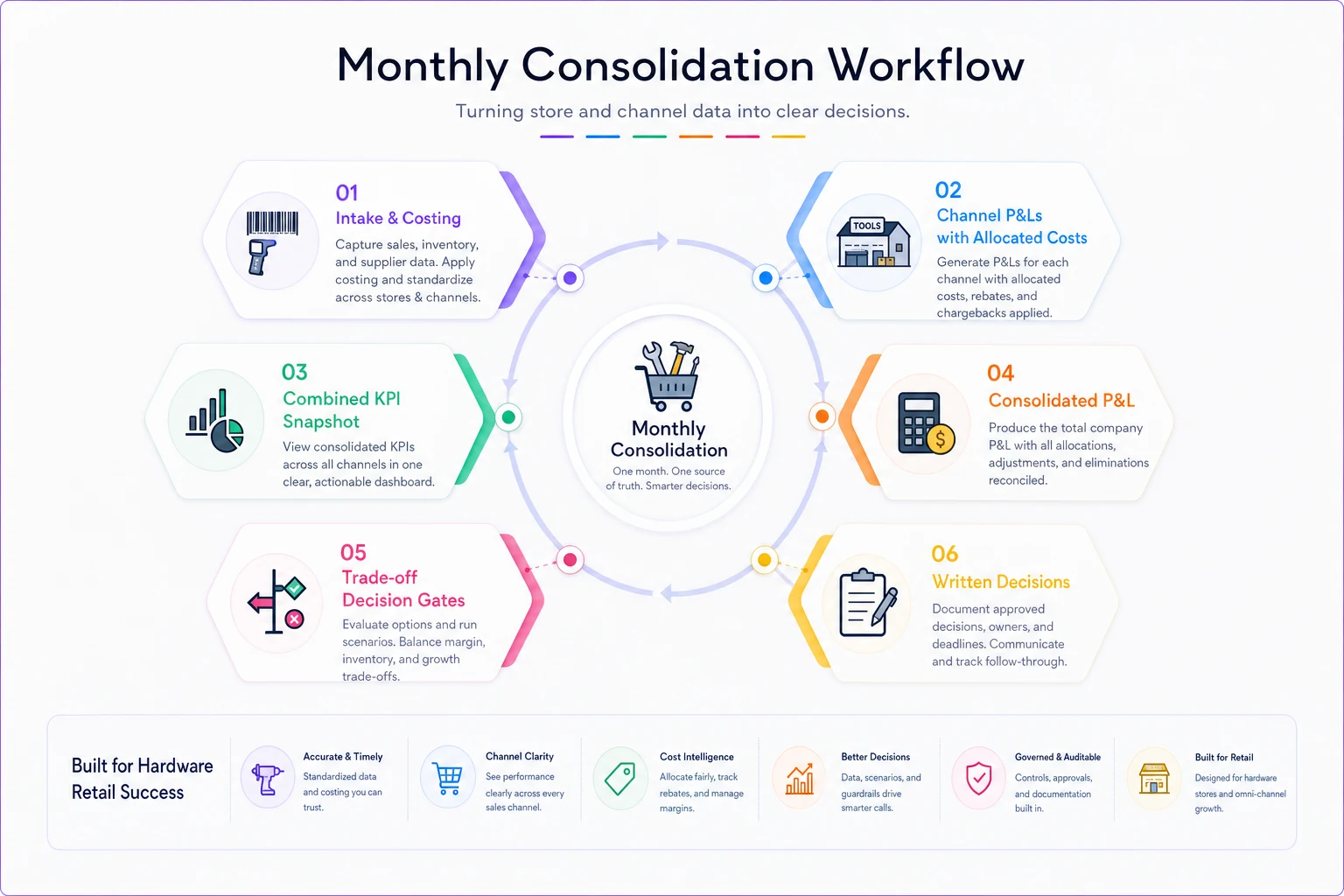
1. Intake and costing templates — at the source, not month-end. Every channel needs a standard intake template that captures true cost at the moment of transaction. For rentals, that's the unit, its serial, the maintenance tagged to it, and idle days. For contractor orders, it's the discount applied and the pick/pack time. For retail, it's the markdown and any shrink adjustment. The goal is that nothing needs to be reconstructed later. This is the single biggest thing that makes month-end bearable instead of a forensic exercise.
2. Build channel P&Ls with shared costs allocated honestly. Take payroll, occupancy, and overhead and split them across channels by a defensible driver — labor hours by channel, square footage, or transaction count. The method matters less than consistency. What you're after is each channel carrying its fair share so the contribution numbers mean something. Margin-per-square-foot thinking fits naturally here; the logic from the margin-per-sqft category governance playbook extends from product categories to whole channels.
3. Pull channel KPIs onto one page.
-
Counter retail blended margin %, markdown rate, shrink %
-
Rentals fleet utilization %, revenue per unit, maintenance cost ratio, lost/overdue count
-
Contractor true contribution %, DSO (days sales outstanding), discount leakage %
The point of one page is that you can compare channels side by side. That comparison is where the siloed thinking finally breaks.
4. Produce the worked consolidated P&L. Revenue, COGS, allocated labor, allocated overhead, contribution — by channel and combined. When you line them up, the ranking by contribution almost never matches the ranking by revenue. That mismatch is the whole reason to do this.
5. Run the trade-off decision gates. Most stores skip this part. It's also the part that actually changes behavior. After the P&L is built, you force explicit decisions by asking trade-off questions out loud.
The decision gates that stop the leakage
A consolidation report nobody acts on is just a prettier version of the siloed reports you already ignore. The gates are what turn numbers into decisions. Run these every month:
-
The capital gate "If I have $X to invest this month, which channel returns the most per dollar — fleet, inventory depth, or contractor credit capacity?" Answer it with contribution numbers, not channel loyalty.
-
The discount gate "What did cross-channel and contractor discounting cost us this month, and is any of it winning business we'd have lost otherwise?" If discount leakage is climbing without a volume payoff, tighten it.
-
The labor gate "Which channel consumed the most labor per dollar of contribution?" A channel that eats disproportionate staff time for thin margin is a candidate to re-price or re-scope.
-
The utilization gate "Which rental units sat idle, and should they be sold, repriced, or redeployed?" Idle fleet is dead capital wearing a productive disguise.
-
The terms gate "Which contractor accounts are stretching past agreed terms, and what's that costing in tied-up cash?"
Each gate ends with a decision written down — do it, don't do it, revisit next month. That's the difference between a routine and a report.
A real scenario
A single-location lumber-and-hardware store doing a little over $2M had been running rentals and contractor accounts for years with separate tracking. Retail had a real P&L; rentals and contractor sales had "revenue reports."
When they finally built one consolidated monthly view, two things fell out immediately. The rental fleet had four units that hadn't rented in over five months, tying up roughly $9k–$11k in idle capital, while two high-demand units were booked solid and could've justified a second each. And their top contractor account — the one everyone treated as untouchable — was running at about 9% true contribution after discounts and a DSO that had crept past 50 days.
Nothing dramatic happened next. They sold two idle rental units and reinvested in the ones that were always booked solid and could've justified a second each. They nudged the top contractor's terms back toward agreement and trimmed the automatic discount by a couple of points — the account stayed.
Over the following two quarters, blended contribution improved by a few points and, maybe more importantly, the monthly meeting stopped being three people defending three separate scorecards. One number, one conversation.
When this makes sense — and when it doesn't
This routine is worth building when you're genuinely running more than one channel at meaningful scale — rentals or contractor sales each clearing 15–20% of revenue. Below that, the overhead of consolidation can outweigh the insight, and a simpler owner financial review will catch most of the risk.
When it's a bad idea: if your intake data is a mess and you try to build consolidated P&Ls from reconstructed guesses, you'll produce confident numbers that are wrong — worse than no report at all. Fix the capture at the source first, then consolidate.
Who should probably not start here: a store that hasn't yet nailed basic channel-level costing. You can't consolidate what you can't individually measure. Get each channel to a clean standalone P&L before trying to merge them.
Where software earns its place
None of this requires fancy tooling to start — a disciplined spreadsheet and a standing monthly meeting will get you most of the value. The reason stores eventually move to an operational platform is that the capture step is where manual systems fall apart. Serial-level rental costs, cross-channel discounts tagged to the right ticket, labor hours split by channel — doing that by hand every month is exactly the kind of work that gets skipped when the store is busy.
Fix the capture at the source first before you try to consolidate.
An AI-assisted operational platform can tag those costs automatically as transactions happen, allocate shared labor by actual activity, and roll the consolidated P&L without a month-end forensic session. The value isn't a flashier dashboard — it's that the consolidation routine actually gets run every single month because the tedious part is handled automatically. A report you reliably produce is worth more than a perfect one you build twice a year.
The takeaway
Running retail, rentals and services under one roof means running three businesses that quietly compete for the same capital, labor and shelf space. Left siloed, each one optimizes for its own scorecard and the combined margin leaks through the cracks nobody owns. A commercial operating system for your hardware store isn't a product you buy — it's the discipline of forcing all three channels through one consolidation routine, with honest cost allocation and explicit trade-off gates that make you choose where the next dollar goes.
Build that cadence, run it monthly, and the leaks stop being invisible.
Build that cadence, run it monthly, and the leaks stop being invisible.
Ready to elevate your hardware store management?
Join 500+ hardware stores using Hardzly to boost operational efficiency, reduce stockouts, and grow revenue.