



Most hardware store margin problems don't show up as a single bad decision. They show up as drift. A promo that ran two weeks too long. A Saturday that was overstaffed because the previous Saturday was busy. A category that kept its markup band from three supplier increases ago. None of these feel like a crisis on their own. Added together across a year, they quietly carve four or five points off your gross margin, and you never see the exact moment it happened.
These decisions live in different places and get made by different people on different days. Pricing is the owner adjusting the POS on a Sunday night. Payroll is the manager building a schedule in a spreadsheet. Promotions are a vendor's co-op money and a gut feel about foot traffic. Assortment is whatever got reordered because it looked low. Nobody is sitting in the middle connecting them, so nobody notices that a deep promo on a low-margin category, staffed with overtime, in a week of soft sales, is the exact combination that turns a "good week for traffic" into a margin loss.
That middle seat is what a margin governance system fills. Not a dashboard you glance at once a month, but a set of rules that decide what you're allowed to do before you do it. Less about reporting, more about governance — pre-agreed thresholds that make the obvious-in-hindsight mistakes harder to make in the first place.
What breaks as the store grows
When you're running a tiny store and making every call yourself, you hold all of this in your head. You know that category is thin, so you'd never deep-discount it and overstaff at the same time. The coordination is implicit — it lives in your judgment.
The moment you add a second manager, a counter lead who can order, or a third person building schedules, that implicit judgment stops traveling. Each person optimizes their own lane. The scheduler optimizes for coverage. The buyer optimizes for not stocking out. The person running promos optimizes for traffic. None of them are wrong, and all of them together drift the margin down, because the connecting logic only ever existed in your head and you never wrote it down.
That's the real scaling failure — not more people making worse decisions, but more people making locally-good decisions that no longer add up.
Why margin leaks hide between departments
Walk through how a single week actually unfolds in a small hardware store and the gaps become pretty obvious.
A vendor offers 15% off on a line of power tool accessories if you promote them. The owner says yes — it's "free" margin from co-op dollars, and it drives traffic. The promo goes live. The manager, building next week's schedule, sees the promo email and adds an extra body on the floor just in case. Receiving brings in a pallet of the promoted SKUs to make sure you don't stock out.
Three separate, reasonable decisions. Here's what nobody calculated:
-
The accessories category runs at roughly 28% margin. Knock 15% off retail and you're selling near 18–20% margin on every unit.
-
The extra labor added somewhere around $600–$900 to the week.
-
The deep inventory buy tied up cash and committed you to selling through at the discounted price.
The promo "worked" — units moved, traffic was up. But the week's blended margin dropped, labor-as-percent-of-sales climbed, and cash went into discounted stock instead of a category that actually pays. Nobody did anything wrong by their own measure. The system had no measure.
In real operations, margin leaks live in the seams between departments, not inside them. Pricing is fine on its own. Scheduling is fine on its own. It's the interaction nobody owns that costs you.
The one-page margin dashboard
Before you can govern anything, everyone involved has to be looking at the same small set of numbers, weekly, in the same format. Not a 40-tab report. One page. If it takes more than five minutes to read, it won't get read, and a dashboard nobody reads governs nothing.
Stop losing sales due to inventory gaps.
Hardzly helps you manage stock levels, orders, and supplier interactions efficiently.
- Unified inventory and sales tracking
- Supplier and purchase order management
- Automated workflow and task scheduling
No credit card required
Keep it to the handful of numbers that actually move together:
| Metric | What it tells you | Rough watch line |
|---|---|---|
| Blended gross margin % (week) | Did the mix of what sold hold your margin | Drop >1.5 pts vs 4-wk avg |
| Labor as % of sales (week) | Did staffing match the sales it earned | Above your target band (often 10–14%) |
| Promo units & promo margin % | What the discounts actually earned | Promo margin below floor |
| Category margin movers | Which categories gained/lost margin share | Any core category down 2+ pts |
| Markdown / discount $ total | How much margin you gave away on purpose | Trending up week over week |
Putting these five on one page forces the connection. You can't look at labor% next to blended margin next to promo margin and not notice when a promo week also ran hot on labor. The dashboard's job isn't just to inform you — it's to make the interactions visible so the rules below have something to act on.
If your category-level margin reporting isn't clean yet, that's the prerequisite work. The approach in turning mixed assortments into margin-per-sqft winners covers how to get categories reporting in a way that makes this dashboard honest.
Go/no-go rules for promotions
A promo should have to pass a check before it runs, the same way a loan has to clear underwriting. Gut feel and co-op money are not underwriting.
A workable go/no-go structure for a small store:
-
Margin floor. The promo price can't drop the item below a hard floor — say 18% margin on general merchandise, higher on categories you've decided to protect. Vendor co-op dollars count toward hitting the floor, but they don't let you go under it.
-
Category eligibility. Already-thin categories (fasteners in bulk, some commodity consumables) are off-limits for deep discounting unless the goal is explicitly traffic and you've accepted the margin hit in writing.
-
Labor coupling. If the promo is projected to need extra staffing, that cost gets subtracted from the promo's expected margin before approval. A promo that only looks good if you pretend labor is free isn't a promo — it's a donation.
-
Duration cap. Every promo has an end date set at launch. The most common leak is the promo that never got turned off — the "sale" price quietly becomes the everyday price for a SKU nobody revisits.
-
Sell-through target. Define upfront what success looks like in units. If it's not moving, you pull it early rather than extending to "give it a chance."
That third rule is the one almost nobody enforces, and it's exactly where promo and payroll collide. A promo evaluated on its own might look fine. The same promo, charged for the labor it pulls in, often doesn't clear the floor. Governing them separately is how the leak forms.
If your markup bands aren't set by category yet, the promo floors won't have anything to sit on top of. The margin-first pricing framework with category-tier markup bands is the foundation those floors should reference.
Labor-adjustment decision rules
Scheduling by "last week felt busy" is reactive, and it reacts too slowly. By the time you've staffed up for a trend, it's often already turning. The fix is a rule set that ties labor to the sales it's supposed to serve, with a defined response to each situation.
A simple labor rule table:
| Situation | Signal | Rule |
|---|---|---|
| Sales running soft mid-week | 3-day sales below band | Cut the softest shift, not across the board |
| Promo week | Promo approved | Add hours only if promo cleared the labor-coupling check |
| Seasonal ramp | Forecast + category signal | Add hours ahead of the curve, remove on a fixed date |
| Overtime creeping | OT hours vs target | Hard stop; redistribute before approving OT |
These are rules, not reactions. A soft mid-week doesn't trigger a debate — it triggers a specific action: trim the lowest-traffic shift. That removes the emotional negotiation ("but we might get busy") that keeps overstaffing in place.
Worth noting: stores that schedule to peak coverage "to be safe" typically run labor 2–3 points higher than stores that schedule to a forecast and accept the occasional stretched hour. On a store doing around $1.2M a year, that's somewhere in the range of $24k–$36k spent to avoid a handful of slightly-busy afternoons.
Labor decisions can't be made in isolation from the promo and margin numbers on the dashboard. For the deeper scheduling mechanics, forecast-driven scheduling deserves its own treatment — but the governance point here is narrower than that.
Worked category examples
Rules feel abstract until you run them through actual categories. Here's how the same governance logic plays out differently across three.
Paint. Decent margin, strong attach (brushes, tape, trays, rollers). Promo rule: you can run a modest discount on the base gallon because the attach items carry the blended margin back up. The go/no-go check passes if the attach items aren't also discounted. Where stores lose here is discounting the paint and the supplies together — then there's nothing pulling the margin back.
Fasteners (bulk). Thin margin, high turn, commodity. Governance rule: no deep promos, ever. This is a traffic-and-loyalty category you protect, not one you discount. The leak here isn't promos — it's pricing drift. Supplier costs rise, the shelf price doesn't, and three increases later you're selling at a loss on some SKUs and never noticed because each one is pennies.
Power tools. Higher ticket, vendor co-op money, promo-heavy by nature. This is the category where the labor-coupling rule earns its keep. Power tool promos drive foot traffic and floor conversations, which pull staff off other tasks. Run the promo margin net of that labor and some "winning" promos turn out flat. The rule forces you to see it before you commit.
Same system, three different answers. That's the whole point — governance isn't a blanket policy, it's a consistent way of deciding that respects how each category actually behaves.
The weekly cadence that ties it together
The dashboard and rules only work if they meet on a fixed schedule. A loose 30–45 minute weekly review is enough. It should hit the four levers in order:
-
Read the page. Blended margin, labor %, promo margin, category movers, total discount $. Five minutes, no discussion yet.
-
Flag the breaches. Anything over a watch line gets named. Not solved — named.
-
Decide pricing moves. Any category that drifted (cost up, price unchanged) gets a correction or an explicit decision to hold.
-
Decide promo moves. Kill anything past its date or under its floor. Approve next week's promos through the go/no-go checklist.
-
Decide labor moves. Set next week's hours against forecast and the promos you just approved — not against how last week felt.
The sequence matters. You decide promos before labor, because labor should respond to the promo plan, not the other way around. Most stores do it backwards — they schedule first, then slot promos into whatever staffing they already committed to. That's how you end up paying for coverage a promo didn't need, or running a promo you can't properly staff.
Decide promos before labor, because labor should respond to the promo plan, not the other way around.
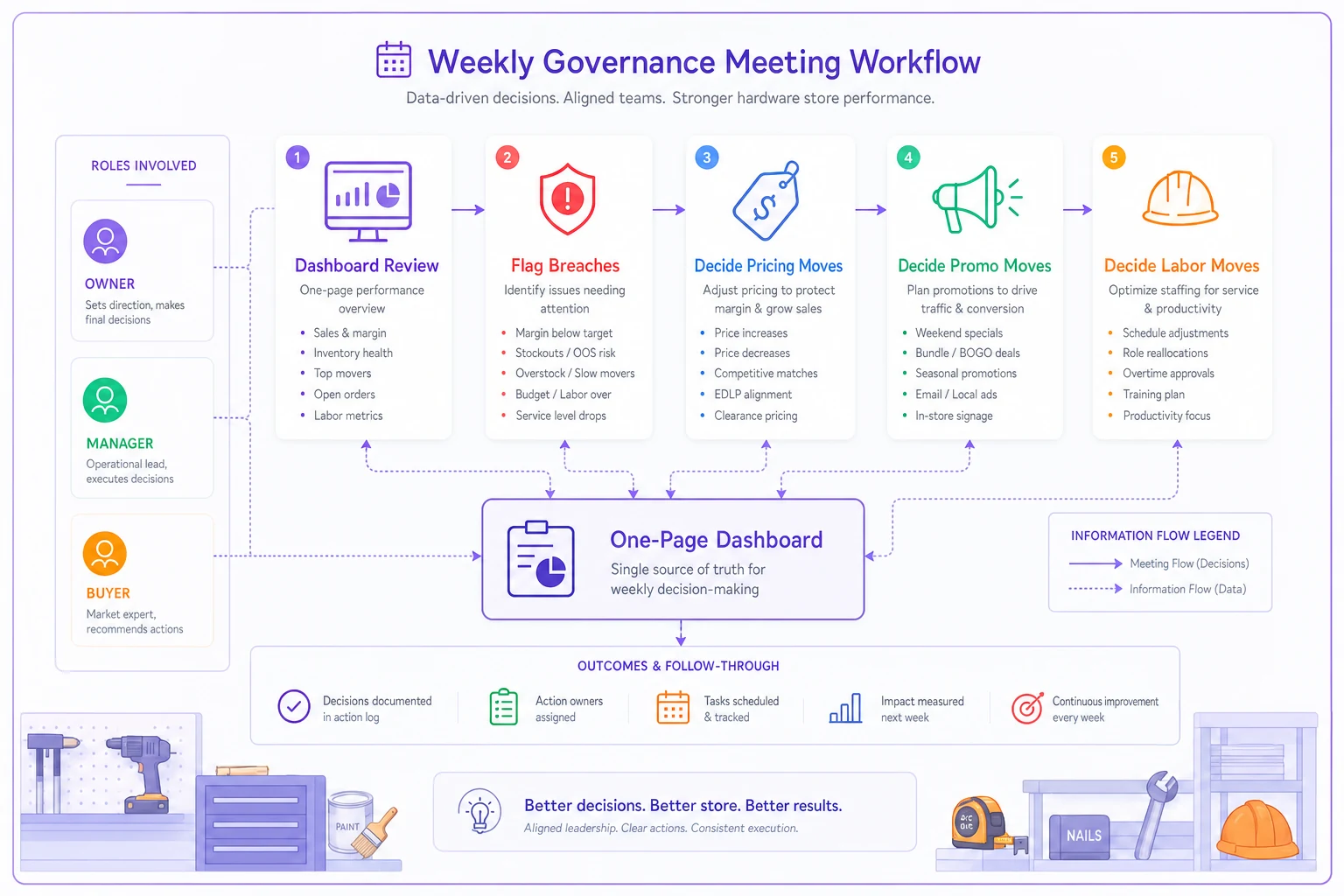
This cadence fits naturally alongside the weekly Owner-10 financial routine. If you already run that, bolt the governance decisions onto it rather than creating a separate meeting. The whole value is that these four levers get decided together, by someone holding all four numbers at once.
A real scenario
A single-location store doing roughly $1.1M a year had a blended margin that kept slipping — down about 3 points over 18 months with no obvious cause. No single disaster, just drift.
When they put the five numbers on one page and looked back, the pattern was clear. They were running 2–3 promos a month, several on thin categories, and a few that had never been turned off. Labor was scheduled to peak coverage most weeks regardless of sales. A cluster of commodity SKUs hadn't been repriced through two cost increases.
The fixes weren't dramatic. They set promo floors and a duration cap, killed four zombie promos that had quietly become permanent low prices, moved scheduling to a forecast-and-rule basis, and repriced about 40 drifted SKUs. Within a couple of months blended margin recovered close to 2 of the 3 lost points, and labor settled roughly a point and a half lower without any noticeable drop in service. Nothing heroic — just the decisions finally being made in the same place instead of four separate ones.
When this makes sense — and when it doesn't
This makes sense when you've grown past the point where you personally make every pricing, staffing, and promo call. The moment a second person can reorder, schedule, or set a sale price, you need the connecting logic written down, because it's no longer living in one head.
This is overkill when you're a true one-or-two-person shop making all four decisions yourself every week. You already have the governance — it's your own judgment, and it travels fine because it never has to leave your head.
Don't bother starting here if your category margins aren't clean. If you can't trust the margin number per category, the dashboard will lie to you and the rules will act on bad data. Get the reporting honest first, then layer the governance on top.
The deeper point is that margin in a hardware store isn't really a pricing problem or a payroll problem or a promo problem. It's a coordination problem. Each lever is fine alone and quietly costly together, and the only durable fix is deciding them as one connected set, on a schedule, against rules you agreed to before the pressure of the moment arrived. Write the rules once while you're calm, and they'll protect your margin on every week you're not.
Ready to elevate your hardware store management?
Join 500+ hardware stores using Hardzly to boost operational efficiency, reduce stockouts, and grow revenue.