



Most single-location owners I've watched run their store already have the pieces of a decent cash system. They watch payables. They eyeball margin. Some run a tight weekly routine. What they're missing is the wiring — the thing that connects a Tuesday-morning glance at the numbers to the decision, three months out, about whether to sign a $40k reorder commitment with a fastener supplier or drop $18k on a new paint-mixing station.
That gap is where cash gets quietly destroyed. Not through fraud or a bad season — through a hundred small decisions made without the daily reality of the store touching the big ones. This article is about building that connective tissue: an owner-facing governance skeleton that takes your short-cycle checks and lets them trigger — or block — your capex and supplier-commitment calls.
If you already run a version of the one-hour weekly Owner‑10 financial routine, this builds directly on top of it. If you don't, that's the ground floor and this is the second and third story.
Why the daily and the quarterly rarely talk to each other
The pattern in almost every cash-squeezed store despite decent sales: daily numbers live in one head — usually the owner's, at the register — and quarterly decisions live in a completely different context. A supplier lunch. A rep's end-of-quarter push. A slow Sunday where the owner finally has time to think.
Those two contexts almost never share data. The rep offers 8% off for a full-quarter commit. The owner remembers sales "felt strong" and says yes. Nobody pulls the actual payables aging, the inventory-to-cash conversion, or the three weeks of soft foot traffic the counter staff have been quietly noticing.
This happens because daily checks get treated as operational and quarterly decisions get treated as strategic — as if they're different animals. They're not. A quarterly capex decision is just a very large, very slow version of a daily reorder. The only difference is you can't undo it as easily.
The governance skeleton fixes this by making the daily and weekly checks produce signals — small, standardized readings — that feed directly into a decision trigger you run before any commitment over a certain dollar threshold.
The three layers, and how they connect
Think of it as three cadences stacked on top of each other, each feeding the one above it.
Stop losing sales due to inventory gaps.
Hardzly helps you manage stock levels, orders, and supplier interactions efficiently.
- Unified inventory and sales tracking
- Supplier and purchase order management
- Automated workflow and task scheduling
No credit card required
| Cadence | Time cost | What you're actually watching | What it feeds |
|---|---|---|---|
| Daily Owner‑10 (light) | 5–10 min | Cash position, yesterday's sales vs. plan, any payable due in 48h | The weekly rollup |
| Weekly review | 45–60 min | Margin by category, payables aging, payroll coverage, slow-moving cash | The quarterly trigger sheet |
| Quarterly decision gate | 2–3 hours | Capex, supplier commitments, seasonal buys, price resets | Actual cash commitments |
The mistake owners make is running all three but never letting the lower layers veto the top one. The daily and weekly are supposed to earn the right to say yes at the quarterly gate. If your last six weeks of payables aging have been creeping up, that's not a footnote when the rep offers a volume deal — it's the whole conversation.
Workflow visualization:
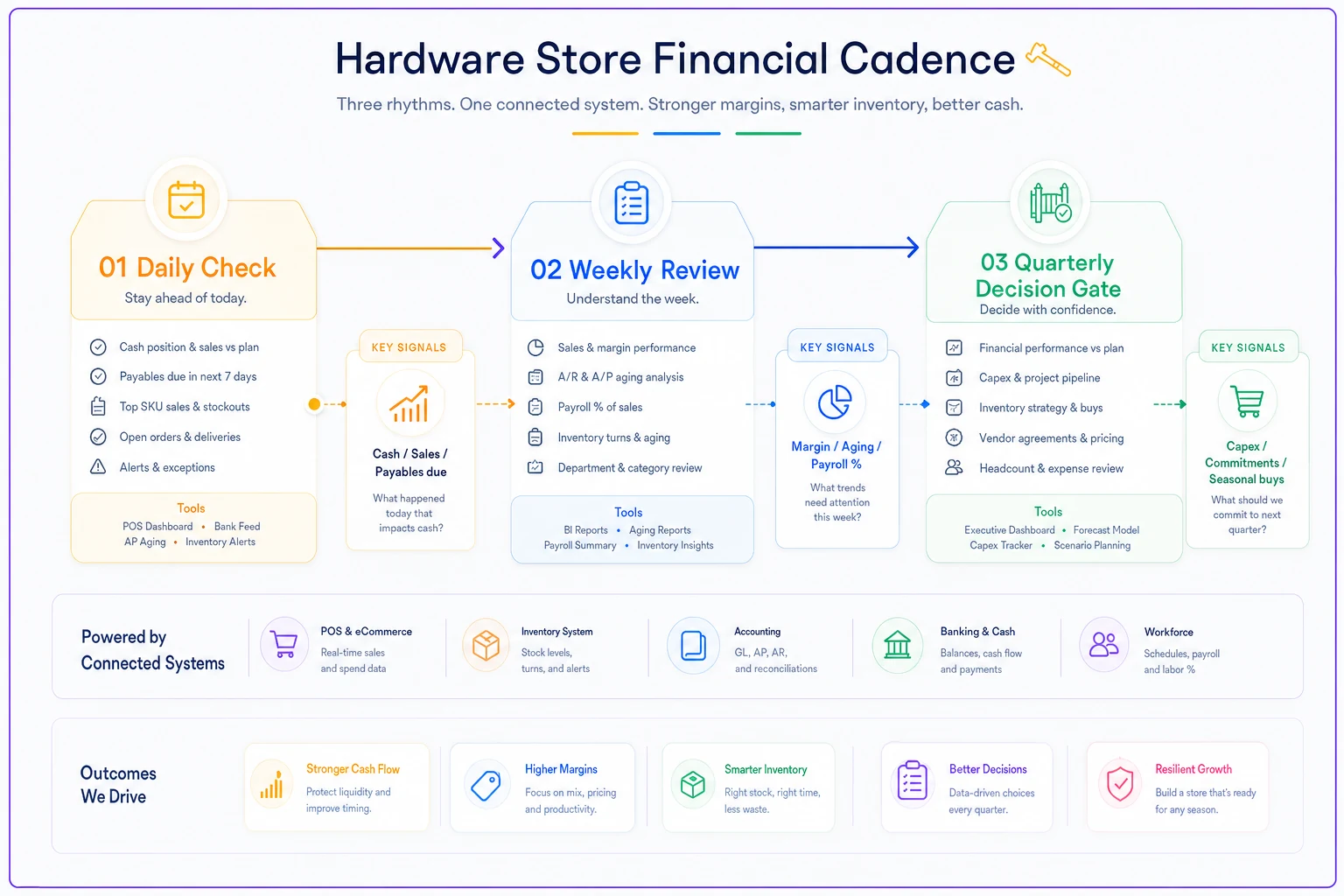
The daily layer is intentionally lighter than the full weekly Owner‑10. You're not doing margin analysis every morning. Three things: confirm cash on hand, glance at yesterday against expectation, flag anything due in the next two days. Ten minutes, tops. It exists to keep the weekly review honest and catch the fast-moving stuff before it compounds.
The signals that actually predict a bad commitment
Not every number deserves to gate a decision. The ones that reliably predict "you're about to over-commit cash" are a short list. Watch these in your weekly review and carry the trend into the quarterly gate:
-
Payables aging drift — average days-to-pay creeping up week over week, even slightly. This is the earliest warning and the most ignored.
-
Inventory-to-cash conversion slowing — stock sitting longer before it becomes cash. If your inventory-to-cash cadence is showing conversion times stretching, a big buy makes it worse.
-
Category margin compression — a category that used to run 42% now running 37% with no obvious explanation. Often it's quiet discounting at the counter or a supplier cost bump that got absorbed.
-
Payroll as a percentage of weekly sales — if this is climbing while sales are flat, you have less slack than the P&L suggests.
-
Concentration risk — one supplier or one contractor account making up a growing share of either purchases or receivables.
A typical version of this: payables aging drifts from 28 to 34 days over five weeks. Sales look flat-to-fine. Nobody panics because nothing broke. Then the rep offers the quarterly commitment, the owner signs, and six weeks later they're stretching a supplier to 50 days and juggling. The signal was there the whole time — it just never made it into the room where the decision happened.
A one-sheet decision trigger you can actually run
The heart of the governance skeleton is a single page you look at before any commitment over a threshold you set. Most single-location owners land somewhere around $10k–$15k as the line where "just decide" becomes "run the gate."
-
What's the commitment and the real cash timing? Not the invoice total — when does cash actually leave, and in what chunks?
-
What do the last 6 weeks of signals say? Pull payables aging trend, inventory-to-cash trend, and the affected category's margin. Write the direction next to each: improving, flat, worsening.
-
What's the reforecast with this commitment baked in? Run your cash position forward 90 days with the new outflow. Does any week go negative or thin?
-
What breaks if I'm wrong? If sales come in 15% under plan, does this commitment become a problem or just a disappointment? There's a real difference between those two.
-
What's the reversibility? Can you cancel, return, or resell? A capex machine and a perishable seasonal buy have very different risk profiles even at the same dollar amount.
If two or more signals in step 2 are worsening, the default answer is no or smaller, regardless of how good the discount looks. That's the whole point of governance — it makes the disciplined choice the automatic one.
Worked reforecast: the fastener commitment
The reforecast step is where owners either save themselves or talk themselves into trouble, so it's worth walking one all the way through.
A store is offered a quarterly fastener commitment: roughly $32k in buys spread across the quarter, in exchange for about 7% off and locked pricing. The rep wants an answer by Friday.
Daily and weekly signals over the prior six weeks:
-
Payables aging
29 → 33 days (worsening, mild)
-
Inventory-to-cash
fasteners specifically turning about 10% slower than last year (worsening)
-
Fastener margin
holding around 40% (flat, fine)
-
Cash on hand entering the quarter
roughly $46k, with normal weekly swings
The reforecast: the $32k doesn't hit all at once — it's roughly $10k–$12k per month in draws. Layer that against known outflows: payroll every two weeks, a $9k insurance renewal in month two, and the normal seasonal dip that hits this store in that exact window. When you push the 90-day cash line forward with those fastener draws included, week 7 dips to about $8k on hand — thin, but not underwater. Week 9, if sales run soft, gets uncomfortable.
The discount is real money, roughly $2,200 saved over the quarter. But two signals are worsening and the reforecast shows a genuinely thin week during a seasonal soft patch. The governance answer isn't a flat no — it's commit smaller. Take the deal on the fast-moving fastener SKUs only, maybe $20k of the $32k, keep the flexibility, and protect week 7. You give up part of the discount to keep the cash buffer intact. That's the trade governance forces you to see clearly instead of discovering it in real time.
The owner who signs the full $32k isn't necessarily wrong because it blew up — most of the time it doesn't. They're wrong because they took on tail risk they never priced.
Where this ties into seasonal buys
Fasteners are steady. Seasonal is where the reforecast really earns its keep, because the outflows and inflows are both lumpy and reversibility is low. A snow-supply commitment made in September against a mild-winter forecast can lock up cash into March.
Seasonal decisions should run through the same one-sheet, with the seasonal forecasting inputs feeding step 3. If you've built out a proper seasonal forecasting and cashflow routine, the reforecast for a seasonal commitment is mostly assembled already — you're layering the commitment onto a cash curve you already understand. Governance doesn't replace that work; it makes sure the work actually reaches the decision.
The pattern worth flagging: owners tend to run solid seasonal forecasts and then commit to capex separately, during the same quarter, without checking whether both fit in the cash line at once. A new $18k rack system and a $25k seasonal buy might each pass on their own and fail together. The quarterly gate exists partly to catch that collision.
A sample quarterly-to-daily cadence
Daily (5–10 min, most days):
-
Cash on hand confirmed
-
Yesterday's sales vs. rough expectation
-
Anything due to a supplier in the next 48 hours
Weekly (45–60 min):
-
Full margin-by-category glance
-
Payables aging — note the direction vs. last week
-
Payroll as % of sales
-
Update the six-week signal trends (this is the part that quietly powers the quarterly gate)
Monthly (1–2 hours):
-
Reconcile the weekly signal trends against the actual P&L
-
Flag any commitment coming up in the next 90 days
-
Rough-in the cash line 90 days forward
Quarterly (2–3 hours):
-
Run every pending commitment over your threshold through the one-sheet
-
Reforecast cash with all commitments baked in together
-
Decide, resize, or defer
The reason this cadence works is that the quarterly meeting isn't a from-scratch analysis session. By the time you sit down, the signals are already trended and the cash line is already roughed in. The gate becomes a 20-minute decision per commitment instead of a dreaded all-day project you keep postponing — which is exactly why most owners skip it and just react to whichever rep called last.
When this level of governance is overkill
If your store is genuinely small — one or two staff, no supplier commitments above a few thousand dollars, no capex on the horizon — the full three-layer skeleton is more machinery than you need. The daily and weekly checks alone will carry you.
It also doesn't fit if your cash position is comfortable enough that no single commitment can hurt you. Some owners run with a large enough buffer that the reforecast always comes back fine. If that's you, run a lighter version — but keep the one-sheet, because buffers shrink faster than owners expect and the discipline is cheap to maintain even when you don't strictly need it.
Where it becomes essential is the awkward middle: enough volume that suppliers push toward commitments, enough capex temptation to matter, but not enough cash cushion to absorb a bad call. That's most single-location stores past their first few years.
Keeping the signals from becoming a second job
The honest risk with any governance system is that it dies from maintenance. Manually pulling payables aging, category margin, and inventory conversion every week is the kind of thing owners commit to in January and abandon by March.
This is where operational software earns its place — not as anything fancy, but as the thing that keeps the six-week signal trends updating without you rebuilding a spreadsheet every Friday. When your POS, payables, and inventory data all live in one place, the weekly signal update becomes a glance instead of a data-entry chore. The quarterly reforecast pulls from numbers you trust because they're the same numbers you've been looking at all quarter. AI-assisted platforms can also surface the drift patterns — payables creeping, a category quietly compressing — before they're obvious enough to catch manually.
The value isn't automation for its own sake; it's that the governance skeleton stays alive long enough to actually catch the decision that matters.
A real scenario
A single-location store doing somewhere in the $1.4M–$1.6M range annually had a habit of saying yes to end-of-quarter supplier deals. Nothing reckless — each individual deal looked smart. But three or four landing in the same quarter kept squeezing cash, and the owner spent every February and August stretching payables and feeling behind.
They put in the three-layer cadence with a threshold set at $12k. The change wasn't dramatic on paper. What shifted was that two commitments in the following quarter got resized instead of accepted whole, and one seasonal buy got deferred by three weeks to clear a thin cash week the reforecast had surfaced. Average days-to-pay settled back into the high 20s instead of drifting into the 40s. The owner described it as finally being able to see the collision coming instead of cleaning it up afterward.
No revenue miracle. Just fewer thin weeks, less stretching, and quarterly decisions that stopped ambushing the cash position.
Closing thought
The governance skeleton isn't really about any single decision. It's about making sure the store you run every day is the same store that shows up when the big money moves. Most cash trouble in single-location stores isn't a disaster — it's a slow accumulation of reasonable-looking yeses that never got checked against daily reality.
Wire your daily and weekly checks to the quarterly gate, keep the one-sheet honest, and let the worsening signals do their job of saying "not this quarter" when they need to. The discount you skip is almost always cheaper than the thin week you avoid.
Wire your daily and weekly checks to the quarterly gate, keep the one-sheet honest, and let the worsening signals do their job of saying "not this quarter" when they need to. The discount you skip is almost always cheaper than the thin week you avoid.
Ready to elevate your hardware store management?
Join 500+ hardware stores using Hardzly to boost operational efficiency, reduce stockouts, and grow revenue.