



Most hardware store owners don't lose money on one big mistake. They lose it through a hundred small breakdowns that never get caught — a mispriced case of caulk, a credit that never showed up, a delivery short two boxes that nobody photographed, a check cut twice because the invoice landed in two different email inboxes.
Each individual slip is tiny. Forty bucks here. A missed $180 credit there. But stacked across a year, across dozens of suppliers, the leakage is real — and it almost always traces back to the same root cause: no governance. No consistent way that documents get named, disputes get evidenced, suppliers get onboarded, accounts get reconciled, and cash gets protected when things go sideways.
This is the part of the business that owners keep meaning to fix and never do, because there's no accounting department to hand it to. So let's build the whole thing as one scaffold you can run yourself — structured so a single person with a phone and a laptop can keep it tight.
Why the leakage is structural, not sloppy
Owners usually assume money leaks because they're disorganized. In practice, it's actually the opposite. They're organized individually — this owner remembers which rep owes them a credit, that manager knows the ABC Fasteners invoice always comes in high — but the knowledge lives in people's heads, not in a system.
Once your store crosses 15–20 active suppliers, human memory stops being a reliable ledger. You physically cannot track which of 40 invoices last month had a pricing discrepancy, or which delivery you flagged as short. And suppliers know this. Not maliciously — but a rep billing 300 accounts isn't going to catch the $60 they overcharged you unless you catch it first, with proof.
The failure isn't laziness. It's that the workflow has no shared spine. Documents get named whatever the person felt like that day. Photos of damaged goods live on somebody's personal phone. Onboarding a new vendor happens over a handshake. Reconciliation only happens when a statement looks scary.
-
A naming convention for POs and invoices
-
A phone-photo dispute evidence habit
-
A supplier onboarding ladder
-
A monthly reconciliation calendar
-
A 48–72 hour emergency cash playbook
Each one is useful alone. Together they compound.
Piece 1: Naming conventions that make disputes winnable
This sounds boring. It's also the single highest-leverage thing in the whole system.
Stop losing sales due to inventory gaps.
Hardzly helps you manage stock levels, orders, and supplier interactions efficiently.
- Unified inventory and sales tracking
- Supplier and purchase order management
- Automated workflow and task scheduling
No credit card required
When a document has a predictable name, you can find it in seconds, sort it, and prove things. When it doesn't, every dispute becomes an archaeology dig. The goal is a name that tells you the supplier, the date, the type, and the reference number without opening the file.
YYYY-MM-DDSUPPLIERTYPE_REFNUMBER
-
2025-03-14ACMEFASTPO_10432 -
2025-03-19ACMEFASTINV_88231 -
2025-03-19ACMEFASTDISPUTE_88231 -
2025-03-21ACMEFASTCREDIT_88231
Notice the dispute and credit files carry the same reference number as the invoice they attach to. That's deliberate. When you sort a supplier's folder alphabetically, the entire life of invoice 88231 lines up in one visual chain: PO → invoice → dispute → credit. You can see instantly whether a dispute ever got resolved. Half the credits stores are owed never get chased simply because nobody can tell which ones are still open.
/Suppliers /ACMEFAST /POs /Invoices /Disputes /Statements /BRIGGSSUPPLY /POs /Invoices ... /Reconciliation /2025-03 /2025-04 /Emergency
The mistake most owners make: naming by category first (/Invoices/all invoices here) instead of by supplier. That feels tidy but it's useless for disputes, because a dispute is always a supplier conversation. You want everything about one vendor in one place so that when you call their rep, you're both looking at the same picture.
If you already keep a clean product master and reporting backbone, this slots right on top of it. Consistent naming upstream makes the inventory-to-cash reconciliation work dramatically faster downstream — you're matching named documents instead of hunting through a mess.
Piece 2: Phone-photo dispute evidence — the habit that pays for itself
Every short shipment, damaged pallet, or wrong-item delivery is a dispute you'll probably lose without a photo taken at the moment of receiving. Not later. Not "I'll remember." At the dock, before anything moves.
The pattern that kills stores: a delivery comes in during a busy Saturday, the receiver signs, the driver leaves, and only Monday does someone notice two boxes of deck screws are missing. By then there's no proof. The supplier's position is reasonable — you signed. You eat it.
-
Photo 1 the full pallet/load as delivered, before unwrapping
-
Photo 2 the packing slip laid flat, readable
-
Photo 3 any damage, close up, with something for scale (a pen, a tape measure)
-
Photo 4 the count discrepancy — the empty spot, the short case
Every photo gets renamed the same day using the convention: 2025-03-19ACMEFASTDISPUTE88231photo1.
The overlooked detail: timestamp and location. Most phones embed both automatically, but confirm yours does. A timestamped photo taken 11 minutes after the delivery window is nearly unarguable evidence. That's the difference between a $200 credit approved in a day and a two-week back-and-forth you eventually abandon.
Confirm your phone embeds timestamp and location on receiving photos before you rely on them as evidence.
> "Hi [Rep], invoice 88231 delivered today short by 2 cases of item #DS-238. I've got the timestamped dock photos and the signed packing slip showing the count. Can you issue a credit against 88231? I'll email the photos now."
It references the invoice number, states the exact shortage, names the item, and mentions proof — all in three sentences. Reps approve those fast because there's nothing to argue.
Piece 3: The supplier onboarding ladder
New suppliers are where sloppy governance gets baked in permanently. Onboard a vendor with no terms documented, no rep contact saved, no dispute process agreed, and you'll be fighting that vagueness for the life of the relationship.
Treat onboarding as a ladder — you don't give a brand-new supplier the same trust as one you've used for three years.
| Tier | Trust level | Payment terms | Order cap | What you verify |
|---|---|---|---|---|
| Tier 0 – Trial | Unproven | Prepay or COD | Small test order | Business legitimacy, lead time claims |
| Tier 1 – Established | 3+ clean deliveries | Net 15 | Moderate | Pricing accuracy, fill rate |
| Tier 2 – Core | 6+ months reliable | Net 30 | Full | Statement accuracy, credit responsiveness |
| Tier 3 – Strategic | 12+ months, key categories | Net 30–45, volume terms | Priority | Consistency across everything above |
The ladder caps your exposure on unproven vendors. A Tier 0 supplier who flakes on a prepay test order costs you a small, contained amount. The same flake on a Net 30 full order — because you skipped the ladder — can tie up thousands.
Onboarding checklist for any new supplier before their first PO:
-
[ ] Legal business name + remit-to address captured
-
[ ] Rep name, direct line, and email saved in supplier folder
-
[ ] Payment terms confirmed in writing (email counts)
-
[ ] Lead time and minimum order documented
-
[ ] Return/dispute process asked about directly
-
[ ] Test order placed and folder created with naming convention
-
[ ] Tier assigned
Suppliers who dodge putting terms in writing during onboarding are the same ones who dispute your credits later. How a vendor behaves in week one predicts how they'll behave in month twelve. If lead times matter to your reordering — and they always do — pairing this ladder with a real supplier lead-time framework keeps reorder decisions from getting blindsided.
Piece 4: The monthly reconciliation calendar
Reconciliation fails not because it's hard but because it has no fixed home on the calendar. It becomes a "when I get to it" task, which means it happens when a statement already looks wrong — too late to catch anything cleanly.
Give it a fixed day. Same day every month. The 5th works well because most supplier statements arrive in the first few days.
Here's the monthly run, completable in about 60–90 minutes for a store with 20–30 active suppliers:
-
Pull every supplier statement for the prior month into that month's reconciliation folder.
-
For each supplier, match statement lines to your named invoices. Because everything shares reference numbers, this is a sort-and-scan, not a hunt.
-
Flag three things invoices on the statement you never received goods for, price mismatches vs. the PO, and credits you're owed that haven't posted.
-
Chase open credits using the same dispute chain of files. Any dispute file with no matching credit file is money still owed to you.
-
Confirm nothing was paid twice — the double-payment check most stores skip entirely.
-
Log the month's leakage — total discrepancies caught and recovered.
That last step matters more than it looks. When you write down "recovered $340 this month," you stop treating reconciliation as a chore and start treating it as a paid job — because it is.
Monthly reconciliation checklist:
-
[ ] All statements filed under
/_Reconciliation/YYYY-MM -
[ ] Every invoice matched to a receiving record
-
[ ] Price variances vs. PO flagged
-
[ ] Open credits chased with dispute references
-
[ ] Double-payment scan completed
-
[ ] Recovered/flagged amount logged
This is the natural monthly complement to a tighter weekly rhythm. If you're already running something like the weekly Owner-10 financial routine, the monthly reconciliation catches what the weekly pass is too fast to see — the slow, cross-supplier discrepancies that only surface over 30 days.
Piece 5: The 48–72 hour emergency cash playbook
Every seasonal store hits at least one cash squeeze a year. A big order lands the same week payroll and a quarterly tax payment are due. Or a slow February drags after a heavy January buy. The emergency isn't the shortage — it's making panicked decisions with no ranked plan.
Decide the order of moves now, while you're calm, so the future stressed version of you just follows the ladder.
Ranked decision triggers — run top to bottom, stop when the gap closes:
-
Pull the exact number first. How short, by what date? "We're tight" is not actionable. "$4,200 short by Thursday" is.
-
Delay non-critical outflows. Any Tier 3 supplier with Net 30 room — pay on the last legal day, not early. Reschedule discretionary buys.
-
Accelerate inflows you control. Call your top contractor accounts with open balances. A short, friendly nudge often pulls $1k–$3k forward within 48 hours.
-
Convert dead stock to cash. A fast markdown on aged inventory beats a missed payroll every single time. Cash now over margin later.
-
Tap the supplier relationship. A Tier 2/3 supplier will often extend a payment a week if you ask before you're late. Never after.
-
Last resort
the credit line.
Known cost, known terms — but it's the last rung because it's the most expensive over time.
> "Hey [Contractor], quick one — I'm reconciling accounts this week. You've got an open balance of $[X] on invoice [#]. Any chance you can settle that in the next day or two? Appreciate it, it helps me a ton."
> "Hi [Rep], I want to give you a heads-up rather than surprise you. I've got a tight week — can we push invoice [#] payment to [date]? I've always paid you clean and I'd rather stay ahead of it."
The heads-up before late framing matters because suppliers extend terms for owners who communicate and refuse owners who go silent. The relationship you built during onboarding is exactly what you're spending here.
Keep this playbook — plus your credit line details and your top-account contact list — in the /_Emergency folder. When you're stressed, you should not be searching for phone numbers.
A real scenario
A single-location store, roughly 25 active suppliers, no bookkeeper, owner handling everything between the counter and the back office.
Before: invoices lived in three email inboxes and a paper tray. Disputes happened by memory. The owner knew he was owed credits but couldn't reliably prove which ones. A rough audit of one quarter found close to $1,100 in never-collected credits and two invoices paid twice — around $1,900 total that had simply walked out the door in ninety days.
After putting the naming convention, dock-photo habit, and the fixed-5th reconciliation day in place, the change wasn't dramatic-looking day to day. Over the next two quarters he was recovering somewhere in the $250–$450 range monthly in credits and catching price variances before paying. The double-payment scan alone caught one duplicate that would've been another few hundred gone. Nothing flashy — just money that used to leak now staying in the store.
The bigger shift was time. Disputes that used to eat a frustrated afternoon of file-hunting turned into a five-minute call with the evidence already named and ready.
When this scaffold is worth it — and when it isn't
When it makes sense: you're past a handful of suppliers, you're the one making payments, and you've noticed credits or discrepancies slipping through. If you've ever paid an invoice you had a nagging feeling about, this is for you.
When it's overkill: if you're running five suppliers and one invoice a week, the full ladder and reconciliation calendar are more structure than you need. Just adopt the naming convention and the photo habit — those two cost nothing and scale with you.
Who should skip parts of it: if you already have a bookkeeper handling reconciliation, don't duplicate their work — but do keep the naming convention and dispute photos, because that's what makes their job accurate. Garbage in, garbage reconciled.
How the pieces reinforce each other
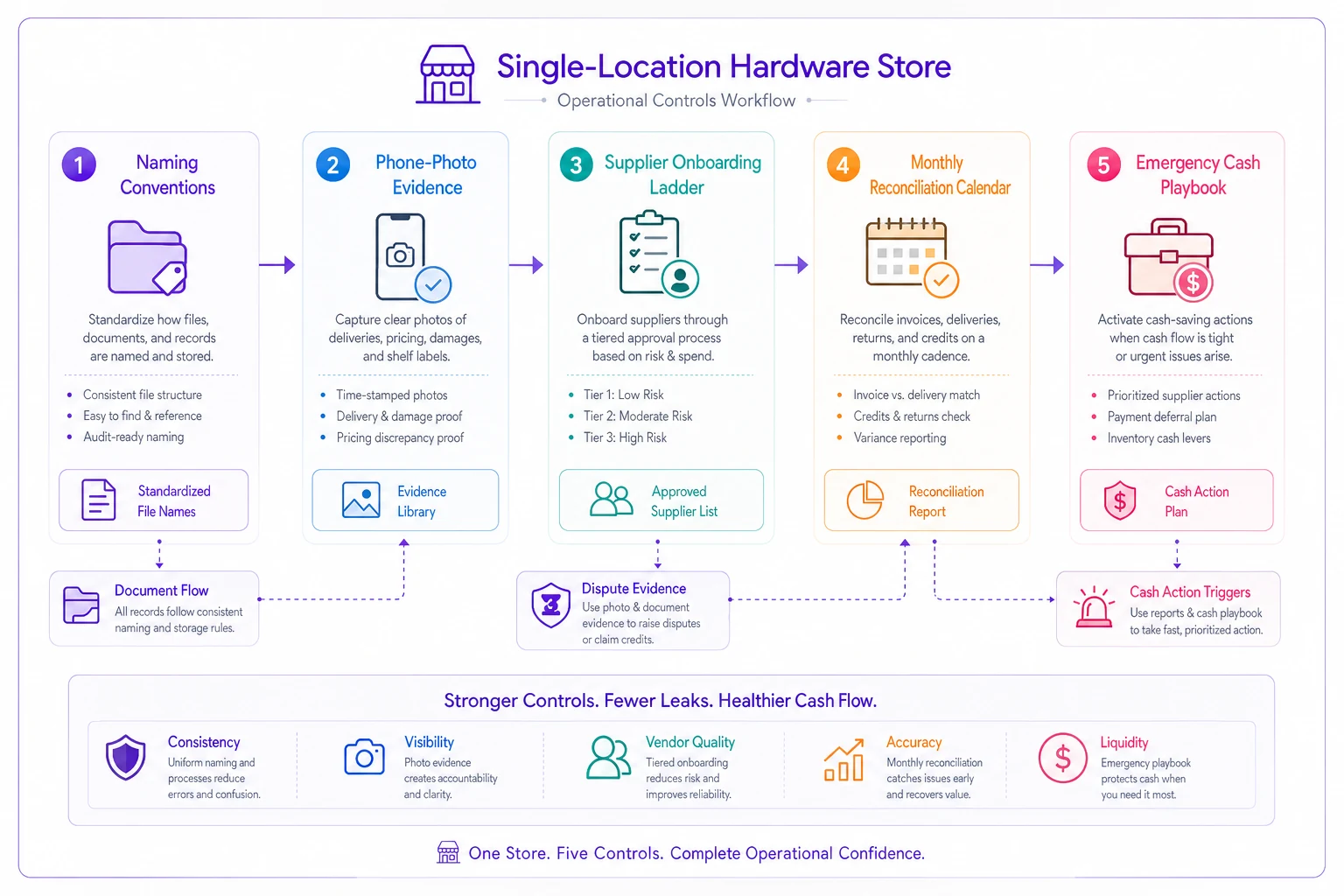
None of these five parts is impressive on its own. The naming convention is just discipline. The photos are just a habit. The value is in how they chain together: consistent names make disputes provable, provable disputes make reconciliation fast, fast reconciliation surfaces the credits you're owed, collected credits and controlled outflows feed the cash cushion, and a documented onboarding ladder means the whole system starts clean with every new vendor instead of inheriting another mess.
Below is a quick visual of how the five pieces chain together.
As you grow, the scaffold is what lets you not hire an office person too early. Operational platforms that centralize supplier records, receiving evidence, and reconciliation tracking into one place can remove that last excuse — the "I don't have time to keep it all straight" one — but the system works on a laptop and a phone long before that.
The stores that stay profitable at a small scale aren't the ones with the cheapest suppliers or the smartest pricing. They're the ones that don't leak. Governance is unglamorous, it never shows up as a line item on a good day, and it's the difference between a store that quietly keeps its money and one that wonders every month where it went.
The stores that stay profitable at a small scale aren't the ones with the cheapest suppliers or the smartest pricing. They're the ones that don't leak. Governance is unglamorous, it never shows up as a line item on a good day, and it's the difference between a store that quietly keeps its money and one that wonders every month where it went.
Ready to elevate your hardware store management?
Join 500+ hardware stores using Hardzly to boost operational efficiency, reduce stockouts, and grow revenue.