

Most single-location hardware stores already survive disruptions. The problem is how they survive them — by memory, by whoever happens to be working that day, and by the owner's phone blowing up at 6am. That works until two shocks land in the same week. A key supplier goes dark the same month a freak cold snap wipes out your pipe insulation stock and your card processor holds a deposit for "review." Now you're improvising three emergencies at once, and the improvisation starts costing real money.
A resilience operating system isn't a binder nobody reads. It's a small, ranked set of triggers, playbooks, and review habits that let a tiny team prepare and recover without hiring consultants or guessing. The goal isn't to make you paranoid about every possible catastrophe. It's to build something lean enough that a 1–3 person store will actually keep it current.
Why resilience breaks at small stores (and it's not lack of effort)
Owners of small hardware stores are usually good in a crisis. The breakdown isn't competence — it's that all the crisis knowledge lives in one head.
In practice, this shows up as three predictable failures:
-
Single point of knowledge. The owner knows which supplier rep to call, which customers to warn, and which account has the cash cushion. Nobody else does. If the owner is sick, traveling, or dealing with a family emergency, the store freezes.
-
No ranking of shocks. Every disruption feels urgent in the moment, so everything gets treated like a five-alarm fire. A delayed fastener shipment gets the same panic energy as a frozen bank account. That drains the team and buries the shocks that actually threaten the business.
-
Recovery with no memory. The store muddles through, then forgets how. The same supplier fails again eight months later and the store relearns the lesson from scratch.
Stores that recover fastest aren't the ones with the biggest cash reserves. They're the ones where the response is written down and assigned — so execution doesn't depend on who's calm that day.
The uncomfortable part: resilience is a coordination problem, not a courage problem. And coordination is exactly what falls apart when a team is small and busy.
The core idea: one runbook, four moving parts
A resilience OS for a small store has four parts. Keep each one short. If any single piece grows past a couple of pages, your team will quietly stop using it.
Stop losing sales due to inventory gaps.
Hardzly helps you manage stock levels, orders, and supplier interactions efficiently.
- Unified inventory and sales tracking
- Supplier and purchase order management
- Automated workflow and task scheduling
No credit card required
-
Ranked shock triggers — a short list of the disruptions that can actually hurt you, ranked by damage and likelihood.
-
Role-assigned playbooks — for each top shock, who does what, in what order, with escalation gates.
-
Incident runbooks — the printable, step-by-step card you grab when the shock is actually happening.
-
Review cadence — postmortems after incidents and one quarterly resilience review so the whole thing stays alive.
The sequence matters. You rank first so you don't waste time writing playbooks for things that almost never happen or barely sting when they do.
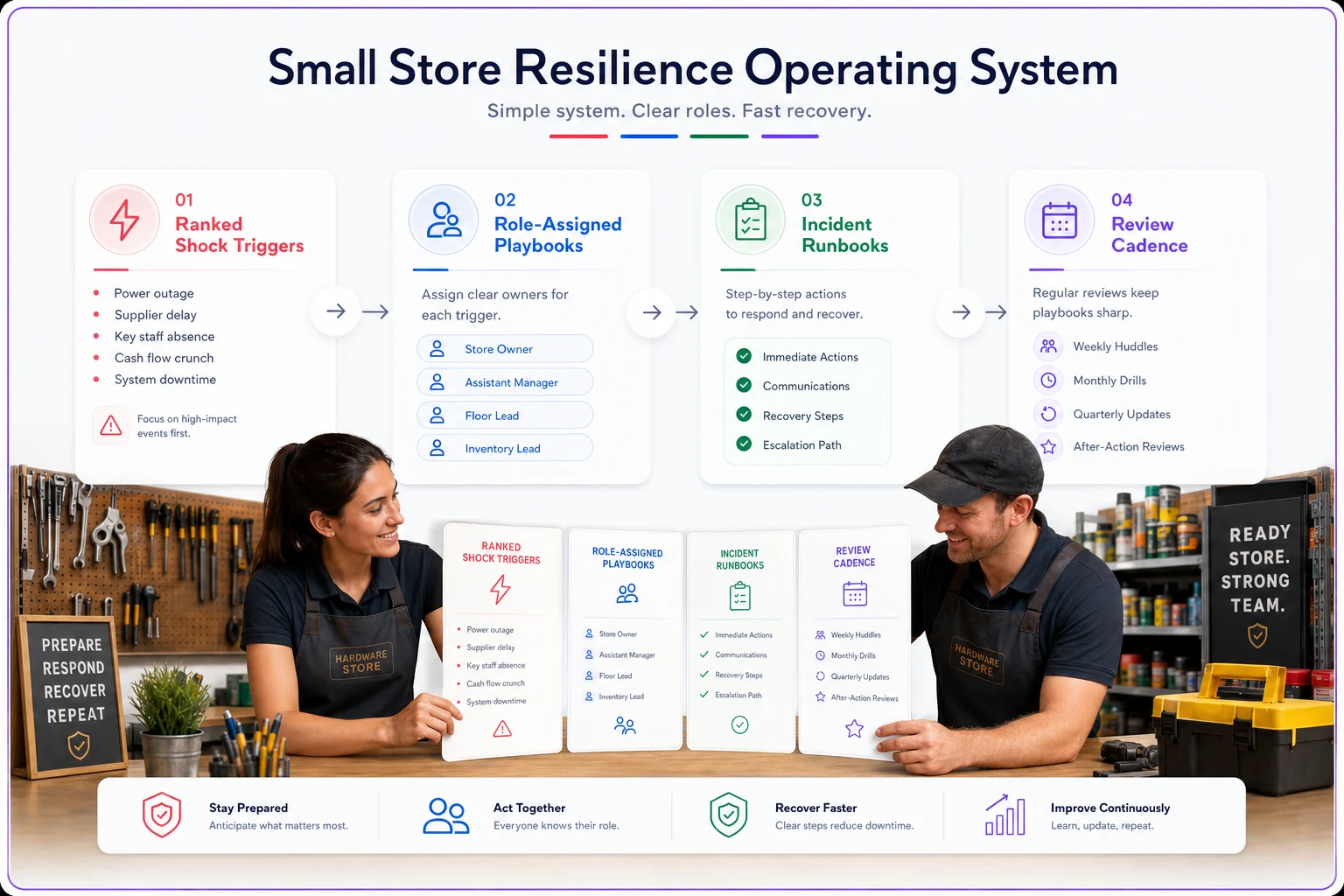
A quick visual of the sequence helps keep the four parts in mind.
Step one: rank your shocks before you write anything
Most stores skip this and jump straight to writing procedures. That's backward. You end up with a thick document covering obscure scenarios and nothing on the two or three shocks that genuinely show up every year.
Score each possible shock on two axes: how likely it is in a given year, and how badly it hurts cash or sales if it lands. You don't need a fancy model. A 1–5 scale on each, multiplied together, gives you a rough priority number that's good enough to sort by.
Here's what a worked ranking looks like for a typical single-location store:
| Shock | Likelihood (1–5) | Damage (1–5) | Priority score | Tier |
|---|---|---|---|---|
| Key supplier goes dark or late | 4 | 4 | 16 | Tier 1 |
| Emergency cash shock (processor hold, big surprise bill) | 3 | 5 | 15 | Tier 1 |
| Weather/seasonal demand spike (storm, freeze, heatwave) | 4 | 3 | 12 | Tier 1 |
| POS / payment system outage | 3 | 4 | 12 | Tier 2 |
| Staff loss (illness, sudden quit) on a 2-person team | 3 | 3 | 9 | Tier 2 |
| Theft/break-in or inventory loss event | 2 | 4 | 8 | Tier 2 |
| Local road closure / access disruption | 2 | 3 | 6 | Tier 3 |
The tiers are what matter. Tier 1 gets a full playbook and a printed runbook. Tier 2 gets a lighter one-page checklist. Tier 3 gets a sentence or two — enough to not start from zero.
One pattern worth noting: owners almost always underrate the cash shock and overrate the dramatic-but-rare events like fire or major theft. The boring shocks — a processor holding your weekend deposits, a supplier quietly pushing your reorder four weeks out — are the ones that actually show up and quietly bleed you.
Step two: build role-assigned playbooks for your Tier 1 shocks
A playbook answers four questions for a specific shock: What triggers it? Who owns the response? What are the steps? When do we escalate?
The "who owns it" part is where small teams get tripped up. You might only have two or three people, but you still need named roles, not just "whoever's around." On a two-person team, one person is usually the Decision Owner (makes the money calls) and the other is the Execution Lead (works the phones, the floor, the customers). Write those names down. Vague ownership is how a shock turns into a standoff where both people assume the other is handling it.
Escalation gates
An escalation gate is a pre-agreed line that, when crossed, bumps the response to a higher level of action. Gates keep you from over-reacting to small problems and from under-reacting to big ones. Examples:
-
Supplier shock gate If a Tier-A SKU will be out of stock for more than 5 business days, switch to the pre-approved substitute and notify affected contractor accounts.
-
Cash shock gate If projected cash dips below two weeks of operating expenses, freeze all discretionary POs and trigger the cash-defense runbook.
-
Weather spike gate If a storm warning lands within 72 hours, pull forward the storm-bundle reorder and extend hours.
The gate removes the in-the-moment debate. You decided the threshold when you were calm, so you don't have to argue about it when you're stressed.
On a two-person team, write both names and a backup contact for each role.
A couple of these playbooks overlap heavily with work you may already have. The supplier side connects directly to a full supplier-disruption playbook with substitution rules and emergency stock bundles — your resilience OS just pulls the trigger and escalation logic up to the top level so it coordinates with everything else. Same with cash: your supplier and cash governance system feeds the thresholds your cash-shock gate relies on.
Step three: the printable incident runbook
The playbook is the full plan. The incident runbook is the one-page card you print and keep somewhere grabbable — taped inside the office cabinet, in the register drawer, wherever. When the shock hits, nobody has time to read three pages. They need the first five moves.
Here's a worked incident runbook for an emergency cash shock:
-
Decision Owner confirms the real number
how much cash is available today and what's due in the next 14 days.
-
Freeze outflows. Halt all non-critical POs. Pause any discretionary spend. (Payroll and rent stay protected — those are never the first cut.)
-
Call the processor/bank if it's a hold. Get a release date in writing. Note it on the card.
-
Execution Lead pulls the list of slow-moving stock flagged for the cash-raise promo (prepared in advance — see below).
-
If the gap is still open after steps 1–4, escalate
call the line-of-credit contact or the pre-identified short-term lender. Do NOT wait until Friday.
The key detail most stores miss: step 4 only works if the "cash-raise stock list" already exists. You can't build a liquidation list during a cash emergency — your judgment is terrible when you're panicking. This is where your existing inventory-to-cash playbook does double duty: the slow-mover list you maintain for normal margin reasons becomes your emergency liquidity lever.
Print one of these for each Tier 1 shock. Three cards. That's the whole emergency kit.
A quick checklist: is your runbook actually usable?
Before you trust a runbook, pressure-test it against this list. If you can't check all of these, it's decoration, not a tool.
-
[ ] Every Tier 1 shock has a named Decision Owner and Execution Lead
-
[ ] Each runbook fits on one printed page
-
[ ] Escalation gates use specific numbers, not vague feelings ("low on cash" is not a gate)
-
[ ] The first three steps require no logins, lookups, or "where did I save that" moments
-
[ ] Any prerequisite lists (substitutes, slow-movers, emergency contacts) already exist today
-
[ ] A second person — not the owner — could run the first five steps alone
-
[ ] Phone numbers and account contacts are on the card, not "in my phone"
That last point about a second person running it is the real test. If the runbook only works when the owner is present and thinking clearly, you haven't built resilience. You've just written down what you already do.
How the parts coordinate during a real multi-shock week
The whole reason to unify these into one OS — instead of four separate documents — is that real disruptions don't line up politely. They stack.
Say a supplier goes late during a pre-storm demand spike. The weather-spike gate trips first (storm warning inside 72 hours), so the Execution Lead starts pulling forward storm bundles and extending hours. Mid-pull, the supplier gate trips too — the insulation reorder that storm demand depends on is now delayed past five days. Instead of two people fighting over one phone, the unified runbook routes it: Decision Owner owns the substitution call (switch to the pre-approved alternate and eat the slightly lower margin to keep stock on the shelf during peak demand), while Execution Lead keeps working the storm prep and customer comms. The escalation gates tell them which problem outranks the other when time is short — in this case, stay in stock during the spike wins, so taking the margin hit on the substitute is the correct call.
Without a unified system, that same week usually plays out as both people reacting to whatever shouted loudest in the last ten minutes. The seasonal-demand side of this is its own discipline — if your storm and freeze planning is still reactive, the groundwork in cutting seasonal deadstock with pre/in/post-season timelines is what feeds the inventory numbers your weather playbook depends on.
The review cadence: how the OS stays alive
Most resilience plans die the same way — written once, filed, never touched, hopelessly out of date by the time they're needed. Two habits keep it current.
Postmortem after every incident. Not a formal report. A 15-minute conversation within a few days of the dust settling, answering three questions: What actually happened? Did the runbook hold up? What one thing do we change? Write the change directly onto the card. A postmortem that doesn't edit the runbook was a waste of 15 minutes.
Quarterly resilience review. Once a quarter, block an hour. Re-score your shock ranking, check that every prerequisite list is current, confirm the contact numbers still work, and read one runbook out loud as if the shock were happening. Rotate which runbook you drill each quarter so all of them get tested over a year.
A realistic quarterly review agenda:
-
Re-rank shocks — 10 minutes. Anything new on the horizon? Any shock that got worse this quarter?
-
Verify prerequisites — 15 minutes. Is the slow-mover list fresh? Substitute table current? Supplier contacts still right?
-
Drill one runbook — 20 minutes. Read it aloud, walk the steps, find the gaps.
-
Update the cards — 15 minutes. Make every edit now, not "later."
The quarterly review is also where you catch drift — the substitute supplier you listed last year went out of business, the credit-line contact changed roles, the storm bundle doesn't match this year's assortment. Drift is silent. It only announces itself at the worst possible moment.
A real scenario: the hardware store that survived a double hit
A single-location store running with the owner plus two part-timers had always handled disruptions on instinct. One January, their main plumbing-supply vendor pushed deliveries out by roughly three weeks right as a hard freeze drove a run on pipe insulation, heat tape, and faucet covers. In the same stretch, their card processor flagged the account and held about $9k in weekend deposits for a five-day "review."
The year before, that combination would have been chaos — the owner glued to the phone with the processor while the floor ran out of the exact items customers were storming in for.
They'd built the OS by that point. The cash-shock runbook froze two discretionary POs they'd been about to place and pointed them at the slow-mover list, where a quick clearance on overstocked summer garden items moved maybe $2k–$3k over a few days. The supplier runbook kicked in the pre-approved substitute brand for insulation and heat tape — a point or two lower on margin, but on the shelf when demand peaked. Because roles were assigned, the owner worked the bank while a part-timer ran storm restocking and customer comms off the printed card.
The processor released the hold on day four. The store didn't miss payroll, didn't stock out on the high-demand freeze items, and captured a demand spike it would normally have fumbled. The difference wasn't luck — it was that the response was decided before the week started.
When this makes sense — and when it doesn't
When it's worth building: If you carry meaningful inventory, depend on a handful of key suppliers, serve contractor accounts who need you reliable, or run close enough on cash that a two-week disruption actually hurts — you need this. Almost every single-location store fits at least two of those.
When to keep it very light: If you're a brand-new store still figuring out your assortment and suppliers, don't over-engineer. Write runbooks for your top two shocks only — probably supplier and cash — and leave the rest as one-line notes. A heavy system you can't maintain is worse than a light one you actually use.
Who should NOT do this: Nobody should build a 40-page resilience manual for a two-person store. If you find yourself writing procedures for scenarios scored in Tier 3, stop. The entire value of this system is in being small enough to stay current. The moment it becomes a project instead of a tool, it's dead.
Where tools fit (without overcomplicating it)
You can run this whole system on printed cards, a shared doc, and a quarterly calendar reminder. Plenty of stores should start exactly there.
The friction tools help with isn't the writing — it's keeping the prerequisite lists current and making sure a trigger actually fires when the numbers cross a gate. The lists your runbooks depend on — slow-movers for the cash raise, pre-approved substitutes, supplier contacts, par levels for storm bundles — all live in the same operational data you're already tracking. When your POS, inventory, and supplier records sit in one place rather than scattered across spreadsheets and someone's memory, the quarterly review stops being archaeology. An operational platform that can watch those thresholds and flag when a cash gate or stock gate is approaching turns your escalation gates from "something we hope we notice" into "something that pings us before it's a crisis." That's the quiet part: a lot of resilience is just noticing the trigger early enough to use the plan you already wrote.
A resilience operating system for a small hardware store isn't about preparing for disasters. It's about removing the two things that actually sink small stores during disruption: knowledge trapped in one person's head, and responses invented under pressure. Rank the handful of shocks that can really hurt you, write short role-assigned playbooks for the top tier, print the five-move runbooks, and keep the whole thing alive with postmortems and a quarterly hour.
Done right, it's maybe four or five pages of material a two-person team can run cold. The payoff shows up exactly when you need it most — the week two shocks land together and, instead of scrambling, you reach for a card that already tells you who does what next.
Ready to elevate your hardware store management?
Join 500+ hardware stores using Hardzly to boost operational efficiency, reduce stockouts, and grow revenue.