

Most independent hardware stores don't lose margin because their shelf prices are wrong. They lose it because the same SKU lives in four or five places — the register, the website, the Google listing, a marketplace feed, maybe a quote a contractor pulled from a competitor on their phone while standing at your counter — and none of those places agree with each other. The gap between them is where margin quietly leaks out.
That's the parity problem. And it's not really a pricing problem — it's a coordination problem. You can have a solid markup framework and still bleed money if your channels drift apart faster than you reconcile them.
What follows isn't a tech project. It's a policy-and-cadence playbook: rank what actually matters, set pricing bands with trade-off rules baked in, run a short daily check, and give your counter staff scripts so they stop making judgment calls that cost you money. Heavy software optional.
Why parity breaks across every store that sells in more than one place
Each channel has a different "owner" and a different update speed. That's the core issue.
Your register price changes when a vendor cost sheet lands on the desk. Your website price changes when someone remembers to log in. Your Google or marketplace price updates on whatever cadence the feed runs — sometimes daily, sometimes whenever. A contractor's expectation gets set by whatever they saw last, which might be a price you ran six weeks ago.
So the real question isn't "are my prices right?" It's "how far have my channels drifted since I last looked, and which gaps are costing real money versus which ones genuinely don't matter?"
That second half is where most owners go wrong. They either try to keep everything in perfect sync — impossible with a small team — or they ignore it entirely until a contractor waves a screenshot at the counter demanding a price you never meant to honor. The middle path is a ranked system where you obsess over the SKUs that move money and loosely monitor the rest.
A few patterns come up over and over:
-
The phantom sale price. A promo ran online, ended at the register, but the website never got updated. You're now selling a $42 item for $34 to anyone who checks before they come in.
-
The marketplace undercut. A feed syncs a cost-plus price, but a repricing rule or a fee structure you forgot about drops it below your floor. You're funding the platform's convenience out of your own margin.
-
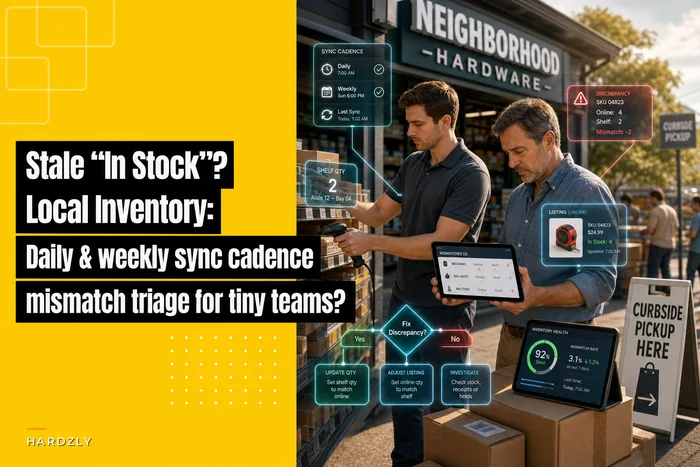
The stale listing mismatch. Your online "in stock" price doesn't match the shelf tag, and an employee didn't want to argue so they just took the lower one. This ties directly into keeping your local inventory sync cadence tight so listings don't go stale.
None of these are dramatic events. They're small, repeated leaks — a dollar here, three dollars there, a few times a day. That's exactly why they survive. Nobody notices a single instance, and nobody adds them up.
Step one: rank your SKUs before you touch pricing
You cannot police thousands of SKUs for parity. You shouldn't try. The first move is splitting your catalog into priority tiers so your daily attention goes where the money actually is.
Stop losing sales due to inventory gaps.
Hardzly helps you manage stock levels, orders, and supplier interactions efficiently.
- Unified inventory and sales tracking
- Supplier and purchase order management
- Automated workflow and task scheduling
No credit card required
Here's a workable three-tier split for a typical hardware store:
| Tier | What goes here | Parity discipline | Check frequency |
|---|---|---|---|
| A — Priority | Top 50–150 SKUs by revenue or margin dollars; anything price-shopped by contractors (common fasteners, popular paint lines, blades, adhesives) | Tight. Must match across all channels within set bands | Daily |
| B — Watch | Mid-velocity items, seasonal movers, anything with a recent cost change | Moderate. Allowed to drift within wider bands | Weekly |
| C — Long tail | Slow movers, one-offs, odd SKUs rarely shopped on price | Loose. Fix on exception only | Monthly or when flagged |
The thing most owners miss: priority isn't about revenue alone — it's about price-shoppability. A $6 box of deck screws that a contractor buys 40 of and checks against the big box every single time belongs in Tier A even though the revenue looks modest. A $380 specialty tool nobody comparison-shops can sit in Tier B. Rank by how often the price gets challenged, not just how often it sells.
Build this list once. It takes an afternoon. Pull your top sellers from the POS, add the SKUs your counter staff tell you get haggled most, and you've got your Tier A. That list becomes the spine of everything else.
Step two: pricing bands with trade-off rules, not fixed prices
A single "correct" price is a trap. Costs move, competitors move, and marketplace fees eat different amounts depending on the category. What you want instead is a band for each priority SKU — a floor, a target, and a ceiling — plus a rule for which direction to lean when margin and conversion pull against each other.
For each Tier A SKU, define:
-
Floor price the absolute lowest you'll sell at on any channel. Below this, you walk away or you're losing money on purpose for a deliberate reason. This should sit above your true landed cost plus the channel's fees.
-
Target price your normal everyday price. Where you want to live.
-
Ceiling price the most you'll charge before you're clearly out of market and hurting conversion.
Then the trade-off rule — the part that keeps staff from improvising:
> When a channel's math forces a choice between margin and conversion, protect margin on A-tier items that aren't actively price-shopped, and protect conversion on A-tier items that are heavily shopped — but never below floor.
A worked example makes this concrete.
Fasteners — 2½" exterior deck screws, 5 lb box:
-
Landed cost
~$11.80
-
Marketplace fee
roughly 12%
-
Floor
$16.50 (covers cost + fee + thin margin)
-
Target
$21.99
-
Ceiling
$24.99
Contractors shop these constantly. So on the marketplace, if a repricer nudges you toward $17, that's inside your band — annoying but survivable, and you protect conversion because this SKU is a volume anchor. At the register, where you're not competing on a screen, you hold target. Different channel, same band, different lean.
Paint — mid-tier interior eggshell, gallon:
-
Landed cost
~$17.40
-
Floor
$28
-
Target
$36.99
-
Ceiling
$41.99
Paint is where the margin actually lives, and it's less price-shopped by the gallon than fasteners are per box. So here you lean toward margin. You do not let a website promo quietly drop this to $29 and then forget to end it. Paint is a profit center; it gets the tightest guard rails. For the deeper logic behind how these tiers and markup bands are built, it's worth pairing this with a full margin-first pricing framework with paint and fastener examples.
Contractor common SKU — construction adhesive, case:
-
Landed cost
~$38 (case of 12)
-
Floor
$4.95/tube equivalent
-
Target
$6.49/tube
-
Ceiling
$7.49/tube
Contractors buy by the case and remember prices. Keep the per-unit and case prices consistent across channels or you'll get the "but online it says..." conversation every single week.
Print these bands. One page, taped by the register and next to wherever feeds get managed. When everyone can see the floor, nobody accidentally sells beneath it.
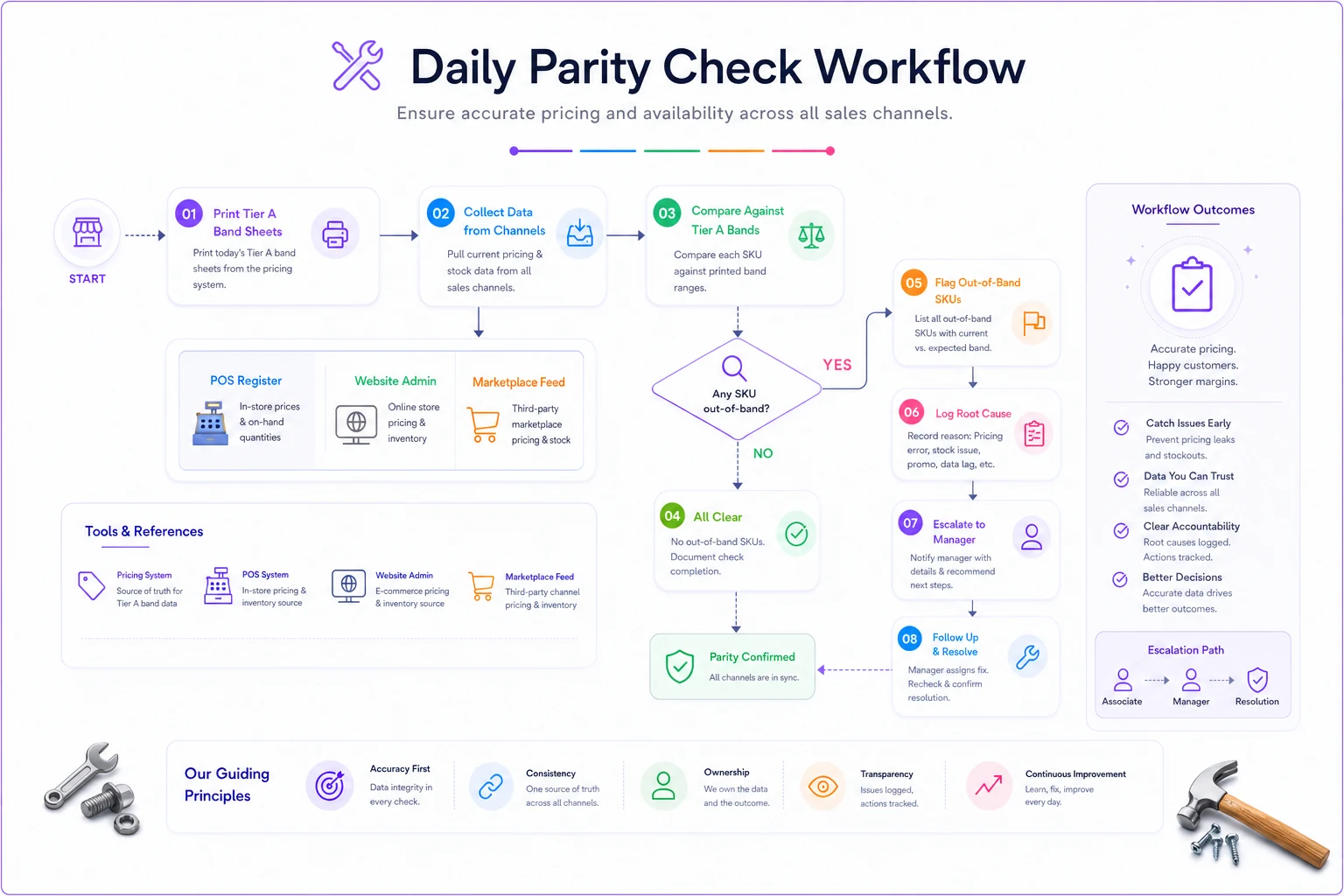
Step three: the daily parity check (ten minutes, same time, every day)
This is the heartbeat of the system. Without a fixed daily routine, bands drift and the policy becomes decoration.
The daily check only covers Tier A — that's the whole point of ranking. You're not auditing the catalog, you're spot-checking the 50–150 SKUs that actually move money.
Here's the routine:
-
Open your Tier A reference sheet (the printed bands) next to your POS and your web/marketplace admin.
-
Pull the current live price for each A-tier SKU on each channel. If you can export a feed, great. If not, rotate — check 20–30 SKUs today, the next batch tomorrow, so the full Tier A gets covered across the week while the hottest 10–15 get checked every day.
-
Flag anything outside its band or any channel more than a set threshold (say 5%) off the register price.
-
Fix same-day or log it with a reason if you're deliberately holding a gap — a real promo, a clearance, a channel-specific decision.
-
Note the cause, not just the number. "Feed didn't sync" is a different problem than "someone changed the web price and forgot the register."
That last step is where the real value hides. After two or three weeks of noting causes, you'll see your recurring failure points — maybe the marketplace feed always lags a day after a cost change, or one person keeps editing web prices without telling anyone. The daily check stops being firefighting and starts being diagnosis.
Check the hottest 10–15 SKUs every day.
Here's a quick visual of the daily check workflow.
Most owners who run this honestly find the same thing: fixes get faster every week because the same five problems keep showing up, and once you fix the process behind them, they stop.
Pickup verification levels: where parity meets the counter
Parity isn't only about the number on a screen. It's about what actually gets honored when a customer shows up — especially for buy-online-pickup-in-store orders, where the price on the order and the price at the register can disagree.
Set three verification levels based on the gap size, so staff aren't negotiating on the fly:
-
Level 1 — Honor on sight (gap under ~$3 or under 5%) Just honor the order price. The time spent arguing costs more than the gap. Move the line.
-
Level 2 — Verify and honor with a note (gap $3–$15) Honor it, but log the SKU and the gap for that day's parity check so the root cause gets fixed. Don't let the same mismatch repeat tomorrow.
-
Level 3 — Hold for manager (gap over ~$15 or below floor) Pause. This usually means something broke badly — a stale promo, a feed error, a floor breach. A manager decides whether to honor as goodwill or correct it, and it gets escalated to a same-day fix.
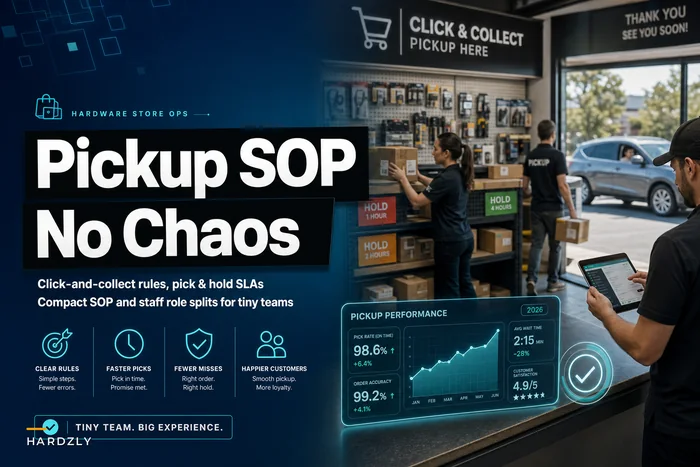
The mistake is treating every mismatch the same. Fighting a customer over $1.80 to protect "principle" costs you the relationship and the line behind them. Quietly eating a $40 floor breach because an employee didn't want conflict costs you real margin. Levels put the judgment into policy so the person at the counter isn't guessing. If your pickup process itself is shaky, tighten the operational side first with a proper click-and-collect SOP covering pick/hold SLAs and role splits — parity scripts work far better on top of a clean fulfillment flow.
Dispute and customer scripts your staff can actually use
When a customer says "it's cheaper online," most staff do one of two bad things: cave instantly, or dig in and create a scene. Neither is a policy. Give them words.
Script 1 — Small gap, honor it: > "You're right, let me match that for you — give me one second." (Done. Logged for the parity check later. No drama.)
Script 2 — Our own channels disagree: > "Looks like our website and register got out of sync on that one — thanks for catching it. I'll honor the lower price today and we'll get that fixed." (Honor within Level 1/2 rules, log the cause.)
Script 3 — Competitor price, below our floor: > "I can't go that low on this one, but here's what I can do — [offer the floor, or bundle, or substitute a comparable in-stock item]." (Protects margin and keeps the sale on your terms rather than theirs.)
Script 4 — Marketplace price lower than in-store, customer wants it honored in person: > "That online price includes the platform's pricing — if you'd like, place the pickup order and I'll have it ready in [X minutes]." (Keeps the channel's economics intact instead of accidentally giving marketplace pricing on a walk-in full-margin sale.)
The pattern across all four: the employee always has a next move that isn't "lose the margin" or "lose the customer." That's what a script buys you — it removes the panic decision.
A real scenario: the slow bleed nobody tracked
A single-location store doing somewhere around $1.6M a year had a website, a Google listing, and a modest marketplace presence. Nobody thought they had a pricing problem — shelf tags were accurate, markups were set properly.
When the owner finally ran a two-week Tier A parity check across about 120 SKUs, the picture was ugly in a quiet way. Roughly 18 SKUs were living below band on at least one channel. A paint line had a dead promo still running on the website, moving maybe 15–20 gallons a week at around $4 under target. A handful of fastener SKUs had drifted below floor on the marketplace because a fee change ate into margin nobody had recalculated.
Nothing individually alarming. Added up, the drift was costing somewhere in the range of $900–$1,300 a month — low-to-mid five figures a year — on prices that were supposedly already "right."
The fix wasn't new software. It was the ranked list, the printed bands, and ten minutes every morning. Within about three weeks the recurring causes were clear — the website promo-ending gap and the marketplace fee drift — and both got structural fixes. The daily check shrank because the same problems stopped repeating.
When this playbook makes sense — and when it doesn't
Run the full system when:
-
You sell the same SKUs across two or more channels (register + web, marketplace, Google listing).
-
Contractors or trade accounts shop you on price. Those customers make parity breaches expensive fast.
-
You're hearing "it's cheaper online" more than occasionally.
Keep it lightweight when:
-
You're essentially single-channel with a mostly informational website. Then you only need Tier A band discipline, not a daily cross-channel check.
Who should not over-build this:
-
A store with very low online volume shouldn't spend an hour a day on parity. Run a weekly check on your top 30 SKUs and move on. The cadence should match where your sales actually come from — building a daily routine for three online orders a week is wasted motion.
The judgment call is always volume-weighted. More channels and more price-shopping buyers mean tighter discipline. Fewer of both means a lighter touch isn't just acceptable, it's the right call.
Where tools fit (and where they don't)
You can run this entire playbook with a spreadsheet and printed band sheets, and plenty of stores should start exactly there — the discipline matters more than the tooling. But once you're reconciling 150 Tier A SKUs across three or four channels daily, the manual pull-and-compare step becomes the bottleneck.
That's the natural point where an AI-powered operational platform earns its place: pulling live prices from each channel into one view, flagging anything outside its band automatically, and logging cause patterns so you're not re-diagnosing the same feed lag every week. The policy stays yours — the bands, the tiers, the trade-off rules are judgment calls only you can make. The software removes the tedious comparison work and surfaces the exceptions so your ten-minute check stays ten minutes even as your SKU count and channel count grow.
Worth holding onto: tools don't set your floor or decide your trade-offs. They make it faster to enforce the policy you already designed. Enforcement at scale is a coordination problem, and repetitive cross-channel checking is exactly the kind of work worth automating once the volume justifies it.
Pulling it together
Cross-channel parity is really a discipline problem dressed up as a pricing problem. The stores that protect margin aren't the ones with the fanciest repricing engine — they're the ones who ranked their SKUs honestly, set bands everyone can see, run a short daily check at the same time every day, and gave their counter staff scripts so nobody improvises away the margin.
Start with the Tier A list this week. Print the bands. Run the daily check for ten days and note the causes. You'll find your leaks fast, and most of them will trace back to three or four repeating process failures you can fix for good.
If a meaningful slice of your volume comes from trade buyers, this parity work pays off double — those are the customers who shop you hardest on price and remember every number. Pair it with a real plan for turning contractor relationships into predictable B2B revenue and your pricing discipline stops being a defensive chore and starts being a reason they keep buying from you instead of the big box down the road.
Cross-channel parity is really a discipline problem dressed up as a pricing problem. The stores that protect margin aren't the ones with the fanciest repricing engine — they're the ones who ranked their SKUs honestly, set bands everyone can see, run a short daily check at the same time every day, and gave their counter staff scripts so nobody improvises away the margin.
Ready to elevate your hardware store management?
Join 500+ hardware stores using Hardzly to boost operational efficiency, reduce stockouts, and grow revenue.